

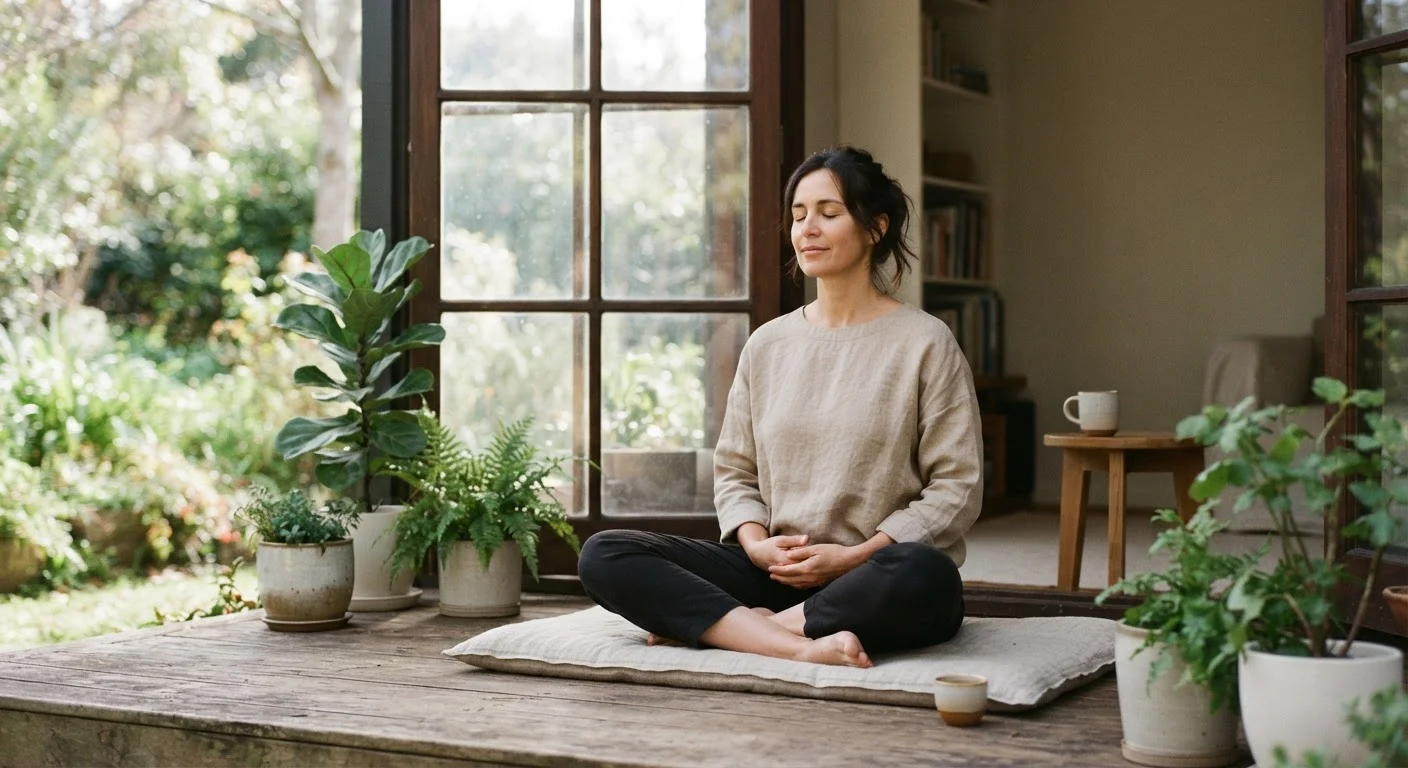
Option A
Mindfulness
Present-moment awareness woven into everyday life.
Best for: People who want to reduce reactivity and stress throughout their daily routines without setting aside formal practice time.
Option B
Meditation
A structured mental exercise practiced in dedicated sessions.
Best for: People seeking a deliberate, consistent practice to train attention, calm the nervous system, or cultivate specific mental qualities.
What Each Term Actually Means
The confusion between mindfulness and meditation is understandable — the two terms appear together constantly in wellness conversations. But treating them as synonyms obscures something genuinely useful: they are related yet distinct, and understanding the difference helps you choose what actually fits your life.
Mindfulness refers to a quality of attention — the capacity to be aware of what is happening in the present moment, intentionally and without judgment. It is not a technique so much as a mental orientation. You can bring mindfulness to a conversation, a meal, or a stressful commute. No cushion or timer required.
Meditation, on the other hand, describes a broad category of deliberate mental exercises typically performed in a dedicated session. Many forms of meditation use mindfulness as their core mechanism, but meditation also includes practices oriented toward compassion, visualization, mantra repetition, and focused attention on a single object. Think of mindfulness as an ingredient and meditation as one method of cooking with it.
| Criterion | Mindfulness | Meditation |
|---|---|---|
| Definition | A quality of present-moment awareness | A structured mental exercise or practice |
| Requires dedicated time? | No — integrates into any activity | Yes — typically a set session |
| Techniques involved | Nonjudgmental attention in the moment | Breath focus, body scan, visualization, mantra, and more |
| Skill level to start | Immediately accessible | Accessible; guidance can help beginners |
| Research support | Strong for stress and anxiety reduction | Growing; varies by technique and outcome |
| Relationship to each other | Can be practiced without meditating | Often uses mindfulness as its foundation |
The Research Behind Each Practice
Both practices have attracted substantial scientific interest, though the evidence base varies in depth and quality depending on the specific outcome studied.
Mindfulness-Based Stress Reduction (MBSR), an eight-week structured program developed at the University of Massachusetts Medical School, is among the most studied mindfulness interventions. Research published in peer-reviewed journals has associated MBSR participation with reductions in perceived stress, anxiety symptoms, and markers of psychological distress. Mindfulness-Based Cognitive Therapy (MBCT) has been evaluated as a relapse-prevention tool for people with recurring depression and is recognized by major clinical guidelines in several countries.
Meditation research — particularly on focused-attention and open-monitoring styles — has shown associations with changes in self-reported well-being, attention regulation, and emotional reactivity. However, researchers caution that study quality is uneven, effect sizes vary considerably, and most findings should be interpreted as promising rather than definitive.
8 weeks
Duration of standard MBSR program
The Mindfulness-Based Stress Reduction program, developed at UMass Medical School, runs over eight weeks and is among the most rigorously studied mindfulness interventions.
~5 min
Effective minimum session length for beginners
Multiple studies suggest even brief daily meditation sessions can produce measurable effects on attention and mood when practiced consistently over time.
3rd
Most common mental health self-care strategy in U.S. surveys
National surveys on complementary health practices have consistently placed meditation among the most widely used mind-body approaches by American adults.
One consistent finding: even short, regular sessions appear to produce measurable effects for many people. This makes both practices accessible starting points for everyday emotional resilience — not just for those already comfortable with formal wellness routines.
For those navigating more serious mental health challenges, these practices complement — but do not replace — professional support. See our guide to therapy, counseling, and psychiatry to understand what different mental health professionals offer.
How to Incorporate Either Into Daily Life
Neither mindfulness nor meditation demands dramatic lifestyle changes. Entry points exist at every level of available time and prior experience.
Starting with Mindfulness
- Choose one routine activity — morning coffee, a walk, brushing your teeth — and give it your full, non-judgmental attention each day.
- When you notice your mind wandering during conversations or tasks, gently return your focus without self-criticism. That noticing is the practice.
- Use sensory anchors: the feel of your feet on the floor, the sound in a room, the temperature of air. These ground attention in the present.
Starting with Meditation
- Begin with sessions as short as five minutes. Consistency over duration matters most when building a new habit.
- Explore different formats — breath-focused practice, body scan, loving-kindness — to find what resonates before committing to one approach.
- Guided sessions through audio resources or apps can help beginners maintain structure. Our overview of mental wellness apps offers a balanced look at what those tools can and cannot do.
Mindfulness and Meditation Are Not Treatments
Both practices can meaningfully support emotional well-being, but they are not clinical treatments for diagnosed mental health conditions. Research distinguishes between their use as wellness tools and their use in structured therapeutic programs delivered by trained professionals. If you are managing a diagnosed condition such as depression, anxiety disorder, or PTSD, speak with a qualified mental health provider before relying on self-directed practice as your primary support.
This article is for general informational and educational purposes only and is not a substitute for professional medical or mental health advice. If you are experiencing significant mental health symptoms, please consult a qualified healthcare provider.
The content on this site is for informational purposes only and is not a substitute for professional advice. Always consult a qualified professional for guidance specific to your situation.