

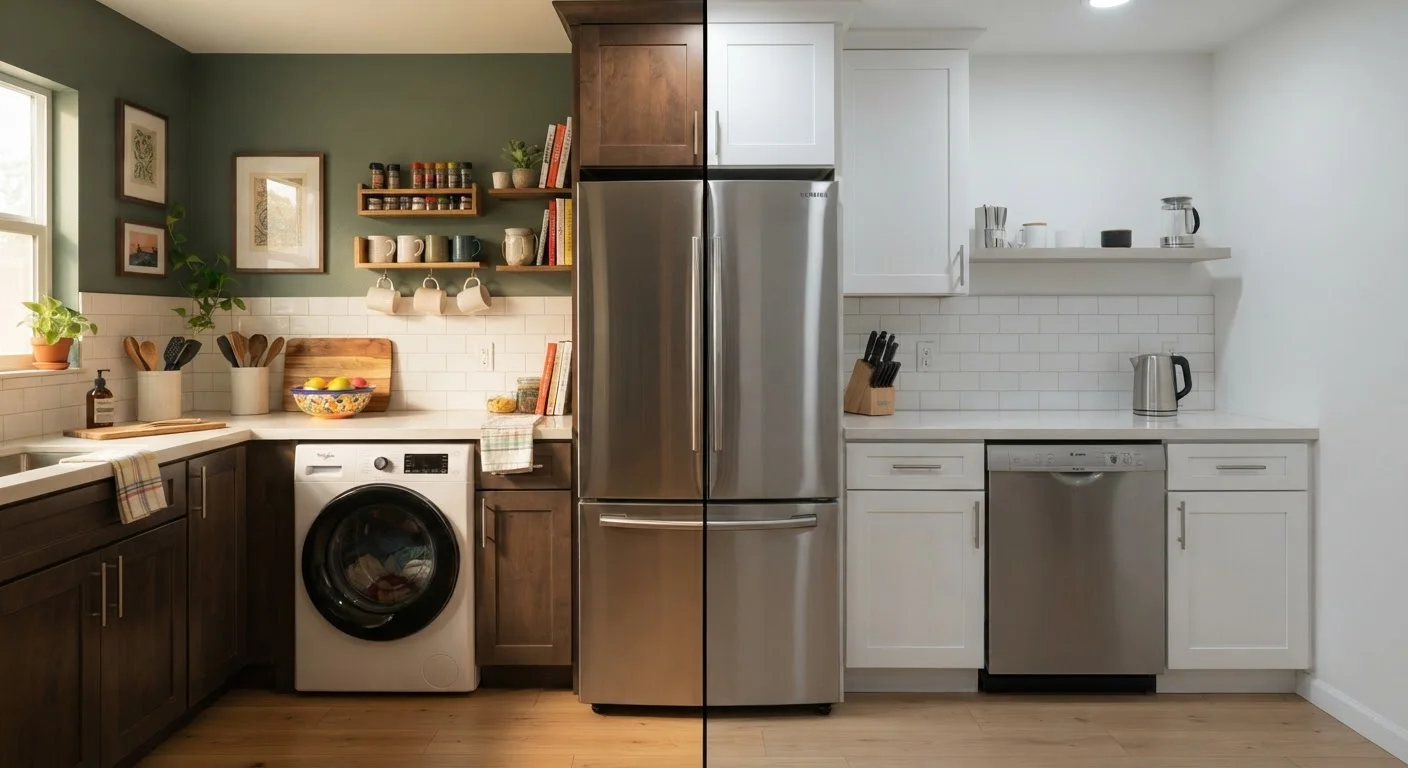
Option A
Owning Your Appliances
The long-term, equity-building approach to household equipment.
Best for: Homeowners and settled renters who want to minimize lifetime costs and retain flexibility over their appliances.
Option B
Renting Your Appliances
The low-upfront, maintenance-included alternative.
Best for: Households in transitional living situations or those who prefer predictable monthly costs over large capital outlays.
How Appliance Rental Plans Actually Work
Appliance rental programs — offered through retailers, utility companies, and third-party rent-to-own providers — let households pay a recurring monthly fee in exchange for use of a refrigerator, washer, dryer, dishwasher, or similar equipment. The provider typically retains ownership throughout the agreement. Some contracts include a buyout option at the end of the term; many do not.
These plans are distinct from rent-to-own agreements, where each payment moves you incrementally toward ownership. Standard rental arrangements are closer to a service subscription: you pay indefinitely for continued use. Key contract terms to examine include the rental period, monthly fee, what maintenance or replacement coverage is included, early termination penalties, and any automatic renewal clauses.
For homeowners weighing all their household costs, it helps to treat this decision the same way you would any recurring expense — as part of your overall budget framework. The Budgeting Basics hub offers grounding in how to categorize and evaluate recurring versus one-time household costs.
| Criterion | Owning | Renting |
|---|---|---|
| Upfront cost | Higher (purchase price or down payment) | Low or none |
| Monthly cost | None after payoff | Ongoing indefinitely |
| Long-term total cost | Lower over 5+ years | Higher over 5+ years |
| Repair responsibility | Owner pays out of pocket | Usually covered by provider |
| Flexibility to upgrade | Owner decides when to replace | Subject to contract terms |
| Equity or resale value | Yes — can sell or transfer | None — no asset is built |
| Early exit costs | None | Often significant penalties |
| Best for | Stable, long-term households | Mobile or transitional households |
The Real Cost Comparison Over Time
The financial gap between renting and owning appliances tends to widen the longer you stay in one place. A mid-range washing machine might carry a purchase price between $600 and $1,000. A rental plan for the same category of appliance commonly runs $30 to $60 per month. At $40 per month, you've spent $960 in just two years — potentially more than the purchase price — and still own nothing.
10–15 yrs
Typical major appliance lifespan
The Association of Home Appliance Manufacturers and consumer research generally cite 10–15 years as a common range for refrigerators, washers, and dryers with routine maintenance.
2–3×
Rental cost vs. purchase price over a decade
General cost modeling across common appliance categories suggests households that rent long-term often pay two to three times the appliance's purchase price before a contract ends.
$150–$400
Average appliance repair cost
Repair cost estimates from home warranty and appliance service industry sources place typical appliance repairs in this range, varying by appliance type and labor market.
Ownership does carry its own costs: installation, occasional repairs, and eventual replacement. Appliance lifespans vary, but many major appliances are designed to last 10 to 15 years with routine care. Spreading a purchase price across that horizon makes ownership significantly cheaper on a per-month basis in most scenarios.
However, total cost isn't the only variable. A household with no emergency fund may reasonably prefer the predictability of a rental plan over the risk of a $400 repair bill arriving unexpectedly. This is a budgeting and risk-tolerance question as much as a pure math problem. For households managing shared living arrangements, the approaches families and roommates use to split costs may also influence which model works better logistically.
What Ownership Requires — and What It Gives Back
Purchasing an appliance — whether outright or through financing — puts you in charge of maintenance decisions. You choose the repair technician, decide when to replace the unit, and can resell it if your circumstances change. Ownership also means the appliance appears as an asset if you're accounting for household inventory, which matters when insuring your home's contents.
The responsibilities are real: you absorb repair costs, handle installation logistics, and manage disposal when an appliance reaches end of life. First-time homeowners in particular sometimes underestimate the cumulative cost of maintaining multiple appliances simultaneously. A broader overview of what household management actually entails is worth reviewing — the full picture for first-time homeowners covers this in practical terms.
Financing an appliance purchase introduces interest costs that narrow the savings gap compared to renting, especially at higher interest rates. If financing is part of your plan, it's worth calculating the total repayment amount — not just the monthly installment — before comparing it against rental alternatives. Similar thinking applies when evaluating other financed assets; the logic used in leasing vs. financing a car translates well to appliance decisions.
Rent-to-Own Is Not the Same as Renting
Rent-to-own agreements — common at dedicated furniture and appliance retailers — structure payments so that completing the full term transfers ownership to you. The total cost is typically much higher than buying outright, but ownership is the end goal. Standard rental plans, by contrast, never transfer ownership regardless of how long you pay. Make sure you understand which type of agreement you are signing before committing.
Making the Decision for Your Household
Three practical questions tend to clarify the right path. First: how long do you realistically expect to stay in your current home? Owners who move in two years or less may find that the convenience value of a rental plan outweighs the lifetime cost premium. Second: do you have sufficient savings to absorb a repair or replacement without financial strain? If not, the maintenance coverage in a rental agreement has genuine monetary value. Third: have you read the rental contract in full, including renewal terms and exit costs?
Rental contracts that auto-renew annually and carry two to three months' penalty for early termination can turn a short-term convenience into a long-term obligation. Treat any rental agreement with the same scrutiny you'd apply to a lease or loan document.
If your household is actively managing debt or building savings, this decision connects directly to your broader financial strategy. The Saving and Debt hub provides context for how recurring fixed costs interact with savings goals over time.
This article is for general informational and educational purposes only and does not constitute financial or legal advice. Contract terms, costs, and conditions vary by provider and region. Consult a qualified financial adviser or read all agreement documents carefully before entering any rental or purchase arrangement.
The content on this site is for informational purposes only and is not a substitute for professional advice. Always consult a qualified professional for guidance specific to your situation.