

What 'full' usually means — and why it's rarely true
When a home feels like it's out of storage, the instinct is to add more: a new shelving unit, a bigger closet, an extra piece of furniture. But in most households, the actual issue isn't a shortage of space — it's that the space already available is being used at less than full capacity, or not used at all.
Common culprits are zones that get overlooked because they don't look like storage: the backs of doors, the tops of cabinets, the void beneath a staircase. These areas don't announce themselves, so they get skipped in the mental inventory of where things can go.
The strategies below focus specifically on spaces most households already have. No major renovation required — just a more systematic look at what's already there.
Organize What You're Keeping — Not Everything
Adding storage capacity only helps if the items you're storing are ones you actually need. Before reorganizing any zone, take a few minutes to remove anything broken, expired, or genuinely unused. A sustainable decluttering system can help you develop this as an ongoing habit rather than a one-time event.
Seven spaces worth a second look
The vertical wall space above furniture
Most people furnish a room to about eye level and leave everything above it blank. That gap between the top of a bookcase or dresser and the ceiling is genuine storage real estate. Sturdy wall-mounted shelves installed in that zone can hold infrequently used items — seasonal décor, spare linens, or bulkier items in labeled bins — without consuming any floor space at all.
Before adding shelves, confirm the wall material and locate studs to ensure safe anchoring. Items stored high should be lightweight and accessed only occasionally.
The gap above furniture and below the ceiling is genuine, usable storage real estate.
Under-bed depth — the full amount of it
Most households use the space directly under the bed's perimeter but ignore the deeper centre zone. Flat, wheeled storage containers sized to the full depth of your bed frame can hold out-of-season clothing, extra bedding, or shoes in a way that keeps them accessible but completely out of sight.
If your current bed frame sits too low for standard containers, bed risers can add clearance inexpensively. The key habit is regular rotation: swap summer and winter items so you're never digging through things you won't need for months.
The full under-bed depth — not just the edges — can store an entire season's worth of clothing.
The backs of cabinet and closet doors
The inside face of a door is a flat, vertical surface that most households leave empty. Over-the-door organizers — in styles suited to everything from cleaning supplies to shoes to pantry staples — mount without tools and can be removed without damage.
Consider what you're repeatedly hunting for and whether storing it on a door you open daily would save time. Cleaning products under a kitchen sink, toiletries in a bathroom cabinet, and accessories in a bedroom closet are all strong candidates.
A door's back face is a flat, tool-free mounting surface most households leave completely empty.
The toe-kick space under kitchen cabinets
The recessed strip at the base of kitchen cabinets — called the toe kick — is typically hollow. In many kitchens, this space runs the full length of the cabinet run and can be fitted with shallow pull-out drawers designed specifically for this gap. They're well-suited to flat items: baking sheets, cutting boards, or even pet food mats and placemats.
Toe-kick drawers are available as retrofit options for existing kitchens, though fitting them does require some basic carpentry. If a DIY approach isn't suitable, a cabinetmaker or carpenter can assess feasibility.
The hollow toe-kick strip beneath kitchen cabinets can be converted into pull-out flat-item storage.
Staircase risers and under-stair voids
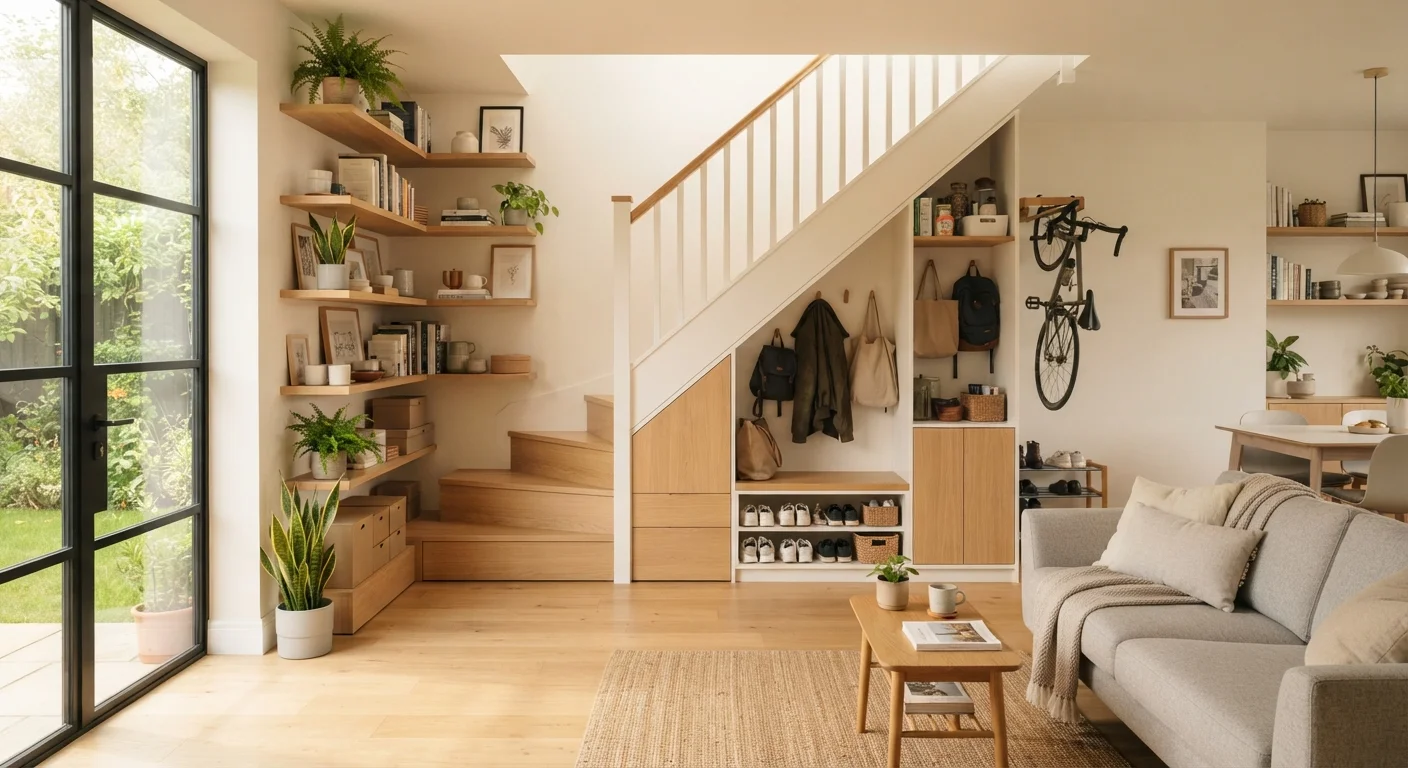
In homes with a staircase, the enclosed void beneath it is one of the largest unused volumes in the house. Depending on construction, it can be converted into shelving, a small closet, pull-out drawers, or even a compact home office nook. Open-plan risers can also be fitted with small pull-out drawers on each step.
Any structural modification to a staircase should be assessed by a qualified contractor to ensure building code compliance and structural integrity. Cosmetic storage additions — such as freestanding shelving slotted into an under-stair alcove — typically require no permits.
The void beneath a staircase is often one of the largest unused storage volumes in the entire home.
Garage walls and ceiling joists
Garage floors fill up quickly, but walls and ceiling joists often go unused entirely. Wall-mounted track systems accommodate hooks, bins, and shelves that can be rearranged as needs change. Overhead ceiling-joist storage platforms are useful for bulky seasonal items like camping gear or holiday decorations.
Garages also concentrate real safety considerations. Before storing chemicals, fuels, or power tools in new configurations, review garage and workshop safety guidance to ensure proper ventilation, separation of hazardous materials, and safe tool storage.
Garage walls and ceiling joists can hold as much as the floor — without sacrificing a single parking spot.
The dead zone at the top of closets
The area above the standard single shelf in most closets — often 12 to 18 inches of clearance to the ceiling — sits empty in the majority of homes. A second shelf installed above the existing one can hold folded items, storage boxes, or anything you reach for only occasionally.
This is also a good moment to reconsider what's actually in the closet. A wardrobe audit can reveal how many items you're storing that you'll never actually use, freeing up space before you add a single shelf.
A second shelf above the existing one turns wasted closet airspace into practical, accessible storage.
Start With One Zone Before Buying Anything
Resist the urge to purchase organizers before you've assessed a space. Measure accurately, remove everything currently stored there, and determine what actually needs to go back in. Many households find that reorganizing existing items — without buying a single product — recovers meaningful space. For more on this approach, see organizing on a tight budget.
Making the gains stick
Reclaiming storage space is only useful if the organization holds up over time. The most reliable way to maintain it is to assign every category of item a specific home — and return things to that location consistently. Labeling bins and containers, even with simple masking tape and a marker, makes it easier for everyone in a household to maintain the system.
Storage improvements also have a secondary benefit: when you know exactly where things live, you're less likely to buy duplicates of items you already own. That has quiet budget implications over time. For households actively managing spending, pairing better organization with broader budgeting basics can reinforce both habits effectively.
This article is for general informational and educational purposes only. Structural modifications to your home should be assessed by a qualified contractor, and relevant building permits should be obtained where required by local regulations.
The content on this site is for informational purposes only and is not a substitute for professional advice. Always consult a qualified professional for guidance specific to your situation.