

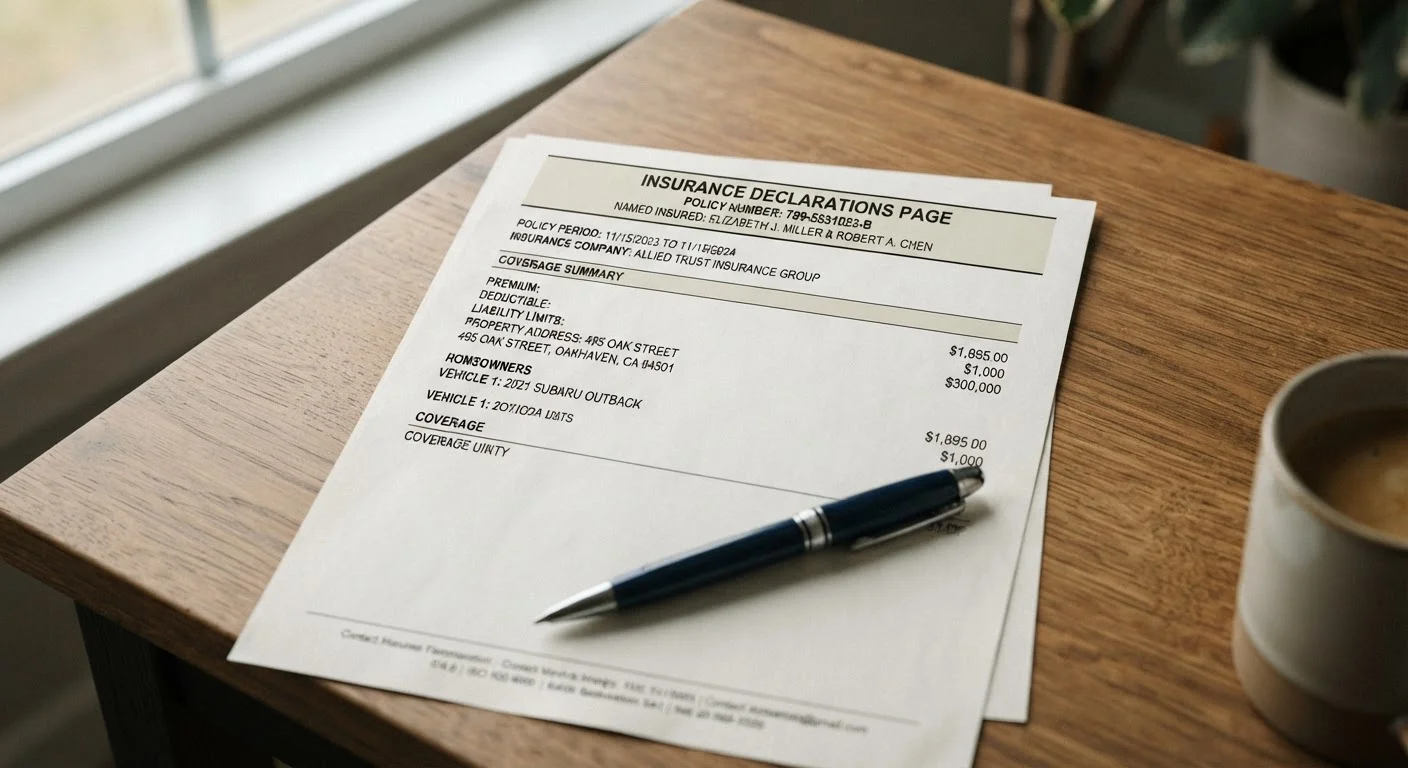
The Core Fields Every Dec Page Contains
Regardless of the type of insurance, every declarations page includes a standard set of fields. Knowing what each one means puts you in control when reviewing or comparing policies.
- Named insured: The person or entity the policy legally protects. If your name is misspelled or a co-owner is missing, notify your insurer right away — this can affect claim eligibility.
- Policy number: Your unique identifier for all interactions with the insurer, from billing questions to claim filings.
- Policy period: The exact start and end dates of coverage. Coverage does not extend beyond the end date unless renewed.
- Coverage types and limits: Each coverage category (e.g., liability, collision, dwelling) is listed with its corresponding maximum payout. This is the ceiling — the most the insurer will pay for a single covered loss.
- Deductibles: The dollar amount you pay before the insurer contributes. Higher deductibles typically mean lower premiums, but more out-of-pocket cost at claim time.
- Premium: The total cost of the policy, sometimes broken into installment amounts.
- Endorsements or riders: Add-ons that expand or restrict your base coverage are referenced here by name or number.
1 in 3
Policyholders who have never read their dec page
According to Insurance Information Institute consumer research, a significant share of insured Americans cannot identify their coverage limits or deductibles without looking them up.
~2 pages
Typical length of a declarations page
Most personal lines dec pages condense an entire policy's key terms into one to two pages, making them the most efficient document for quick coverage review.
For a broader look at how coverage types work together, see the major insurance coverage categories explained in plain English.
How the Dec Page Differs From the Rest of Your Policy
A common mistake is treating the declarations page as the whole policy. It isn't. The full policy document contains the fine print that determines whether a specific claim is covered — including exclusions, defined terms, and conditions that must be met.
Think of the dec page as the label on a prescription bottle: it tells you the key facts at a glance, but the detailed instructions and warnings are inside. If you ever have a dispute with your insurer over a claim, adjusters and courts look at both documents together.
“The declarations page tells you what you bought. The policy form tells you what you actually get. Consumers who only read one are often surprised at claim time.”
— J. Robert Hunter, Former Director of Insurance, Consumer Federation of America
This distinction matters most when you're comparing policies. Two policies might show identical limits on their dec pages but differ significantly in what they exclude. Always read the full policy — or ask your agent to walk you through the exclusions — before assuming coverage is equivalent. Our guide on reading an insurance policy walks through the other sections worth checking.
Applying This to Specific Policy Types
The dec page looks slightly different depending on the type of insurance, but the underlying logic is the same.
Auto insurance: Your dec page will list each vehicle by make, model, and VIN, along with the coverage types selected — such as liability limits expressed as split limits (e.g., 100/300/100) or a single combined limit. See car insurance coverage types explained for a detailed breakdown of what each auto coverage does.
Homeowners insurance: Expect to see the property address, dwelling coverage amount, personal property limit, liability limit, and loss-of-use coverage. The replacement cost versus actual cash value distinction is critical and will appear here or in an endorsement reference.
Health insurance: Health dec pages often go by the name "Summary of Benefits and Coverage" and show your deductible, out-of-pocket maximum, and co-pay structure rather than a single payout limit.
Keep a Digital Copy of Your Dec Page
Store a photo or PDF of your current declarations page somewhere accessible — your phone's cloud storage or email is fine. If you need to file a claim after a disaster or accident, having instant access to your policy number and coverage limits can save significant time and stress.
If you're purchasing your first policy and navigating this for the first time, our first-policy guide covers the broader decisions you'll face before you sign.
What to Check at Every Renewal
Your declarations page changes at renewal, and not always in obvious ways. Insurers can adjust limits, add exclusions, change your premium, or drop an endorsement. A few minutes of review can prevent costly surprises.
- Confirm the named insured and any listed additional insureds are correct.
- Verify coverage limits haven't been reduced without your explicit consent.
- Check that any endorsements you added — like scheduled personal property or an umbrella tie-in — are still listed.
- Compare this year's premium to last year's. A significant increase warrants a conversation with your agent about why and whether your coverage level still makes sense for your situation.
Endorsements May Not Be Fully Described
Your dec page lists endorsements by name or form number, but doesn't explain what they do. Always request the actual endorsement document from your insurer if you're unsure what a listed add-on covers or excludes. This is especially common with water backup, earthquake, and home business endorsements.
For a broader reference on how different coverage categories work and interact, the Coverage Types hub is a practical starting point.
This article is for general informational and educational purposes only and does not constitute personalized insurance, legal, or financial advice. Coverage terms, limits, exclusions, and regulations vary by provider and state. Always read your actual policy documents and consult a licensed insurance agent or adviser for guidance specific to your situation.
Frequently Asked Questions
Insurers typically mail a declarations page when you first purchase a policy and again at each renewal. Most companies also make it available through an online account portal or their mobile app. If you can't locate it, call your insurer or licensed agent and request a copy.
No. The declarations page is a summary; the full policy includes detailed exclusions, definitions, and conditions that govern your coverage. You need both documents to understand exactly what is and isn't covered.
A coverage limit is the maximum dollar amount the insurer will pay for a covered loss. A deductible is the amount you must pay out of pocket before coverage begins. Both figures appear on your declarations page.
Yes, and errors do occur — misspelled names, wrong vehicle identification numbers, or incorrect coverage amounts. Always review your dec page when you receive it and contact your insurer immediately if anything looks wrong.
Not always, but having it on hand speeds up the process. It gives you and your claims adjuster quick access to your policy number, coverage types, and limits without digging through the full policy document.
Yes. Auto, homeowners, renters, health, and life policies all include a declarations page in some form. The specific fields vary by policy type, but the core purpose — summarizing coverage at a glance — is universal.
The content on this site is for informational purposes only and is not a substitute for professional advice. Always consult a qualified professional for guidance specific to your situation.