

Our Verdict
Collision and comprehensive are complementary, not interchangeable. Collision responds when your car is involved in a crash; comprehensive steps in for nearly everything else that can damage or destroy it. Together, they provide broader protection than either does alone — but whether that protection is worth the added premium depends on your vehicle's value, your financial situation, and the risks you face.
| Best for | Recommended |
|---|---|
| Drivers with a financed or leased vehicle | Both collision and comprehensive (typically required by lender) |
| Owners of high-value or newer vehicles paying out of pocket | Both collision and comprehensive |
| Owners of older, low-value vehicles weighing premium costs | Review whether either coverage is cost-effective given actual cash value |
| Drivers in areas prone to severe weather, flooding, or high vehicle theft | Comprehensive coverage is especially valuable |
The Core Difference: What Triggers Each Coverage
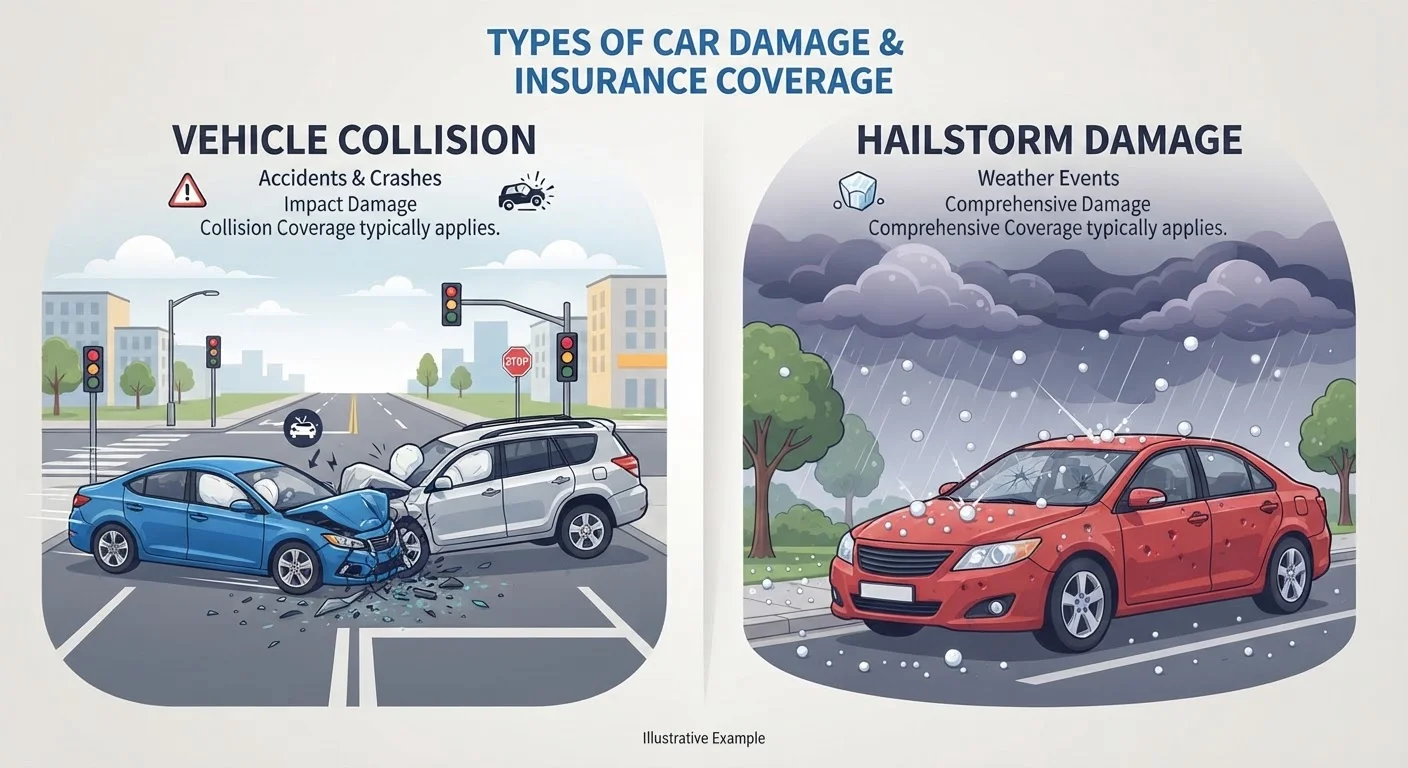
Auto insurance policies can feel like a maze of overlapping terms, but the line between collision and comprehensive is actually fairly clean once you see it. The simplest way to think about it: collision coverage responds when your car runs into something, and comprehensive coverage responds when something happens to your car — other than a collision.
Collision coverage applies when your vehicle makes physical contact with another car, a guardrail, a fence, a telephone pole, or any other object. It also covers single-vehicle accidents like rolling your car. Fault doesn't change whether collision applies — it pays for damage to your vehicle regardless of who caused the crash.
Comprehensive coverage (sometimes called "other than collision" on policy documents) covers a wide range of scenarios that have nothing to do with driving into something: theft, vandalism, fire, flooding, hail, a falling tree branch, or a collision with an animal such as a deer. These are events largely outside a driver's control.
For a broader look at how these fit into your overall auto policy, see Car Insurance Explained: Coverage Types Every Driver Should Understand.
| Collision Coverage | Comprehensive Coverage | |
|---|---|---|
| What triggers a claim | Crash with vehicle, object, or rollover | Theft, weather, fire, animals, vandalism |
| Fault requirement | Not required — covers regardless of fault | Not applicable — non-collision event |
| State law requirement | Not legally required | Not legally required |
| Lender/lease requirement | Typically required | Typically required |
| Separate deductible | Yes | Yes |
| Common examples | Rear-end crash, hitting a pole | Hail damage, deer strike, car theft |
Deductibles, Premiums, and Cost Considerations
Both collision and comprehensive come with their own deductibles — the amount you pay out of pocket before your insurer covers the rest. Common deductible amounts range from $250 to $1,000 or more. Choosing a higher deductible generally lowers your premium, while a lower deductible raises it.
Adjust Your Deductible to Manage Premiums
If the combined cost of collision and comprehensive feels high, consider raising one or both deductibles to bring the premium down. Just make sure you can realistically cover the deductible amount out of pocket if you need to file a claim. Keeping that amount in a dedicated savings fund is a straightforward way to stay prepared.
Comprehensive deductibles are sometimes lower than collision deductibles on the same policy, partly because comprehensive claims (like hail damage) tend to be more frequent in certain regions. You can typically set each deductible independently when you purchase or renew your policy.
One practical rule of thumb: if your vehicle's actual cash value (what a buyer would pay for it today) is only a few times your annual premium for these coverages, the math may not favor carrying them. For example, if a vehicle is worth $3,000 and you're paying $600 a year combined for collision and comprehensive, a major claim payout — minus your deductible — might barely exceed what you've already spent in premiums. This is a personal calculation, not a guarantee of any outcome, and it's worth discussing with a licensed insurance agent. For more on navigating costs and claims, visit Costs & Claims.
When Lenders and Leasing Companies Get Involved
Neither collision nor comprehensive coverage is required under state law — unlike liability insurance, which virtually every state mandates. However, if you finance or lease your vehicle, your lender or leasing company almost certainly requires both. This protects their financial interest in the vehicle for the duration of your loan or lease.
Dropping Coverage During an Active Loan Can Backfire
Removing collision or comprehensive coverage while you still owe money on your vehicle likely breaches your financing agreement. Lenders can respond by placing their own insurance on the vehicle at your expense — and force-placed policies are typically far more costly than standard coverage. Check your loan or lease terms before making any changes.
If you drop either coverage while still carrying a loan or lease, you're likely violating your financing agreement. Lenders can respond by purchasing "force-placed" insurance on your behalf — usually a much more expensive policy that protects the lender's interest but offers you little protection — and bill you for it.
Once a loan is paid off, the decision to keep or drop collision and comprehensive is entirely yours. That's a good moment to reassess your vehicle's value and your own risk tolerance. For guidance on evaluating coverage decisions more broadly, Choosing a Policy is a useful resource.
This article provides general insurance information for educational purposes and is not personalized insurance, financial, or legal advice. Coverage terms, exclusions, and costs vary by insurer and by state. Always read your actual policy documents and consult a licensed insurance agent or adviser for guidance specific to your situation.
The content on this site is for informational purposes only and is not a substitute for professional advice. Always consult a qualified professional for guidance specific to your situation.