

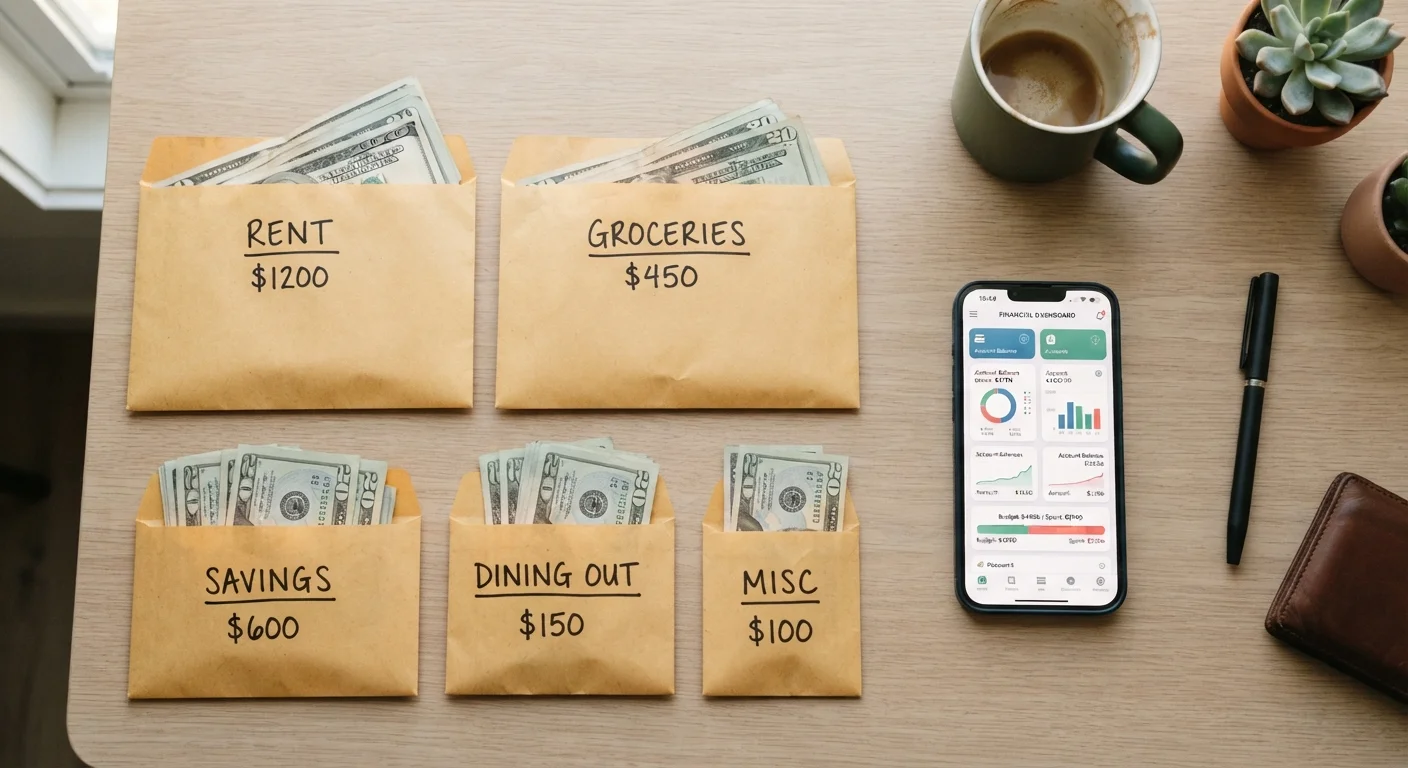
Option A
Envelope Budgeting
The tangible, cash-first spending discipline.
Best for: People who overspend on discretionary categories and benefit from a physical barrier to impulsive purchases.
Option B
Digital Spending Accounts
The modern, automated approach to category-based spending.
Best for: Tech-comfortable earners who want real-time visibility into spending without handling physical cash.
The Core Logic Behind Both Systems
At their heart, envelope budgeting and digital spending accounts solve the same problem: money that isn't assigned a purpose tends to disappear. Both systems force you to allocate your income into categories before spending begins — shifting the decision-making from the checkout line to the start of the month.
The envelope method, popularized decades ago as a cash-management tool, works by withdrawing physical currency and dividing it into labeled envelopes — one for groceries, one for dining out, one for gas, and so on. When an envelope is empty, spending in that category stops. No exceptions, no borrowing from next month.
Digital spending accounts replicate that logic electronically. Whether through a dedicated sub-account feature offered by some banks, or through a budgeting platform that segments your checking balance into virtual "buckets," the principle is identical: each dollar is spoken for before it's spent. The difference is execution — one uses paper and coins, the other uses software and card transactions.
Before choosing between them, it helps to have a clear picture of your current spending patterns. Our step-by-step expense audit guide walks you through gathering that baseline data honestly.
| Criterion | Envelope Budgeting | Digital Spending Accounts |
|---|---|---|
| Spending medium | Physical cash only | Cards, transfers, digital payments |
| Setup complexity | Low — envelopes and cash | Moderate — account or app configuration |
| Real-time tracking | Manual count of remaining cash | Automatic, often with alerts |
| Works for online purchases | No | Yes |
| Suitable for shared budgets | Challenging to coordinate | Easier with shared accounts or apps |
| Psychological spending friction | High — cash feels tangible | Moderate — relies on notifications |
| Monthly reporting | Manual only | Automated category summaries |
| Ongoing cost | None | Varies — some apps charge fees |
Where Envelope Budgeting Excels — and Where It Struggles
Envelope budgeting's greatest strength is psychological friction. Handing over physical bills registers as a loss in a way that tapping a card does not. Research in behavioral economics consistently finds that cash payments feel more "painful" than electronic ones, which tends to reduce impulsive or excess spending in discretionary categories.
It's also completely transparent: you can see exactly how much remains in each envelope at any moment without opening an app or logging in anywhere. For people who struggle with abstract numbers on a screen, that tangibility is meaningful.
The system's weaknesses are equally real, however. Cash is inconvenient for online purchases, subscription services, and automatic bill payments — categories that now make up a significant portion of most households' spending. Carrying cash also raises security concerns. And if you share finances with a partner, coordinating physical envelopes across two people requires deliberate communication. For shared household budgeting approaches, see our guide on managing shared household finances.
~83%
Share of U.S. payments that are non-cash
According to the Federal Reserve's Diary of Consumer Payment Choice, non-cash payments — including debit, credit, and digital transfers — account for the large majority of U.S. consumer transactions, underscoring why cash-only systems face practical limits.
~1 in 3
Adults who report following a formal budget
Gallup polling has consistently found that fewer than half of American adults maintain a detailed household budget, suggesting significant room for structured systems like envelope or digital methods to make an impact.
How Digital Spending Accounts Work in Practice
Digital spending accounts eliminate the cash-handling friction while preserving the category discipline that makes envelope budgeting effective. In practice, this means dividing your monthly take-home pay into virtual allocations — either within a single checking account using a budgeting platform, or across multiple physical sub-accounts at your bank.
The real-time nature of digital tracking is a genuine advantage. Many platforms push notifications when a category is running low or when you've exceeded a limit, which mimics the psychological signal of an emptying envelope — just digitally. Spending reports at month-end can also reveal patterns that aren't obvious when you're managing cash manually.
One area to watch: digital systems only work if transactions are categorized accurately. Miscategorized charges — a restaurant that codes as a grocery store, for instance — can create a false sense of budget compliance. Periodic manual reviews are still necessary. It's also worth noting that many spending categories that quietly drain budgets are easy to miss in either system without intentional setup.
A Note on Bank Sub-Accounts vs. Budgeting Apps
Some banks natively offer the ability to divide a checking balance into labeled "buckets" or sub-accounts at no extra cost — which can replicate digital envelope logic without a third-party app. Budgeting apps that connect to your existing accounts offer more detailed categorization and reporting but may charge monthly fees. Neither approach involves investment products or carries FDIC implications beyond what your underlying bank account already provides. Review any platform's terms, fee structure, and data-sharing practices before linking financial accounts.
Choosing the Right System — or Combining Both
Neither system is objectively superior. The envelope method tends to outperform for people who identify a specific problem category — say, restaurant spending or impulse shopping — where the physical cash constraint creates accountability that a phone notification simply doesn't. If your broader budget is already structured but one or two categories keep blowing up, targeted cash envelopes for those categories alone can be a practical fix without overhauling everything else.
Digital spending accounts tend to work better as a whole-budget operating system: they handle the complexity of modern financial life, accommodate bills and subscriptions, and scale more naturally when income or expenses change. They also integrate more cleanly with savings goals and debt payoff tracking — all part of a broader financial picture covered in our saving and debt guidance.
For those who want a full budgeting framework around whichever system they choose, envelope and digital accounts both pair naturally with zero-based budgeting principles, where every dollar of income is assigned before the month begins. Our article on zero-based budgeting explains how that structure works in detail.
This article is for general informational and educational purposes only and does not constitute personalized financial advice. Consult a qualified financial professional for guidance specific to your situation.
The content on this site is for informational purposes only and is not a substitute for professional advice. Always consult a qualified professional for guidance specific to your situation.