

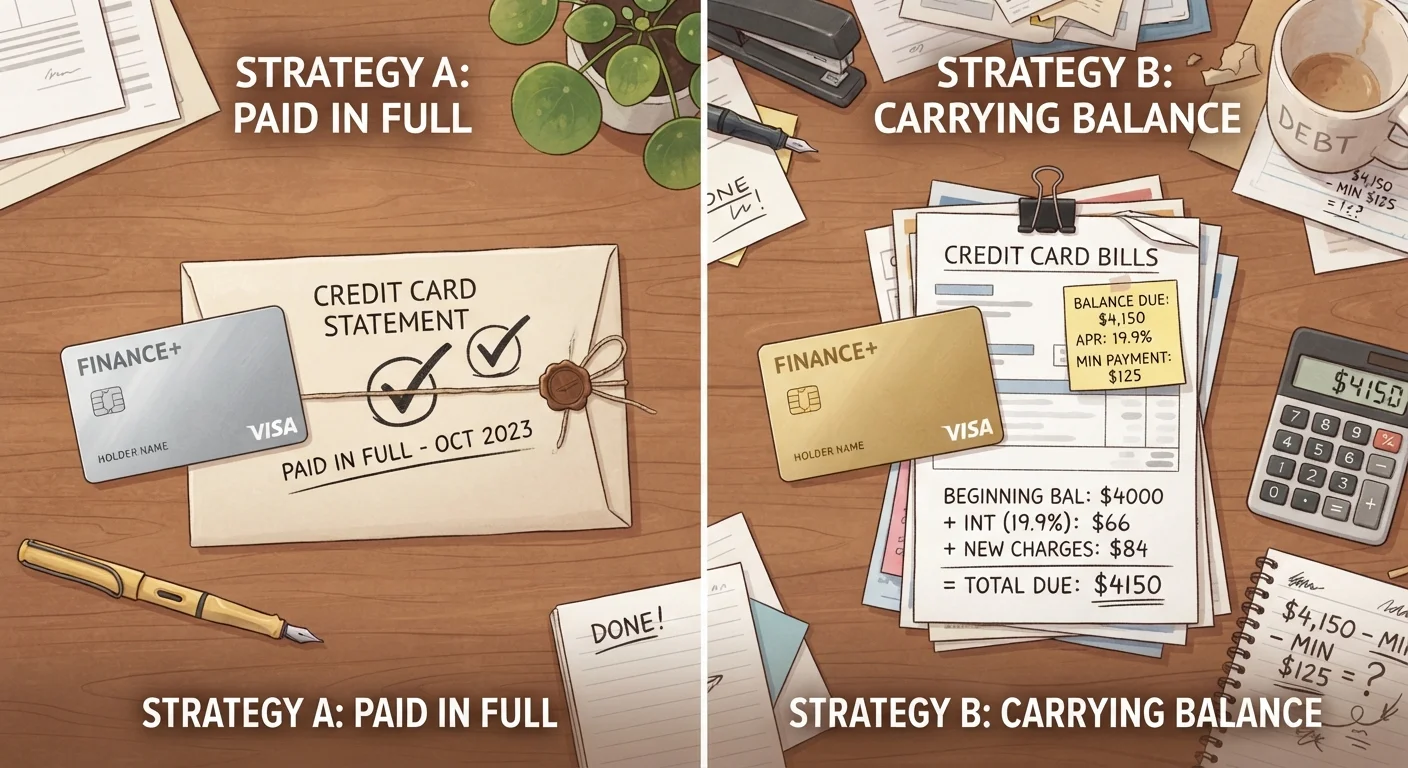
Option A
Carrying a Balance
The common but costly habit.
Best for: Situations where cash flow is temporarily constrained and short-term borrowing is unavoidable — though it always carries a cost.
Option B
Paying in Full
The interest-free approach.
Best for: Anyone who can cover their full statement amount each month and wants to avoid interest charges entirely.
How Each Approach Actually Works
When you use a credit card, your issuer tracks purchases throughout the billing cycle and presents a statement balance at the end. You then have a due date — typically 21 to 25 days later — to respond. What you do next defines whether you're carrying a balance or paying in full.
Paying in full means sending the complete statement balance before the due date. Issuers are required to extend a grace period during which no interest accrues on new purchases, so paying in full effectively makes your card interest-free for everyday spending.
Carrying a balance means paying less than the full statement amount — even if you pay more than the minimum. Any unpaid balance rolls into the next cycle and begins accruing interest at the card's APR. Most consumer credit cards carry APRs that can range widely; once interest starts accruing, it compounds, meaning you pay interest on previous interest. The grace period also disappears for new purchases until the balance is fully cleared.
For a broader look at credit card mechanics, the Credit & Banking hub covers related fundamentals worth reviewing.
| Criterion | Carrying a Balance | Paying in Full |
|---|---|---|
| Interest charges | Yes — APR applied to unpaid balance | None during grace period |
| Grace period on new purchases | Lost until balance is cleared | Maintained each cycle |
| Credit utilization impact | Higher utilization, potential score drag | Lower utilization, score-friendly |
| Credit score boost from method | No — a common myth | No direct boost, but avoids harm |
| Monthly cash flow required | Minimum payment only | Full statement balance |
| Total cost of purchases | Higher — interest adds to cost | Face value only |
| Financial flexibility over time | Reduced — interest erodes budget | Preserved — no ongoing interest drag |
The Real Cost of Revolving Debt
Interest charges on a carried balance can be deceptively large. Suppose you carry a $1,500 balance on a card with an 22% APR and make only minimum payments. Depending on how minimum payments are structured, it could take several years to pay off and cost hundreds of dollars in interest — money that delivers no new purchasing power.
~22%
Average credit card APR in the US
According to Federal Reserve data, average credit card interest rates have risen significantly in recent years, making carried balances more expensive than in prior decades.
Nearly half
US cardholders who carry a monthly balance
Federal Reserve surveys have consistently found that a large share of American credit card holders do not pay their full statement balance each month.
One persistent misconception is that carrying a small balance signals responsible use to credit bureaus and helps your score. This is not accurate. As the Credit Score Myths article explains, carrying a balance does not boost your credit score — it just costs you money in interest. What does matter to scoring models is your credit utilization ratio: the share of available credit you're using. High revolving balances push that ratio up, which can drag your score down.
It's also worth noting that interest charges are not the only cost. Some cards impose fees on late payments or balance transfers that can stack on top of APR-based charges. For a fuller picture of avoidable costs, see Banking Fees That Are More Avoidable Than Most People Realize.
Your Credit Limit Isn't a Spending Target
A high credit limit can feel like permission to spend up to it, but carrying a balance close to your limit elevates your utilization ratio — a key factor in most credit scoring models. Keeping utilization below 30% of your total available credit is a widely cited guideline, though lower is generally better. For more on how card decisions affect your score, see Why Closing Old Credit Cards Can Backfire.
Finding a Path Forward If You're Already Carrying a Balance
If you currently carry a balance, the goal isn't to feel overwhelmed — it's to understand your options and make deliberate choices. A few strategies worth considering:
- Pay more than the minimum. Even modest increases above the minimum payment can meaningfully shorten your payoff timeline and reduce total interest paid.
- Target the highest-APR balance first. If you have multiple cards, directing extra payments to the highest-rate balance is often the most cost-efficient approach (sometimes called the avalanche method).
- Explore balance consolidation carefully. Moving high-interest debt to a lower-rate product can reduce costs, but comes with trade-offs. Our article on consolidating debt walks through both the potential benefits and the real risks.
- Avoid adding new charges you can't pay off. Continuing to spend on a card with a balance can make it harder to break the cycle.
Once you're on a path toward eliminating revolving debt, transitioning to a pay-in-full habit is the most straightforward way to keep interest out of your monthly expenses — and to redirect those dollars toward savings or other financial goals. Our guide on paying off debt and saving at the same time explores how to structure both priorities without sacrificing one entirely.
This article is for general informational purposes only and does not constitute personalized financial or legal advice. Consult a qualified financial professional for guidance specific to your situation.
The content on this site is for informational purposes only and is not a substitute for professional advice. Always consult a qualified professional for guidance specific to your situation.