

Option A
Debt Avalanche
The mathematically optimal, interest-minimizing approach.
Best for: Borrowers who are motivated by long-term savings and want to minimize total interest paid over time.
Option B
Debt Snowball
The psychologically rewarding, momentum-building method.
Best for: Borrowers who need early wins and motivational milestones to stay committed to a repayment plan.
How Each Strategy Works
Both the debt avalanche and debt snowball share the same structural framework: you make the minimum required payment on every debt each month, then direct any remaining available funds toward one designated priority debt. The methods differ only in how that priority is determined.
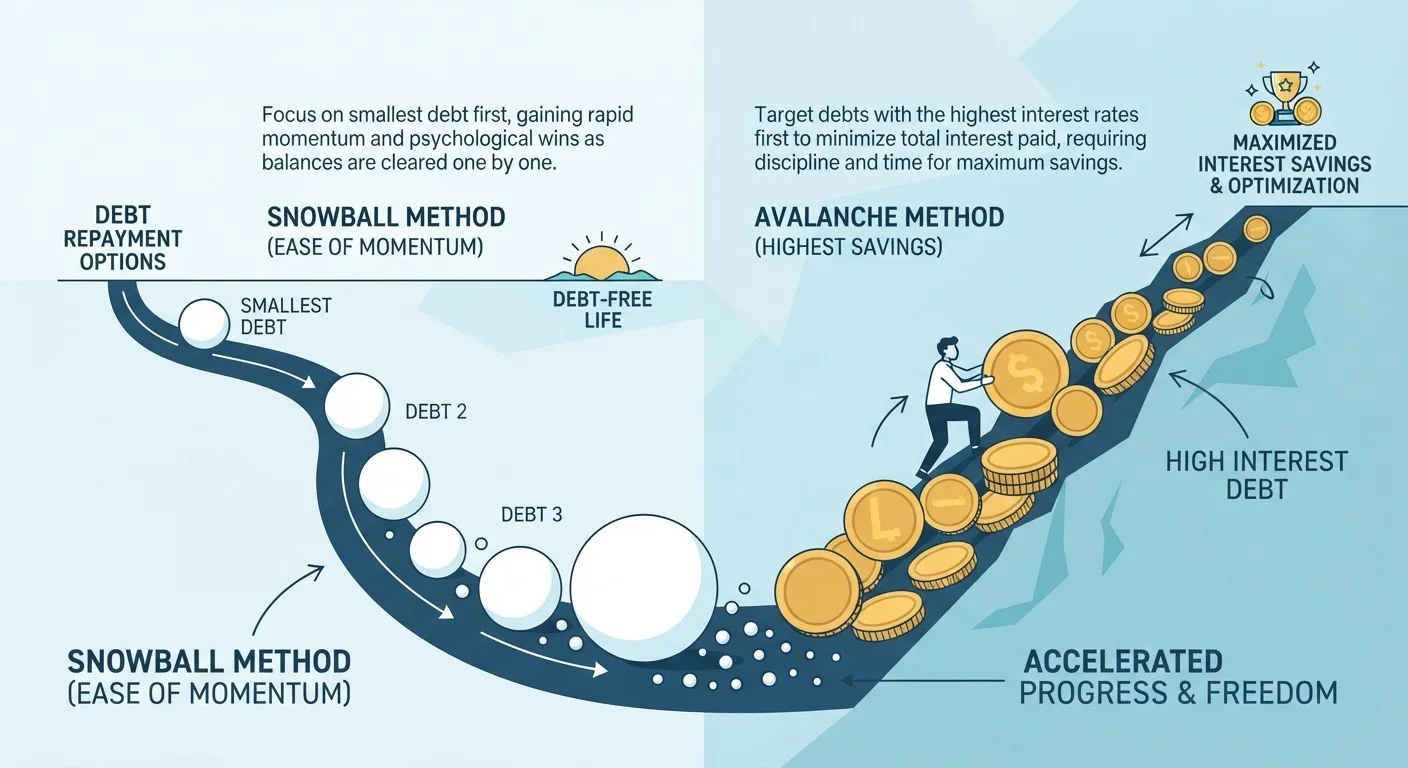
Debt Avalanche: You rank your debts from highest interest rate to lowest. The account with the steepest rate receives your extra payment dollars first. Once that balance is eliminated, you redirect those funds — now freed up — toward the next highest-rate debt, and so on. Because high-interest debt is the most expensive to carry, attacking it first lowers the total interest that accumulates across your repayment timeline.
Debt Snowball: You rank debts from smallest balance to largest, regardless of interest rate. Extra funds go to the smallest balance first. When that account is paid off, you roll those freed-up payments into the next smallest balance. Each closed account creates a slightly larger payment to apply to the next, resembling a snowball gaining mass as it rolls.
Before committing to either approach, it's worth reviewing the financial readiness checklist to ensure the right foundations are in place first.
| Criterion | Debt Avalanche | Debt Snowball |
|---|---|---|
| Repayment order | Highest interest rate first | Smallest balance first |
| Total interest paid | Generally lower | Generally higher |
| Time to first payoff | Potentially longer | Typically faster |
| Motivational design | Data-driven, long-term focus | Milestone-driven, early wins |
| Best suited for | Disciplined, math-motivated savers | Those needing momentum and closure |
| Complexity | Requires tracking rates carefully | Simpler balance-based ranking |
The Real Cost Difference — and Why Motivation Still Matters
In a purely mathematical comparison, the avalanche method almost always results in less total interest paid. The gap can be meaningful when high-rate debts — such as credit card balances carrying rates above 20% — are large and would otherwise compound for years.
20%+
Average credit card APR in the US
According to Federal Reserve data, average credit card interest rates have exceeded 20% annually in recent years, making high-rate debt among the most costly to carry.
Hundreds to thousands
Potential interest saved with avalanche method
Consumer finance analyses consistently show that prioritizing high-interest debt can save significant sums, though the exact figure depends heavily on balances, rates, and repayment speed.
However, research in behavioral economics consistently shows that debt repayment is not purely a math problem. A study published in the Journal of Marketing Research found that people who focused on eliminating individual accounts — the snowball approach — were more likely to successfully reduce their overall debt compared to those who allocated payments based on interest rates alone. The motivational effect of closure is real, and it can outweigh a mathematical advantage if abandoning a plan midway means paying interest indefinitely.
The honest answer is that the best strategy is whichever one you will actually follow through on. If early wins keep you engaged, the snowball's slightly higher interest cost may be worth the trade-off. If you're disciplined and motivated by data, the avalanche is the stronger financial choice.
For readers also trying to balance debt payoff with building savings, paying off debt and saving simultaneously explores when and how that balance is achievable.
Putting Either Method Into Practice
Regardless of which strategy you choose, a few practical steps apply to both:
- List all your debts — including balance, minimum payment, and interest rate — before deciding on order.
- Identify your extra payment capacity — even a small consistent surplus accelerates either method significantly.
- Automate minimum payments on all accounts to avoid late fees or credit score damage while focusing extra funds on your priority debt.
- Revisit your plan periodically — life circumstances change, and your approach should adapt. See signs your debt repayment plan isn't working for guidance on when to course-correct.
Hybrid Approaches Are Valid Too
Some borrowers blend both strategies — using the snowball to eliminate one or two small accounts quickly for a motivational boost, then switching to the avalanche for the remaining higher-rate balances. There's no rule requiring a rigid commitment to one method from start to finish. What matters is maintaining consistent extra payments and not allowing momentum to stall. A solid budget foundation also helps; the Budgeting Basics hub covers the practical tools needed to track spending and identify payment capacity.
Some borrowers also explore debt consolidation as a parallel tool — combining multiple debts into a single loan, potentially at a lower rate. This doesn't replace a repayment strategy, but it can change how one is applied. See consolidating debt: potential benefits and real trade-offs for a balanced look at what that involves.
This article is for general informational and educational purposes only and does not constitute personalised financial or legal advice. Please consult a qualified financial professional for guidance tailored to your individual circumstances.
The content on this site is for informational purposes only and is not a substitute for professional advice. Always consult a qualified professional for guidance specific to your situation.