

Our Verdict
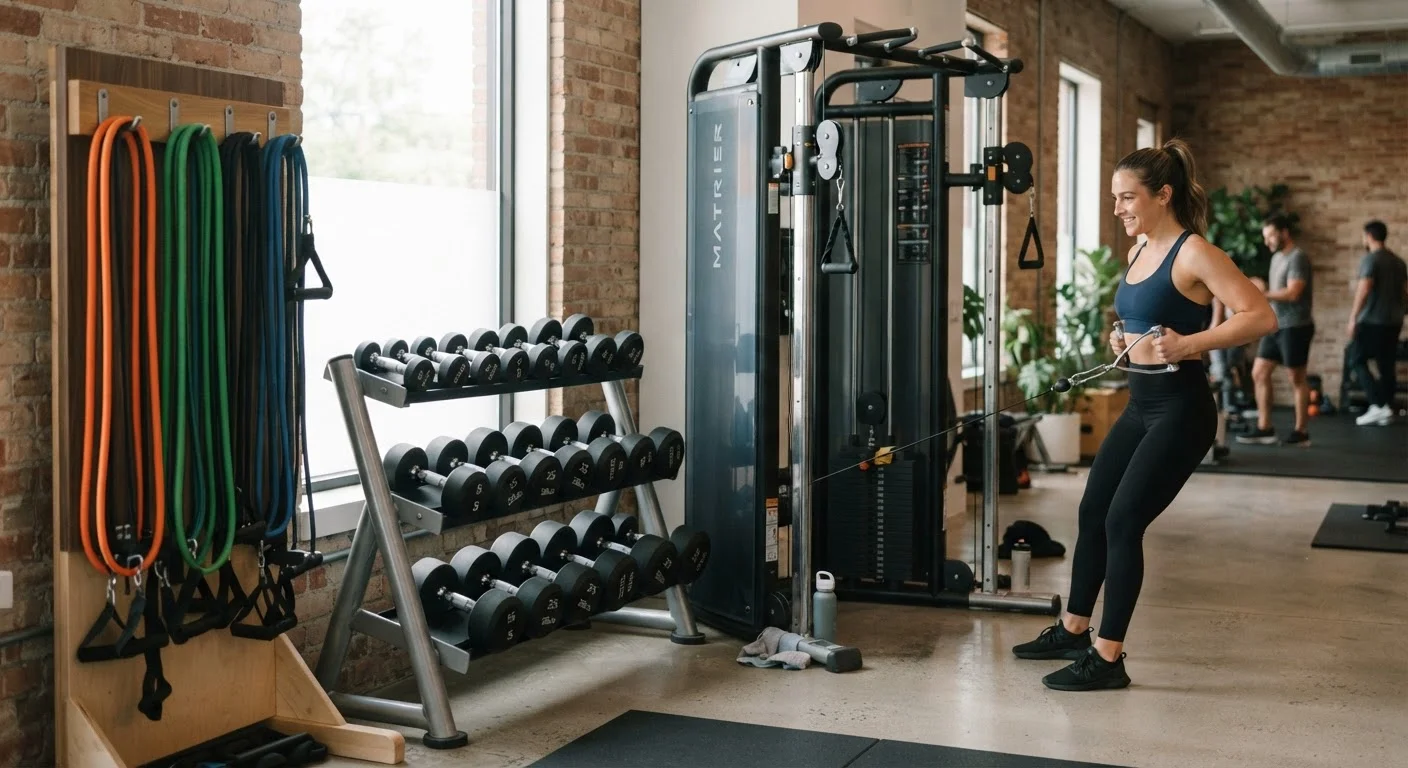
Resistance bands, free weights, and machines each occupy a legitimate place in strength training. Bands excel for portability and rehab-friendly work; free weights deliver functional strength gains across a wide range of movements; machines provide guided, controlled resistance ideal for isolation or beginners learning movement patterns. Most people benefit from incorporating more than one tool over time.
| Best for | Recommended |
|---|---|
| Beginners or those recovering from injury | Resistance Bands or Machines |
| Those training at home or while traveling | Resistance Bands |
| Building overall functional strength and muscle mass | Free Weights (Dumbbells & Barbells) |
| Targeted muscle isolation with controlled movement | Cable Machines |
Why the Tool You Use Actually Matters
Strength training is one of the most well-supported forms of physical activity for long-term health. It supports bone density, metabolic function, and muscle preservation across the lifespan. But the equipment you use shapes how your muscles are challenged, which muscle fibers are recruited, and how safely a movement can be performed - especially for people new to resistance training.
Understanding the practical differences between resistance bands, free weights, and machines helps you make more intentional choices rather than defaulting to whatever happens to be available. If you've been sorting through common fitness myths, you may already know that no single method is universally optimal - and the same logic applies here.
Resistance Bands: Accessible and Adaptable
Resistance bands are elastic loops or tubes that create tension when stretched. Unlike free weights, the resistance they provide increases as the band is stretched further - a property called accommodating resistance. This means the hardest part of the movement often occurs near the peak of the range of motion, which differs from how gravity-based tools work.
Key advantages:
- Highly portable and inexpensive
- Low compressive force on joints, making them suitable for rehabilitation contexts
- Available in multiple resistance levels, allowing gradual progression
- Can replicate many upper and lower body exercises
Limitations:
- Resistance is difficult to quantify precisely, complicating progressive overload tracking
- Bands degrade over time and can snap if worn or overstretched
- Less effective for heavy loading compared to free weights or machines
Bands Work Well as a Complement
Resistance bands are particularly useful as a complement to other tools - for warm-up activation, mobility work, or adding variable resistance to barbell exercises. Many strength athletes use bands not as a standalone solution, but to enhance what heavier tools already do well.
Bands are particularly useful as a complement to other tools - for warm-up activation, mobility work, or adding variable resistance to barbell exercises.
Free Weights: Dumbbells and Barbells
Free weights include dumbbells, barbells, and kettlebells. Because they move through space without a fixed path, they require your body to recruit stabilizer muscles alongside the primary muscles being trained. This can make movements more demanding - and more transferable to real-world physical tasks.
Dumbbells allow each limb to work independently, which can help correct strength imbalances between sides. Barbells enable heavier loading and are foundational to powerlifting and many strength programming frameworks.
Key advantages:
- Broad exercise variety - squats, deadlifts, presses, rows, and more
- Supports progressive overload with measurable increments
- Engages stabilizing musculature for functional strength transfer
Limitations:
- Requires more technique and body awareness to perform safely
- Risk of injury increases when form breaks down, particularly under heavy load
- Barbells specifically require more space and a spotter for certain movements
Form quality is especially important with free weights. Our overview of common exercise form errors covers the technique breakdowns most likely to stall progress or raise injury risk.
| Resistance Bands | Dumbbells | Barbells | Cable Machines | Weight Stack Machines | |
|---|---|---|---|---|---|
| Portability | Excellent | Moderate | Poor | None | None |
| Cost (general range) | Low | Moderate | Moderate-High | High (gym) | High (gym) |
| Stabilizer muscle engagement | Moderate | High | High | Moderate | Low |
| Beginner accessibility | High | Moderate | Lower | High | High |
| Progressive overload precision | Difficult | Easy | Easy | Moderate | Moderate |
| Joint stress | Low | Moderate | Moderate-High | Low-Moderate | Low-Moderate |
| Exercise variety | Moderate | High | High | High | Limited |
Machines: Guided Resistance for Targeted Work
Weight stack machines and cable machines constrain movement to a fixed or semi-fixed path, reducing the stabilization demand. This makes them particularly useful for learning a movement pattern, isolating a specific muscle group, or training safely when fatigue is high.
Cable machines are a versatile subset: they use a pulley system to deliver constant tension throughout the range of motion, unlike plate-loaded machines. This makes cables especially effective for exercises like cable rows, lat pulldowns, and face pulls.
Key advantages:
- Lower technical barrier - the machine guides the movement
- Useful for muscle isolation (e.g., leg curl, chest fly)
- Cables maintain tension at both ends of the range of motion
- Generally safer for training to higher fatigue levels without a spotter
Limitations:
- Less carryover to functional movement patterns than free weights
- Limited to gym settings; not portable
- Fixed movement paths may not suit all body proportions
If you're thinking about what equipment to include in a home setup, our guide on setting up a home workout space offers practical planning considerations.
Putting It Together: Choosing What Fits Your Goals
There is no hierarchy that places one tool above all others. Research on resistance training generally supports the principle that consistent, progressive overload - gradually increasing the challenge placed on your muscles over time - is the driver of adaptation, regardless of the specific tool used.
That said, your starting point matters. Beginners often benefit from machines or bands to learn basic movement patterns with lower injury risk. As competency grows, introducing free weights broadens the training stimulus and strengthens stabilizing musculature. Bands and cables can serve as complementary tools throughout, adding variety and targeting specific ranges of motion.
Strength training also interacts meaningfully with cardiovascular exercise. If you're curious how these two training approaches differ in their effects on your body, cardio vs. strength training breaks down their distinct contributions to overall fitness.
This article is for general informational and educational purposes only and is not a substitute for professional medical or fitness advice. If you have a health condition, injury, or are new to exercise, consult a qualified healthcare provider or certified fitness professional before beginning a strength training program.
The content on this site is for informational purposes only and is not a substitute for professional advice. Always consult a qualified professional for guidance specific to your situation.