

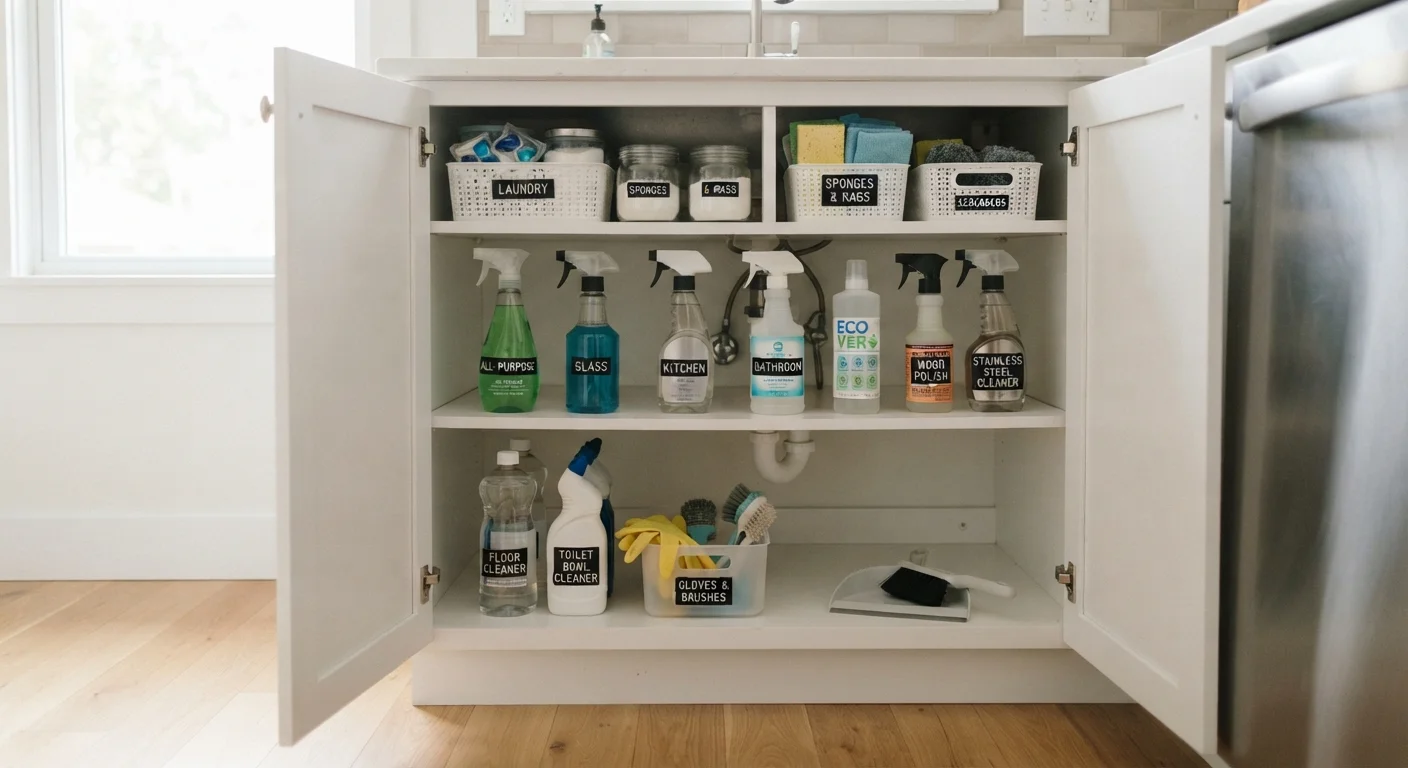
Why Chemical Storage Errors Happen at Home
Most households accumulate a surprisingly large collection of cleaning agents, pesticides, and maintenance chemicals over time. The problem isn't usually carelessness — it's assumption. People assume that if a product is sold at a grocery store, storing it casually is fine. Labels focus on how to use a product, not always on how incompatible products interact when stored in proximity or mixed accidentally.
Understanding the real risks starts with recognizing that chemicals don't have to be actively combined to cause harm. Off-gassing, container leaks, and heat exposure can create hazardous conditions in a closed cabinet or garage. For a broader look at home safety hazards — including those in storage-heavy spaces — see our guide to garage and workshop safety.
Storing incompatible chemicals on the same shelf or in the same cabinet.
Why it happens: Most people organize by room purpose or convenience — all cleaners together, all garage products together — without considering chemical families or reactivity.
Transferring chemicals into unlabeled or repurposed containers, especially bottles that once held food or beverages.
Why it happens: People decant into smaller containers for convenience, or reuse what's on hand without thinking about how misleading a familiar container can be.
Storing chemicals in areas with poor ventilation or high temperature fluctuation, such as under sinks near pipes or in unventilated garages.
Why it happens: Under-sink cabinets are convenient and out of sight, making them a default choice — but they're often warm, humid, and sealed tight.
Keeping chemicals accessible to children and pets without any physical barrier.
Why it happens: Parents often rely on verbal warnings or the belief that children understand danger — but young children and curious pets cannot reliably self-regulate around hazardous materials.
Holding onto expired, degraded, or unidentifiable chemicals instead of disposing of them properly.
Why it happens: Disposal feels complicated — people don't know where to take old products, so the chemicals sit in storage indefinitely, sometimes leaking or reacting over time.
The Risks Most Labels Leave Out
Product labels are legally required to cover first-aid steps and proper disposal, but they rarely address what happens when your bleach-based cleaner sits on the same shelf as your ammonia-containing glass spray. Chlorine gas — produced when bleach and ammonia mix — can cause respiratory damage even in small concentrations. Similarly, mixing bleach with acidic cleaners like vinegar-based products releases chlorine fumes.
~90,000
Annual household chemical exposures reported to U.S. Poison Control
According to data published by the American Association of Poison Control Centers, tens of thousands of household chemical exposures are reported each year, many involving cleaning products.
~50%
Chemical exposures involving children under age 6
Poison Control data consistently shows that children under six represent a disproportionate share of reported household chemical exposure cases annually.
Heat amplifies these risks. A garage or under-sink cabinet that reaches high temperatures in summer can accelerate the breakdown of oxidizing agents and aerosol propellants, increasing pressure inside containers. Ventilation is not a luxury for chemical storage — it's a structural requirement.
Families with young children face compounding risks. Safe storage of chemicals is closely tied to broader child-proofing strategies detailed in our article on child-proofing beyond the baby years. And because chemical organization is part of managing any household well, it connects naturally to the principles in our Home Management hub.
Never Mix Bleach With Other Cleaners
Combining bleach with ammonia, vinegar, rubbing alcohol, or other household cleaners can produce chlorine gas or other toxic byproducts — even in small amounts. This can happen in a mixing bucket, a drain, or simply from fumes meeting in a poorly ventilated space. When in doubt, use one product at a time and rinse surfaces thoroughly between applications.
If you ever suspect a chemical exposure — swallowed, inhaled, or skin contact — contact the Poison Control Center at 1-800-222-1222 immediately. For emergencies involving loss of consciousness or breathing difficulty, call 911 first.
This article is for general informational and safety education purposes only. It is not a substitute for professional advice or emergency medical care.
The content on this site is for informational purposes only and is not a substitute for professional advice. Always consult a qualified professional for guidance specific to your situation.