

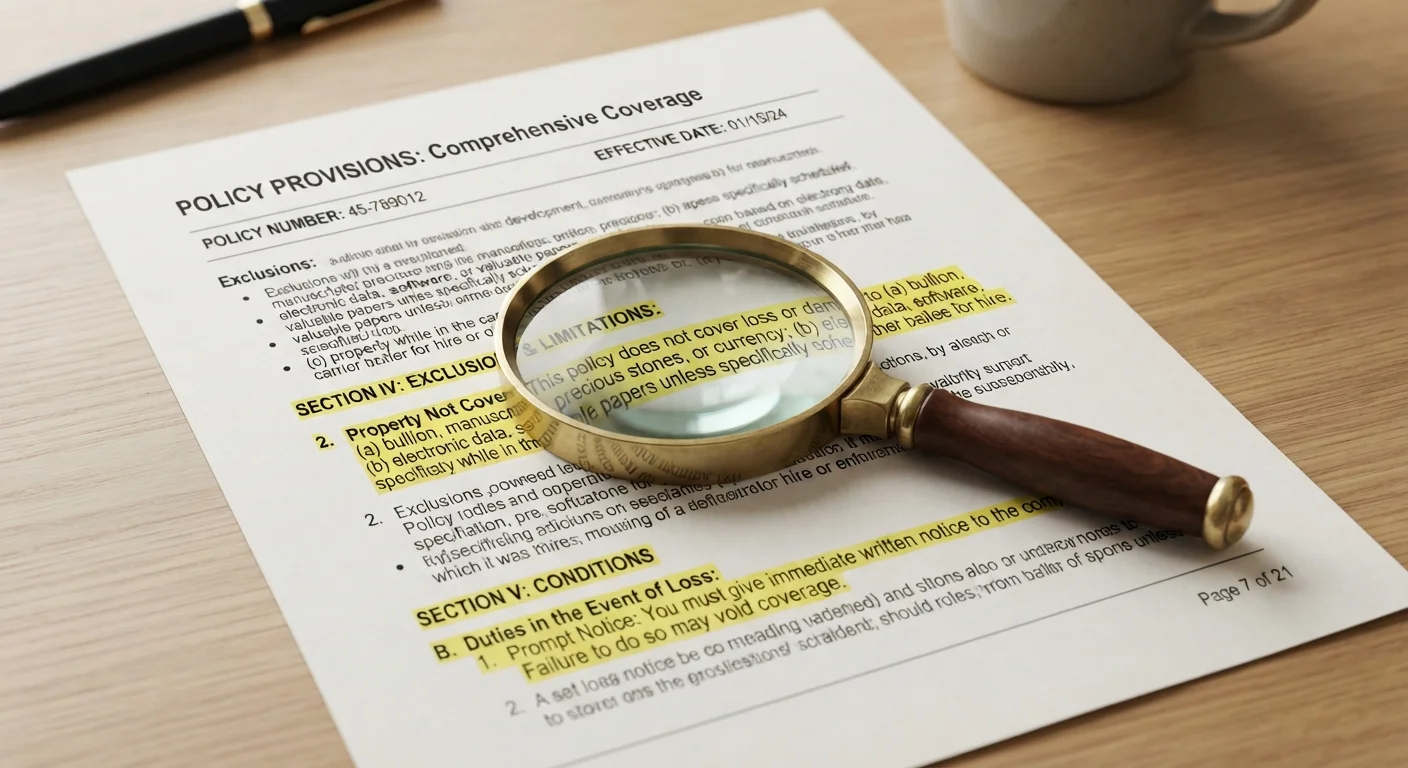
What Exclusions Actually Do in a Policy
Most people buy insurance by focusing on what it covers. Exclusions work the other way: they carve out situations where the insurer's obligation stops. Together, covered perils and exclusions define the true shape of a policy.
Think of a policy as a circle. The insurer covers everything inside the circle. Exclusions draw lines that remove slices from that circle. The premium you pay reflects the size of what remains. Understanding both sides — coverage and exclusions — is the only way to know what you've actually purchased.
Exclusions exist in virtually every type of policy. Health plans exclude certain procedures or pre-existing conditions. Homeowners policies typically exclude flood and earthquake damage. Life insurance policies often exclude suicide within a defined period after issue. Auto policies may exclude damage that occurs during commercial use of a personal vehicle. To see how exclusions interact with the rest of your policy's structure, see how deductibles, premiums, and limits work together.
Exclusions Are Not Always Labeled Clearly
Some exclusions appear as straightforward "we do not cover" language. Others are embedded in definitions — for instance, defining 'occurrence' narrowly so that certain events never qualify as covered losses in the first place. A careful read of both the exclusions section and the definitions section is necessary to understand the full scope of what a policy excludes.
Common Types of Exclusions Across Policy Categories
Exclusions fall into a few recognizable patterns regardless of the type of insurance involved.
- Intentional acts: Damage or loss you cause on purpose is almost universally excluded. Insurance is designed for accidents, not deliberate harm.
- Wear and tear: Gradual deterioration is not a covered loss. Homeowners and auto policies exclude mechanical breakdown and aging materials because maintenance is the policyholder's responsibility.
- Catastrophic or government-defined events: Floods, earthquakes, and acts of war are commonly excluded from standard policies. Separate coverage — like the National Flood Insurance Program — exists for some of these risks.
- Business activity: Personal policies often exclude losses tied to business use. A home office claim or a delivery driver's accident may fall outside a standard personal policy.
- Illegal activity: Losses arising from criminal conduct by the policyholder are typically excluded.
For a broader view of how coverage is structured across policy types, review the major insurance coverage categories.
~1 in 7
Homeowners unaware of flood exclusion
Industry consumer surveys have consistently found that a significant share of homeowners do not know that flood damage is excluded from standard homeowners policies.
Top reason
Why property claims are denied
According to insurance industry data, exclusion-related denials — including policy exclusions and excluded perils — are among the leading reasons property claims are not paid.
How to Spot and Evaluate Exclusions Before You Need Them
The time to understand an exclusion is before a loss occurs, not after. Here's a practical approach to reading your policy with exclusions in mind.
First, locate the exclusions section in each coverage part — policies are often divided into sections for liability, property, medical payments, and so on, and each may carry its own exclusions. Second, cross-reference any exclusion with the definitions section, since terms like "occurrence" or "bodily injury" may carry specific meanings that affect how broadly the exclusion applies.
Third, ask yourself whether the excluded risk is one you face. A homeowner in a flood-prone area who discovers that flood damage is excluded has actionable information — they can purchase separate flood coverage. A renter in a high-rise who finds the same exclusion may reasonably decide the risk is low enough to accept.
Reading an insurance policy without getting lost in the fine print takes practice, but focusing on exclusions first is one of the most efficient ways to assess whether a policy truly fits your situation.
Make a Short List of Your Biggest Risks
Before reviewing exclusions, write down the two or three losses that would hurt you most financially — a flooded basement, a totaled car, a major medical event. Then check specifically whether those scenarios are excluded in your current policies. This targeted approach is faster than reading every line and helps you focus on what actually matters to your situation.
Filling the Gaps Exclusions Leave Behind
Identifying an exclusion is only the first step. The next is deciding what, if anything, to do about it.
Some exclusions can be removed or modified by adding an endorsement — sometimes called a rider — to your existing policy. For example, a homeowner might add scheduled personal property coverage for jewelry that would otherwise fall under a sublimit or exclusion. An auto policyholder might add a rideshare endorsement to cover gaps that arise when using a personal vehicle for hire. Understanding auto coverage types can help you identify where personal auto policies commonly fall short.
Other excluded risks require an entirely separate policy. Flood coverage, earthquake insurance, and umbrella liability policies are purchased separately precisely because standard policies exclude those exposures.
Finally, some exclusions represent risks you may decide to self-insure — meaning you accept the financial exposure rather than pay to transfer it. That's a legitimate choice, but it should be a deliberate one. Learn about coverage gaps that often go unnoticed to make sure your decision is fully informed.
This article is for general informational and educational purposes only and does not constitute insurance, legal, or financial advice. Coverage terms, exclusions, and availability vary by insurer, policy, and state. Always read your actual policy documents carefully and consult a licensed insurance agent or adviser about your specific situation.
Frequently Asked Questions
Exclusions are typically listed in a section titled "Exclusions" within each coverage part of your policy. They may also appear in the definitions section or as conditions on declarations pages. Reading the full policy document — not just the summary — is the only reliable way to find all of them.
Sometimes, yes. Insurers often sell endorsements or riders that add back coverage for specific excluded risks. In other cases, a separate specialty policy covers what a standard policy excludes — flood insurance being a common example. Ask your agent what options exist for the gaps that concern you.
Exclusions allow insurers to price policies accurately and remain financially stable. Without them, premiums would have to account for every conceivable risk, making coverage unaffordable for most consumers. Exclusions also prevent coverage for risks the policyholder can control or that are better addressed by other types of insurance.
You have the right to appeal the denial through your insurer's internal process. If you believe the exclusion was applied incorrectly, you can also file a complaint with your state's insurance department. Consulting a licensed public adjuster or attorney may be worth considering for large disputed claims.
No. Exclusions vary by insurer, policy type, and state. State regulators often set minimum standards, but insurers can include additional exclusions within those limits. Always compare the exclusions section — not just price — when evaluating policies.
The content on this site is for informational purposes only and is not a substitute for professional advice. Always consult a qualified professional for guidance specific to your situation.