

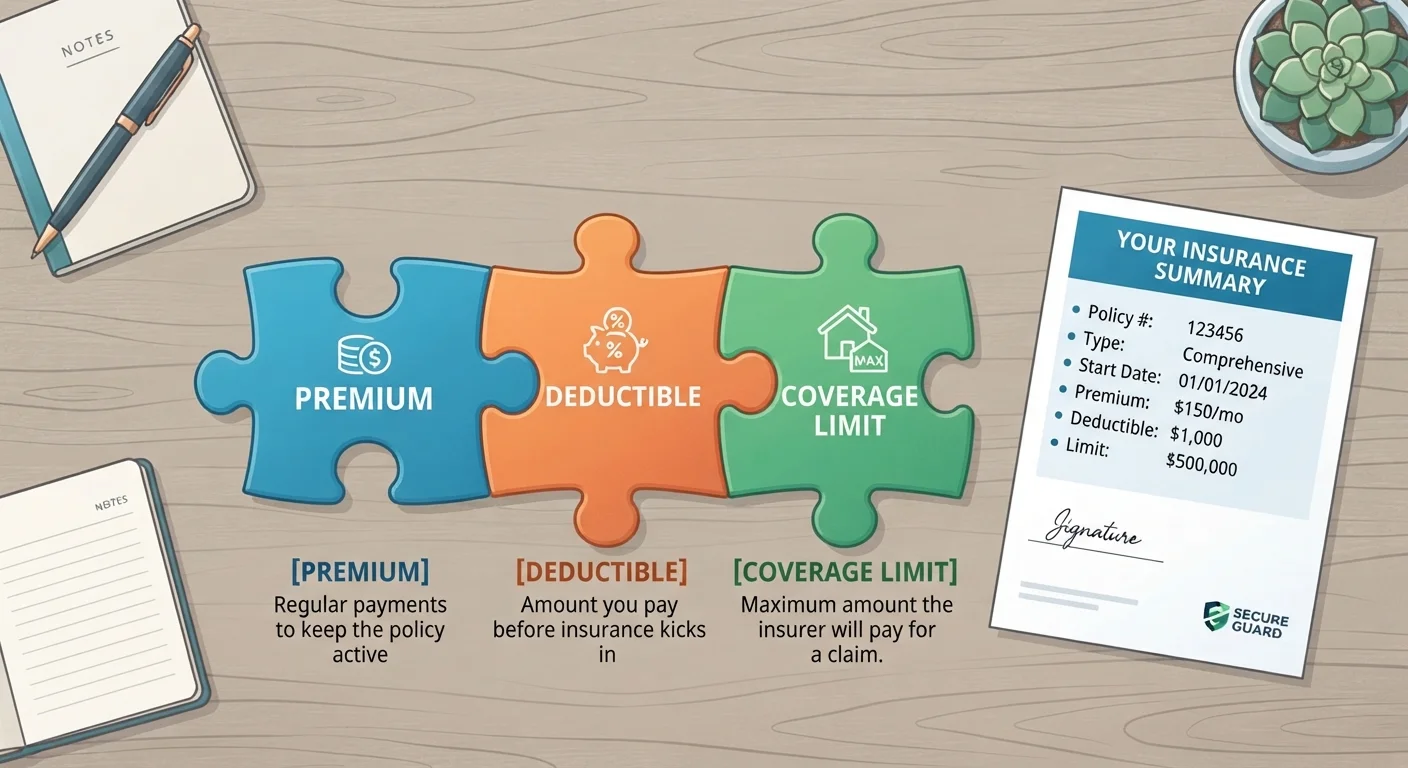
The Three Numbers That Define Your Policy
When you buy an insurance policy, you're agreeing to a financial arrangement built on three core variables: your premium, your deductible, and your coverage limit. Misunderstand any one of them and you may end up with a policy that doesn't work the way you expected when a claim finally arises.
Think of them as three dials on the same machine. Turn one and the others are affected. A policy with a low premium often carries a high deductible or a lower coverage limit — or both. Understanding how they interact is the foundation of comparing policies across health, auto, home, or life insurance. For a broader look at how these terms appear across coverage types, see our guide to the major insurance coverage categories.
$1,644
Average annual auto insurance premium in the U.S.
According to the National Association of Insurance Commissioners (NAIC), average expenditures on auto insurance have risen steadily in recent years.
$1,500+
Common individual health plan deductible
The Kaiser Family Foundation has reported that average individual deductibles for employer-sponsored health plans regularly exceed $1,500 for single coverage.
40%
Americans who couldn't cover a $400 emergency expense
Federal Reserve surveys have consistently found that a significant share of U.S. adults would struggle to absorb an unexpected $400 expense, underscoring why deductible levels matter.
Premiums: The Cost of Staying Covered
Your premium is the recurring amount you pay to keep your policy in force. Miss enough payments and your coverage lapses — meaning a claim filed during that gap likely won't be paid. Premiums are typically billed monthly, quarterly, or annually.
What determines your premium? Insurers weigh risk factors specific to each coverage type. For auto insurance, that might include your driving record and the vehicle's value. For health insurance, it may include your age and whether you use tobacco. For homeowners insurance, your home's location, age, and construction materials all play a role.
Match Your Deductible to Your Savings
A common guideline is to set your deductible at an amount you could realistically pay out of pocket today. If a $2,000 deductible would strain your budget, a lower deductible — even with a higher premium — may give you more financial stability when a claim occurs. This is a personal financial decision, and a licensed agent can help you model the tradeoffs.
One important point: paying your premium does not mean your insurer will pay every claim in full. That depends on your deductible and coverage limit — the other two variables.
Deductibles: What You Owe Before Coverage Kicks In
A deductible is the dollar amount you must pay toward a covered claim before your insurer contributes. If you have a $1,000 auto deductible and file a claim for $3,500 in damage, you pay the first $1,000 and your insurer covers the remaining $2,500 — assuming the loss falls within your coverage limit.
Health insurance deductibles work similarly, though they typically reset annually and interact with other cost-sharing features like copays and coinsurance. For a deeper look at those mechanics, see how premiums, deductibles, and out-of-pocket maximums work together in a health plan context.
Life insurance generally has no deductible — the insurer pays the stated death benefit when a covered event occurs, subject to the policy's terms and exclusions.
Coverage Limits: The Ceiling on What Your Insurer Will Pay
A coverage limit is the maximum your insurer will pay for a covered loss. Anything beyond that limit is your financial responsibility. Limits may be set per claim (per-occurrence), per year (aggregate), or both.
In auto insurance, your liability limit might be expressed as $100,000 per person / $300,000 per accident. In homeowners insurance, you typically have a separate dwelling limit, personal property limit, and liability limit. Understanding which limit applies to which type of loss is critical — and it's explained in your policy's declarations page.
Coverage limits also intersect with exclusions — things your policy explicitly does not cover at any limit. Understanding how exclusions work is just as important as knowing your limits. You can also expand base coverage with add-ons; riders and endorsements often raise specific limits or add new coverage categories.
“The declarations page of your policy is the most important document most people never read. It tells you exactly what your limits are, what you're paying, and what the insurer has agreed to cover — all on one or two pages.”
— J. Robert Hunter, Former Director of Insurance, Consumer Federation of America
How These Three Elements Work as a System
The practical relationship between these three variables plays out differently by insurance type, but the logic is consistent: you're balancing predictable ongoing costs (premiums) against potential out-of-pocket exposure (deductibles and gaps above limits).
A person with a robust emergency fund might deliberately choose a high-deductible plan to reduce their monthly premium. Someone with limited savings might prioritize a lower deductible, accepting a higher premium in exchange for more predictable costs if a claim arises. Neither approach is universally right — it depends on individual financial circumstances.
For auto insurance specifically, understanding how collision and comprehensive coverage factor into this equation matters. Comprehensive vs. collision coverage is a common area of confusion that affects which deductibles apply and when. For anyone ready to evaluate their options more broadly, the Choosing a Policy hub and the Costs and Claims hub offer practical guidance on next steps.
This article is for general informational purposes only and does not constitute personalized insurance, financial, or legal advice. Coverage terms, limits, and costs vary by insurer, policy, and state. Always read your policy documents carefully and consult a licensed insurance agent or adviser for guidance specific to your situation.
Frequently Asked Questions
Your premium is what you pay to maintain coverage — it's due whether or not you file a claim. Your deductible is what you owe before your insurer pays when a claim does occur. They are separate costs that you may pay at different times.
In most cases, yes — insurers reward you for taking on more initial financial risk. However, the relationship isn't always perfectly proportional. Other factors like your location, claims history, and coverage type also affect your premium.
You are generally responsible for any amount above your coverage limit. For example, if your home policy has a $300,000 dwelling limit and rebuilding costs $350,000, you would need to cover the $50,000 gap yourself.
Not always. Some auto policies waive the deductible for certain types of claims, like glass repair. Life insurance typically has no deductible. The specifics depend on your policy type and insurer.
Yes, in most cases you can request changes at renewal or sometimes mid-term, though changes may affect your premium immediately. Contact your insurer or licensed agent to understand what adjustments are allowed under your specific policy.
Health insurance often uses out-of-pocket maximums rather than strict coverage limits, with ACA-compliant plans required to cap those amounts annually. Auto insurance uses per-occurrence and sometimes aggregate limits for liability and property damage, which are set state-by-state for minimums.
The content on this site is for informational purposes only and is not a substitute for professional advice. Always consult a qualified professional for guidance specific to your situation.