

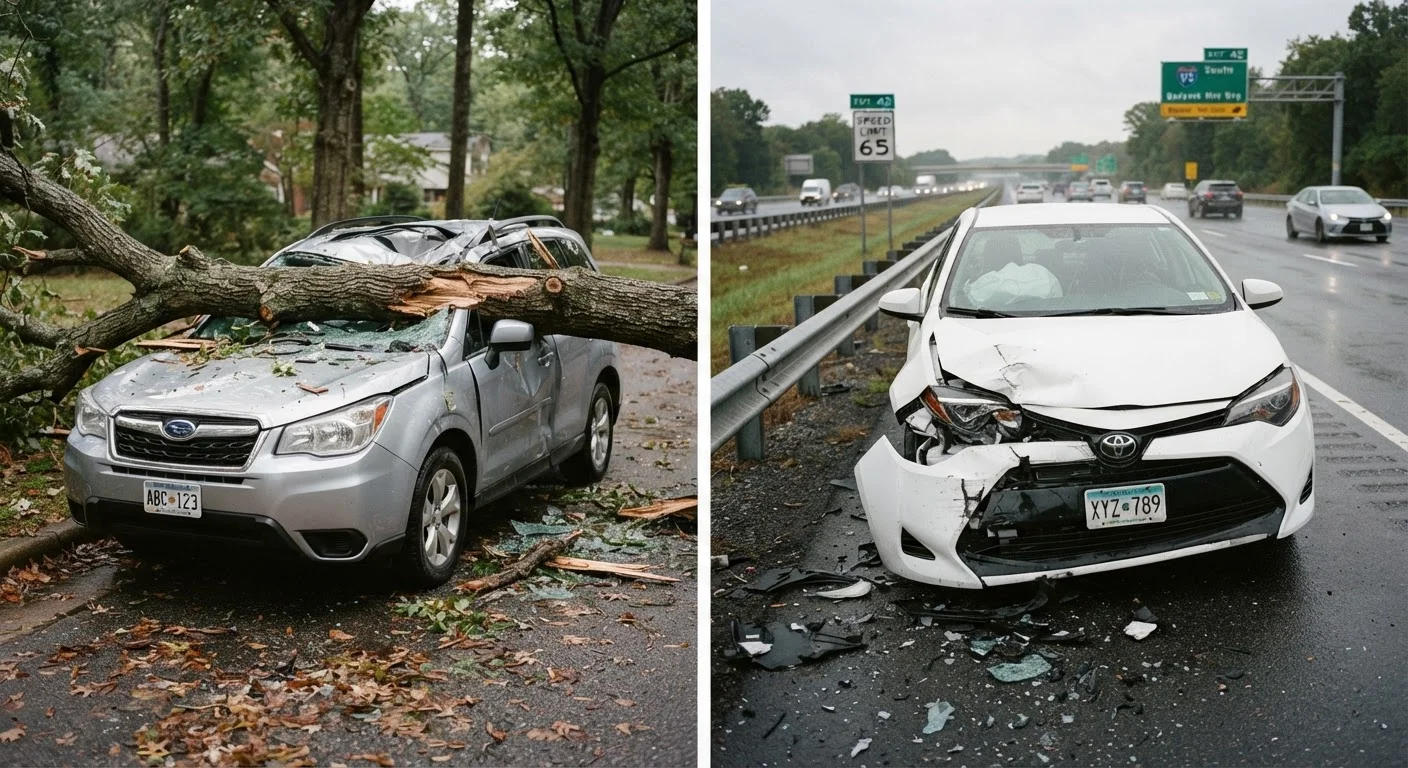
Option A
Comprehensive Coverage
Protection against things outside your control.
Best for: Drivers who want protection from weather, theft, animal strikes, and other non-collision events.
Option B
Collision Coverage
Protection when your car makes contact with something else.
Best for: Drivers who want their insurer to help pay for repairs after an at-fault accident or impact with an object.
The Core Difference: What Triggered the Damage?
The fastest way to tell these two coverages apart is to ask a single question: did your car make physical contact with another vehicle or object? If yes, collision is likely in play. If the damage happened some other way - a storm, a deer, a thief - you're looking at comprehensive.
Collision coverage responds when your vehicle hits or is hit by another car, strikes a pothole hard enough to cause damage, or makes contact with a fixed object like a fence, curb, or utility pole. Fault matters in terms of how your insurer handles subrogation, but collision coverage can apply regardless of who caused the accident.
Comprehensive coverage picks up everything else. The list is broad: theft, vandalism, falling objects (a tree limb, for example), flooding, fire, hail, and animal strikes - including a deer running into your path. Neither windshield chips nor a tornado cares about your driving behavior, which is why comprehensive is sometimes described as coverage for events outside the driver's control.
For a broader look at how these fit into a full auto policy, see our guide to auto insurance coverage types.
| Criterion | Comprehensive Coverage | Collision Coverage |
|---|---|---|
| What triggers it | Non-collision events (weather, theft, animals, fire) | Contact with another vehicle or object |
| Theft covered | Yes | No |
| Hail or flood damage | Yes | No |
| At-fault accident repair | No | Yes |
| Hitting a guardrail | No | Yes |
| Animal strike | Yes | No |
| Separate deductible | Yes | Yes |
| Typically required by lenders | Yes | Yes |
| Average relative premium cost | Generally lower | Generally higher |
Deductibles, Premiums, and the Value Calculation
Both coverages carry their own deductible - the amount you pay out of pocket before your insurer covers the rest. Deductibles are chosen when you set up your policy and typically range from $250 to $1,500 or more. A higher deductible lowers your monthly premium but increases what you owe if you file a claim.
Comprehensive coverage generally costs less in premium than collision because statistically, non-collision claims are less frequent than accident claims. However, this varies by location. Drivers in regions with high hail frequency, flood risk, or vehicle theft rates may see comprehensive premiums climb.
~6%
Share of insured vehicles with a comprehensive claim annually
According to data from the Insurance Information Institute, comprehensive claims occur less frequently than collision claims across the US.
~20%
Share of insured vehicles with a collision claim annually
The Insurance Information Institute reports collision claims are significantly more common, reflecting everyday driving risk.
$500
Most common deductible amount chosen by drivers
Industry surveys consistently show $500 as the deductible level most frequently selected for both comprehensive and collision coverage.
The central financial question with either coverage is whether the annual premium - plus your deductible - is worth it relative to your car's current market value. If your vehicle is worth $4,000 and you carry a $1,500 deductible, your maximum net payout in a total-loss scenario is $2,500. Some drivers with older, paid-off vehicles decide that gap doesn't justify the cost. This is a personal financial judgment, not a one-size-fits-all answer. For more on how these moving parts connect, our explainer on deductibles, premiums, and coverage limits goes deeper.
Also worth understanding: both comprehensive and collision typically pay out based on the vehicle's actual cash value at the time of loss - not what you paid for it or what it would cost to replace it new. For a full breakdown of that distinction, see our piece on actual cash value vs. replacement cost coverage.
Common Scenarios That Trip Drivers Up
Real-world situations often blur the line in ways that surprise drivers at claim time. Here are a few that come up frequently:
- A deer runs into your car: Comprehensive - even though your car moved, this is an animal strike, not a collision in the insurance sense.
- You swerve to avoid a deer and hit a guardrail: Collision - your car made contact with a fixed object. The deer's involvement doesn't change that.
- A hailstorm dents your roof and hood: Comprehensive - weather events fall squarely in this category.
- Your car is stolen from a parking lot: Comprehensive - theft is explicitly covered here, not under collision.
- You back into a pole in a parking garage: Collision - contact with a stationary object, regardless of speed.
- A neighbor's tree falls on your parked car: Comprehensive - falling objects are a covered peril under comprehensive coverage.
These distinctions matter because claiming under the wrong coverage - or assuming one applies when it doesn't - can delay or complicate your claim. Our article on common auto insurance myths covers several more misconceptions that catch drivers off guard.
What 'Full Coverage' Actually Means
You'll often hear drivers say they have 'full coverage,' but that phrase has no standard legal definition in the US. It typically refers to a policy that includes liability, comprehensive, and collision - but it doesn't mean every possible loss is covered. Gap insurance, rental reimbursement, and roadside assistance are separate add-ons not automatically included. Always verify what's actually in your policy rather than relying on shorthand terms.
This article is for general informational purposes only and does not constitute insurance, financial, or legal advice. Coverage terms, exclusions, and eligibility vary by insurer, policy, and state. Review your actual policy documents and consult a licensed insurance agent for guidance specific to your situation.
The content on this site is for informational purposes only and is not a substitute for professional advice. Always consult a qualified professional for guidance specific to your situation.