

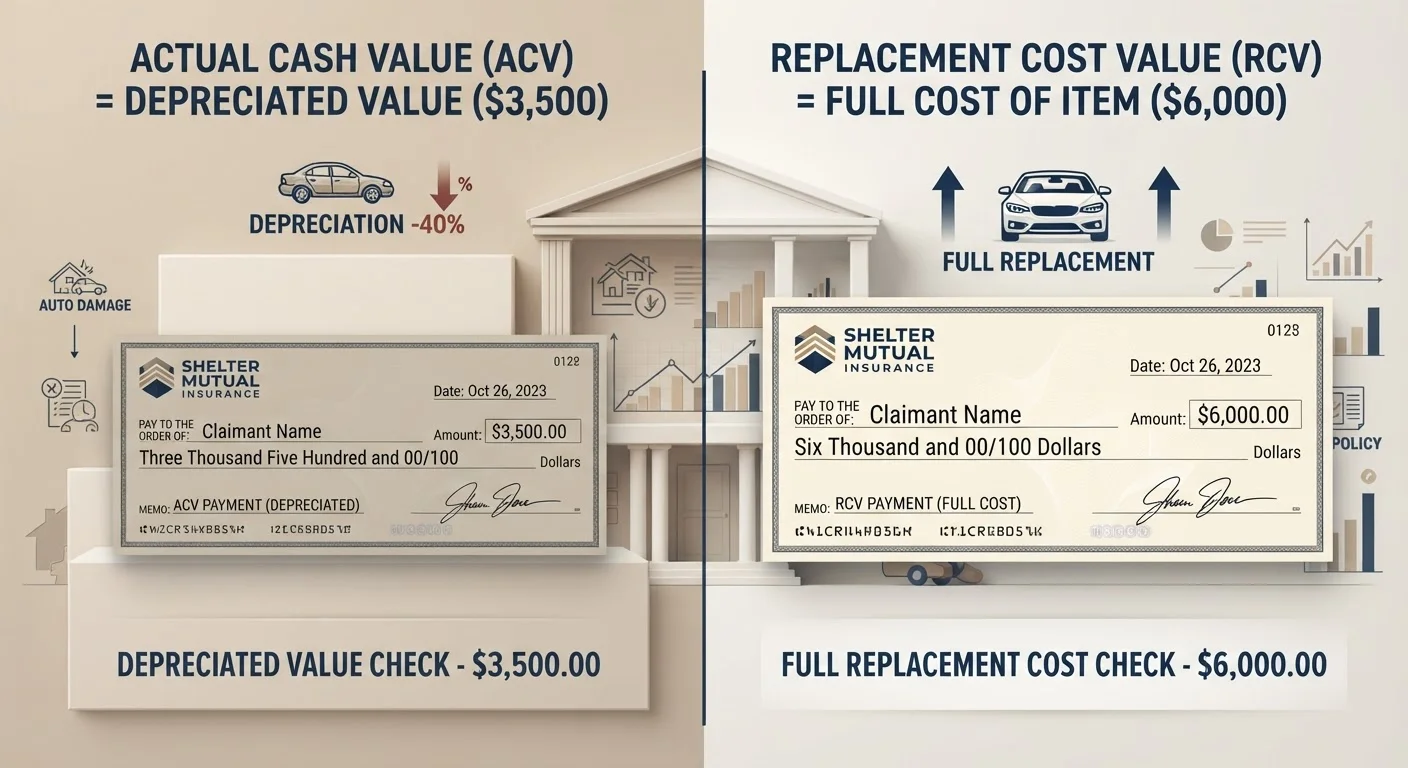
Option A
Actual Cash Value (ACV)
The depreciation-adjusted payout option.
Best for: Budget-conscious policyholders who can absorb some out-of-pocket cost after a claim or own older property.
Option B
Replacement Cost Value (RCV)
The full-replacement, no-depreciation option.
Best for: Homeowners and renters who want to fully replace lost or damaged items without covering a depreciation gap themselves.
What These Two Terms Actually Mean
When you file an insurance claim, the amount your insurer pays depends heavily on one key policy detail: how your property is valued. Two methods dominate most home and auto policies — Actual Cash Value (ACV) and Replacement Cost Value (RCV). Understanding the difference is essential before you choose a policy, not after you file a claim.
Actual Cash Value is calculated by taking what an item would cost to replace new and subtracting depreciation — the loss in value that occurs through age, wear, and obsolescence. If your five-year-old roof is damaged, an ACV policy pays what that roof is worth today, not what it costs to put a new one on.
Replacement Cost Value, by contrast, does not subtract depreciation. It pays the full cost to repair or replace the damaged property with a comparable new item at current market prices. That same damaged roof would be settled based on the actual cost to replace it — minus your deductible — regardless of its age.
These definitions apply broadly across the major coverage types found in homeowners, renters, and auto policies.
| Criterion | Actual Cash Value (ACV) | Replacement Cost Value (RCV) |
|---|---|---|
| How payout is calculated | Replacement cost minus depreciation | Full cost to replace at current prices |
| Depreciation deducted | Yes | No |
| Typical premium cost | Lower | Higher |
| Payout after major loss | Smaller — may leave a gap | Larger — covers full replacement |
| Common in auto policies | Yes — standard default | Rarely available for vehicles |
| Common in home policies | Often default for contents | Available as upgrade or endorsement |
| Best suited for | Older property, budget-focused buyers | Newer property, full-recovery priority |
How the Gap Adds Up in Practice
The financial difference between ACV and RCV can be stark. Consider a washing machine purchased for $900 several years ago. If it's destroyed in a covered event, an insurer might determine its current ACV is $300 after factoring in years of use. An ACV policy pays $300 (minus your deductible). An RCV policy pays whatever a comparable new machine costs today — potentially $1,000 or more — again minus your deductible.
Multiply that kind of gap across the contents of a home after a fire or significant water damage, and the difference in what you walk away with can reach tens of thousands of dollars.
~10–20%
Typical premium increase for RCV over ACV
Industry estimates generally place the added cost of replacement cost endorsements at roughly 10–20% more than comparable ACV coverage, though this varies by insurer and property type.
30–50%
Depreciation applied to mid-age household items
Insurers often apply substantial depreciation to items like appliances, electronics, and flooring that are several years old, significantly reducing ACV payouts compared to replacement cost.
This is why reviewing your premiums, deductibles, and claims process together — rather than any one factor in isolation — gives you a clearer picture of your policy's true value. As noted in our article on why cheaper premiums don't always mean better value, a lower monthly cost can mask significant gaps at claim time.
Where Each Method Shows Up
ACV is the default valuation method in many standard policies, particularly for personal property under homeowners and renters coverage, and for vehicles under collision and comprehensive auto coverage. If your policy doesn't explicitly state that it provides replacement cost coverage, assume it pays ACV.
RCV is typically available as an upgrade or endorsement, and it comes with a higher premium. For dwelling coverage — the part of a homeowners policy that covers the structure itself — replacement cost is more commonly included as a baseline, though this varies by insurer and policy tier. Always check your declarations page.
For auto policies, the dynamics differ. Most standard auto policies pay ACV for a totaled vehicle, meaning you receive the car's market value at the time of the loss. Understanding how collision and comprehensive auto coverage work helps clarify when ACV payouts are triggered.
Check for a 'Recoverable Depreciation' Clause
Some RCV policies pay out in two stages: an initial ACV payment is issued first, and then the withheld depreciation amount — called recoverable depreciation — is released once you complete repairs or replacements and submit documentation. If your policy works this way, you'll need to front the difference temporarily. Always ask your insurer how and when depreciation is recovered under your specific policy.
If you have a homeowners policy, also review how valuation applies separately to your dwelling and your personal property — these are distinct coverages that may carry different valuation methods. Our guide on dwelling vs. personal property coverage explains the distinction.
This article is for general informational purposes only and does not constitute personalized insurance, financial, or legal advice. Coverage terms, eligibility, and payouts vary by policy and provider. Always read your policy documents carefully and consult a licensed insurance agent or adviser for guidance specific to your situation.
The content on this site is for informational purposes only and is not a substitute for professional advice. Always consult a qualified professional for guidance specific to your situation.