

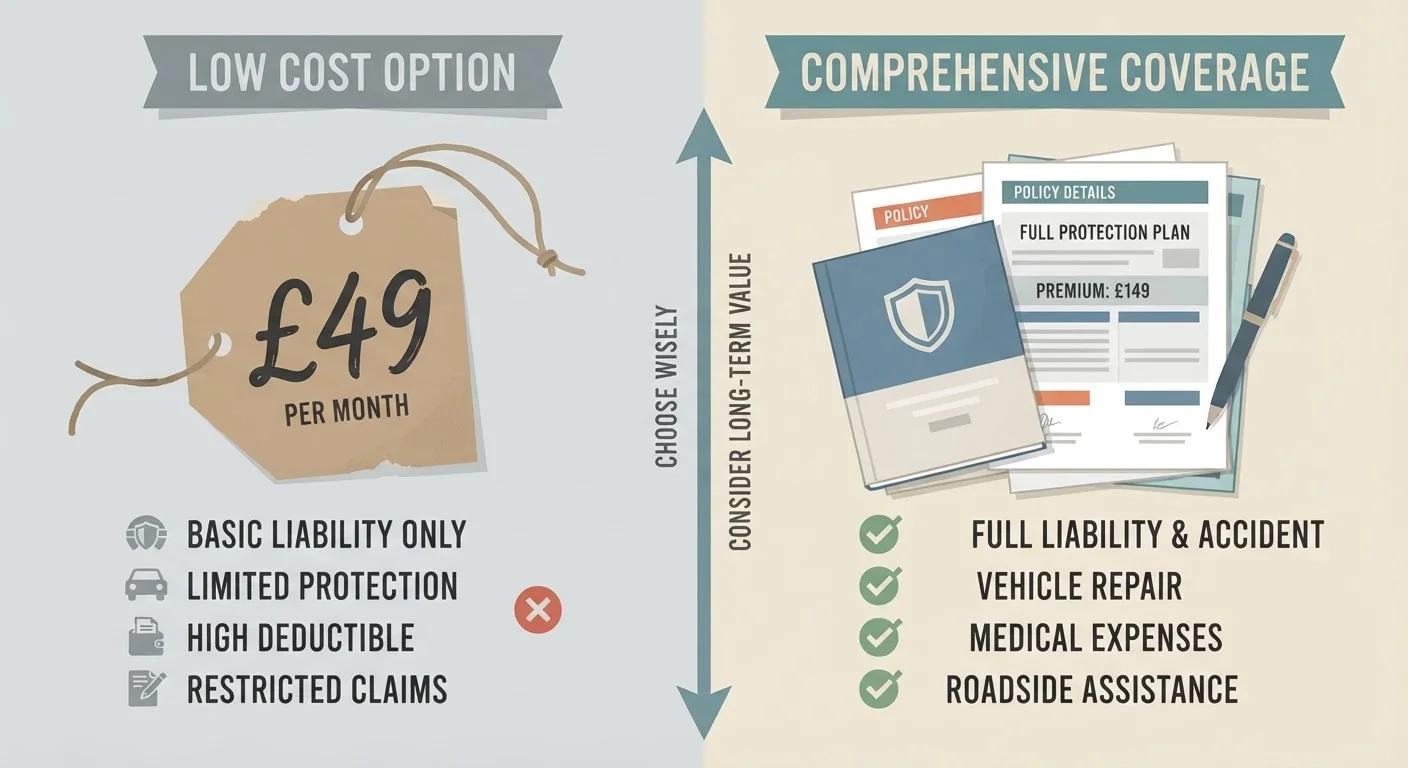
The Gap Between Price and Protection
Insurance shopping often narrows to a single question: which plan is cheapest? That instinct is understandable — premiums are recurring, predictable, and easy to compare. But a policy's real cost only becomes clear when you need to use it.
A plan with a low monthly premium may carry a high deductible, lean coverage limits, or exclusions that eliminate protection exactly when a major loss occurs. Understanding how premiums, deductibles, and out-of-pocket maximums work together is essential before you can evaluate what you're actually getting for your money. The sections below cover the most common mistakes insurance shoppers make when price becomes the only filter — and what to do differently.
This Is General Information, Not Advice
This article provides general educational information about insurance concepts. It is not personalized insurance, financial, or legal advice. Coverage terms, exclusions, and costs vary by provider, policy, and state. Always read your actual policy documents and consult a licensed insurance agent before making coverage decisions.
Common Mistakes That Cost More Than You Save
Each of the errors below tends to show up quietly — often not until a claim is filed. Recognizing them in advance gives you the opportunity to ask better questions and read policy documents with a sharper eye.
Choosing a plan based solely on the monthly premium without accounting for the deductible.
Why it happens: Premiums are the most visible number in any quote, so they naturally anchor the comparison. Most shoppers don't model what they'd owe if they actually filed a claim.
Ignoring coverage limits that leave large gaps when a serious loss occurs.
Why it happens: Policy summaries often highlight what is covered without making exclusions or sub-limits obvious. Shoppers assume that if a risk category is listed, the full loss is covered.
Overlooking the payout method — actual cash value versus replacement cost coverage.
Why it happens: The distinction isn't prominently advertised, and both options sound complete. Many policyholders only discover the difference when a claim check arrives significantly lower than expected.
Underestimating out-of-pocket costs beyond the deductible, including co-insurance and caps.
Why it happens: Shoppers focus on the deductible as the one number standing between them and full coverage, not realizing that co-insurance clauses or out-of-pocket maximums can add substantially to their exposure.
Treating two policies with identical premiums as equivalent without comparing what they cover.
Why it happens: Same price feels like same value, but insurers reach similar premium figures through different combinations of limits, exclusions, deductibles, and payout methods.
40%
Consumers who don't read policy exclusions before purchasing
Industry consumer research consistently finds a large share of policyholders are unaware of key exclusions until a claim is denied.
2–3x
Potential difference in claim payout: ACV vs. replacement cost
Depending on asset age and depreciation, actual cash value payouts can be a fraction of what replacement cost coverage would provide for the same loss.
If you're navigating the costs and claims side of insurance for the first time, it helps to understand the full picture of what you might owe before you commit to any plan.
How to Evaluate True Policy Value
Once you understand the mistakes above, a more useful evaluation framework becomes clear. Rather than comparing monthly premiums side by side, model a realistic loss scenario for each policy. Ask: if a mid-sized claim occurred, what would I actually pay out of pocket — and what would the insurer pay?
Pay particular attention to the declarations page, which summarizes your limits and deductibles, and the exclusions section, which lists what the policy will not cover. These two sections together reveal more about a policy's actual value than any marketing summary.
Low Premiums Can Signal Thin Coverage
A significantly lower premium compared to competing plans is sometimes a sign that coverage limits are narrower, the deductible is much higher, or key risks are excluded. Before assuming a cheaper plan saves you money, verify that the coverage scope matches your actual needs — not just a lower-risk profile that reduces the insurer's exposure.
For households that hold multiple policies, bundling policies can simplify coverage management — but bundling for convenience without reviewing individual policy terms can introduce the same gaps described here. Savings on premium should never substitute for a careful read of what each policy actually covers.
This article is for general informational and educational purposes only. It does not constitute personalized insurance, financial, or legal advice. Coverage details, exclusions, and costs vary significantly by provider, policy type, and state. Read your full policy documents carefully and speak with a licensed insurance agent or adviser before making any coverage decisions.
The content on this site is for informational purposes only and is not a substitute for professional advice. Always consult a qualified professional for guidance specific to your situation.