

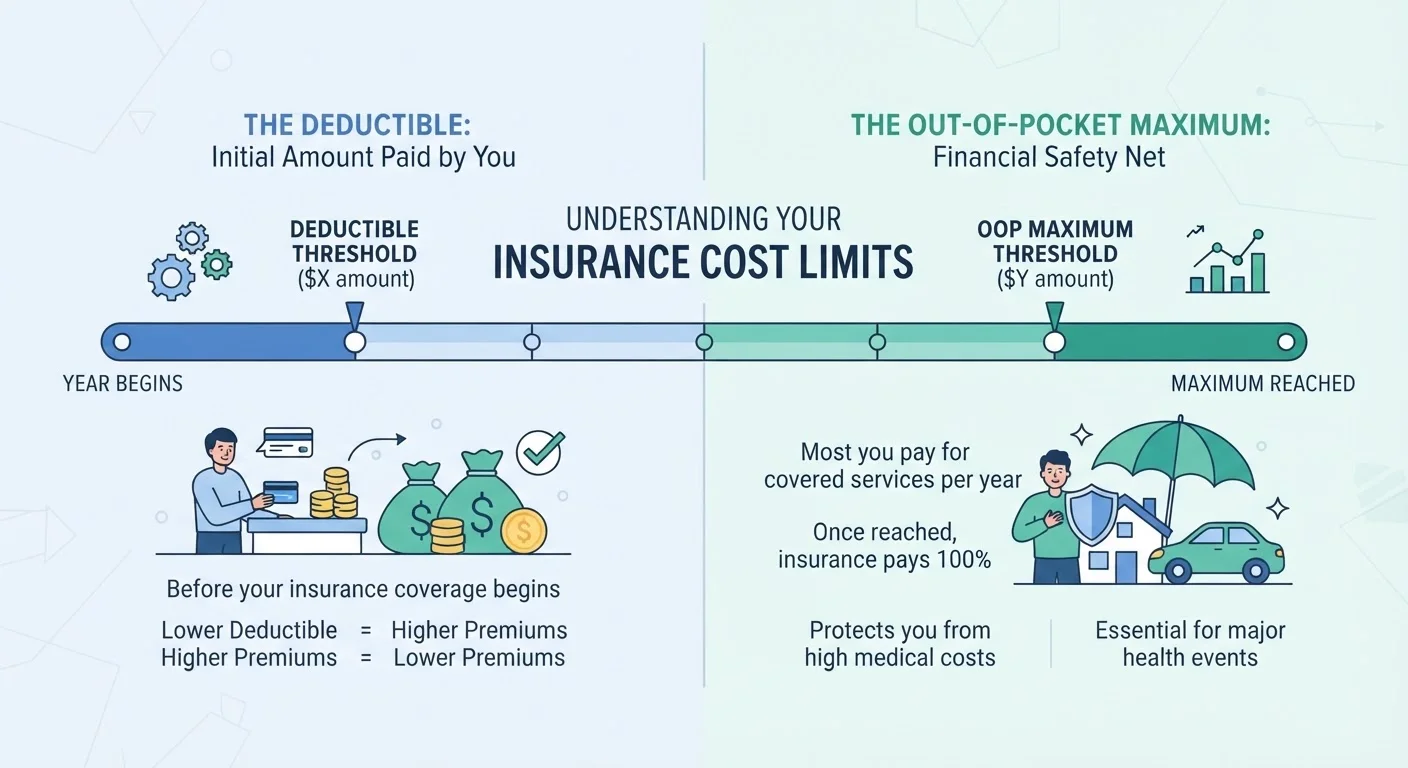
Option A
Deductible
The amount you pay before insurance begins sharing costs.
Best for: Understanding the threshold at which your insurer starts covering a share of your medical bills.
Option B
Out-of-Pocket Maximum
The ceiling on what you'll ever pay in a single plan year.
Best for: Knowing exactly when insurance absorbs 100% of your covered costs for the rest of the year.
Two Different Jobs, One Insurance Plan
When you look at a health insurance plan's cost summary, you'll usually see a deductible and an out-of-pocket maximum listed near each other. They're related, but they do completely different things.
The deductible is the dollar amount you pay out of your own pocket for covered services before your insurer contributes anything. If your deductible is $1,500, you cover the first $1,500 of eligible medical costs each plan year — then insurance kicks in.
The out-of-pocket maximum (sometimes called the out-of-pocket limit) is the absolute ceiling on what you'll spend on covered, in-network care in a plan year. After you hit that ceiling, your insurer pays 100% of covered costs for the rest of the year.
Think of it this way: the deductible is a starting line. The out-of-pocket maximum is the finish line. Between those two points, you're typically sharing costs with your insurer through coinsurance (a percentage split) or copays (fixed dollar amounts per visit). For a fuller primer on these terms, see our breakdown of premiums, deductibles, and copays.
| Criterion | Deductible | Out-of-Pocket Maximum |
|---|---|---|
| What it represents | Amount you pay before insurance shares costs | Total annual cap on your cost-sharing |
| When it applies | At the start of each plan year | After deductible + coinsurance/copays accumulate |
| What happens after you hit it | Insurer begins paying its share (coinsurance begins) | Insurer pays 100% of covered in-network costs |
| Does your premium count toward it? | No | No |
| Resets | Each plan year | Each plan year |
| Typical range (ACA marketplace plans) | $500 – $7,000+ | $2,000 – $9,450 (federal cap for 2024) |
How the Math Actually Works
Here's a simplified example to show how the two limits interact. Suppose your plan has:
- Deductible: $1,500
- Coinsurance after deductible: 20% (you pay) / 80% (insurer pays)
- Out-of-pocket maximum: $5,000
You have an unexpected hospital stay that results in $20,000 in covered charges. Here's how costs flow:
- You pay the first $1,500 — your deductible is met.
- On the remaining $18,500, you pay 20% coinsurance. That's $3,700.
- Your total so far: $1,500 + $3,500 of that coinsurance = $5,000 — your out-of-pocket maximum.
- Any remaining covered, in-network costs that plan year: $0 from you.
Notice that coinsurance payments count toward your out-of-pocket maximum. So does your deductible. What typically does not count: your monthly premium, out-of-network charges on plans that separate those limits, and costs for services your plan explicitly excludes.
$9,450
ACA individual out-of-pocket limit (2024)
The Affordable Care Act sets an annual federal ceiling on out-of-pocket maximums for marketplace-compliant individual plans; the 2024 limit is $9,450 for self-only coverage.
~1 in 4
Adults who struggle with unexpected medical bills
Kaiser Family Foundation health tracking polls consistently find roughly one in four U.S. adults report difficulty affording unexpected medical costs in a given year.
Where People Get Confused
The most common misconception is treating these two numbers as interchangeable. They're not — and confusing them can leave you financially unprepared.
Misconception 1: "Once I hit my deductible, I'm done paying." Not quite. After your deductible, you still owe coinsurance or copays until you reach your out-of-pocket maximum. Depending on your plan structure, that gap can be substantial.
Misconception 2: "My out-of-pocket maximum covers everything." The out-of-pocket limit applies only to covered, in-network services on most plans. Out-of-network care, non-covered services, and your monthly premium don't count toward it. For deeper context on how all three cost tiers work in tandem, see how premiums, deductibles, and out-of-pocket maximums interact.
Misconception 3: "A lower deductible always means lower costs." Plans with lower deductibles often carry higher out-of-pocket maximums. If you have a significant health event, you could end up spending more overall. The high-deductible vs. low-deductible trade-off is worth examining carefully before enrolling.
Family Plans Have Two Sets of Limits
If you're on a family plan, you'll usually see both individual and family deductibles and out-of-pocket maximums. An individual family member can hit their own deductible before the family deductible is met — but once the family out-of-pocket maximum is reached, the insurer covers 100% for all covered members. Read your Summary of Benefits and Coverage carefully to understand which limits apply and when.
This article is for general informational purposes only and does not constitute personalized insurance, financial, or legal advice. Coverage terms, limits, and rules vary by plan and state. Always read your actual policy documents and consult a licensed insurance agent or broker for guidance specific to your situation.
The content on this site is for informational purposes only and is not a substitute for professional advice. Always consult a qualified professional for guidance specific to your situation.