

Start here
What a Budget Actually Is (and Isn't)
Next
Step 1: Calculate Your Real Monthly Income
Then
Step 2: Map Out Your Spending Categories
When you're ready
Step 3: Choose a Budgeting Framework
Final step
Step 4: Track, Review, and Adjust
What a Budget Actually Is (and Isn't)
A budget is a written plan that tells your money where to go before you spend it. That's the entire concept. Despite a common perception that budgeting means deprivation or obsessive penny-counting, a well-designed budget actually creates freedom — because you decide in advance what matters and what doesn't.
A budget is not a moral judgment about your spending, a guarantee of financial success, or a rigid document that can never change. It is a living tool that reflects your current income, priorities, and goals. For a deeper look at terminology that often trips up first-timers, see key budgeting terms defined in plain language.
Net income
The money you actually receive after taxes and other deductions are taken out of your paycheck — what you have available to spend or save.
Fixed expense
A bill that stays the same amount each month, such as rent or a car loan payment, giving you predictability in your plan.
Variable expense
A necessary cost whose amount changes month to month — groceries and utilities are common examples — leaving you some control over the total.
Periodic expense
A cost that doesn't occur every month but is predictable — like annual insurance renewals or holiday gifts — that should be planned for by setting aside a small amount monthly.
Discretionary spending
Money spent on non-essential items and experiences — dining out, streaming services, hobbies — that you choose to purchase rather than being obligated to.
Step 1: Calculate Your Real Monthly Income
Start with your net income — the money that actually lands in your bank account after taxes and payroll deductions. Using gross (pre-tax) salary is the most common first-budget mistake and leads to plans that are impossible to follow.
- Salaried workers: Divide your annual net pay by 12, or use a recent pay stub's net amount multiplied by your pay frequency.
- Hourly or variable-income earners: Use an average of your last three months of deposits. In months where income exceeds the average, set the extra aside rather than spending it.
- Multiple income sources: Add all consistent net streams (side work, rental income) but be conservative — count only amounts you can reliably expect.
This single number — your monthly take-home income — is the ceiling for every decision that follows.
Step 2: Map Out Your Spending Categories
Pull up three months of bank and credit card statements. Group every transaction into one of three expense types:
- Fixed expenses
- Same amount due every month — rent or mortgage, loan payments, insurance premiums. These are non-negotiable in the short term.
- Variable expenses
- Necessary but fluctuating — groceries, utilities, gas. You control how much you spend within the category.
- Periodic expenses
- Infrequent but predictable — annual subscriptions, car registration, holiday gifts. Divide the annual total by 12 and treat it as a monthly line item so the expense never surprises you.
Once categorized, total each group. This gives you a realistic picture of your current spending — not an idealized version. Building savings is a natural next priority after needs are covered; why an emergency fund comes before other financial goals explains that foundational step clearly.
Don't Skip Periodic Expenses
Many first budgets fall apart because annual or semi-annual costs are forgotten. Add up all irregular bills for the year, divide by 12, and include that monthly amount as its own category. When the bill arrives, the money is already waiting.
Step 3: Choose a Budgeting Framework
A framework gives your categories structure and percentage targets. Two approaches work well for beginners:
The 50/30/20 Rule
Allocate 50% of net income to needs (housing, food, utilities, transportation), 30% to wants (dining out, entertainment, hobbies), and 20% to savings and debt repayment. It's a flexible starting point — not a universal prescription. Adjust the percentages if your housing costs or debt load push the numbers in a different direction.
Zero-Based Budgeting
Every dollar of income is assigned a job until the balance reaches zero — not because you've spent it all, but because savings and investments count as assignments too. This method demands more attention but leaves nothing unaccounted for. For a full breakdown, see how zero-based budgeting works and whether it fits your life.
Choose whichever framework you'll actually use. The most sophisticated method abandoned in week two produces worse outcomes than the simplest method followed consistently.
Percentages Are Starting Points, Not Rules
The 50/30/20 split is a widely cited guideline, not a regulation. Readers in high cost-of-living areas may find that housing alone consumes 40% or more of take-home pay. Adjust category targets to reflect your actual situation, and revisit them as income or expenses change over time.
Step 4: Track, Review, and Adjust
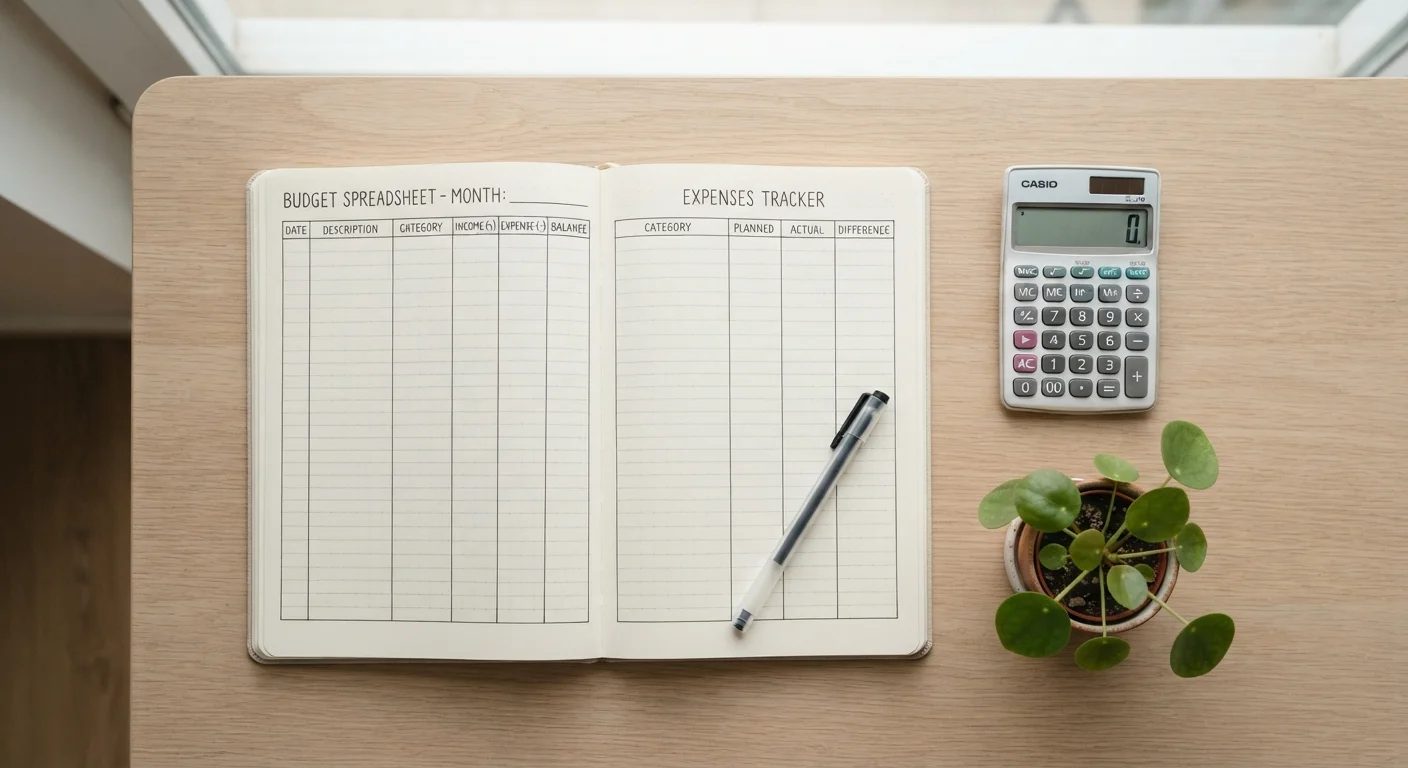
Writing a budget is only half the work. Tracking actual spending against your plan is what creates change. You don't need elaborate software — a notes app, a spreadsheet, or a paper ledger all work. What matters is checking in at least once a month.
At each monthly review, ask three questions: Did I stay within each category? If not, why — a one-time event or a pattern? Does my plan need a permanent adjustment, or was it an anomaly? Over time, this process becomes quick and largely automatic. For a structured way to approach each new month, a monthly budget reset checklist provides a practical template.
Budgeting also connects to how you use credit and banking products. Understanding how spending habits interact with your credit profile is covered in the Credit & Banking hub, and strategies for building savings alongside debt management are explored in the Saving & Debt hub.
For readers who want to go deeper after this introduction, the complete personal budgeting roadmap covers frameworks, tracking methods, and long-term habit formation in detail.
This article is for general informational and educational purposes only and does not constitute personalized financial advice. Consult a qualified financial professional for guidance specific to your circumstances.
Frequently Asked Questions
You can begin budgeting at any income level — there is no minimum. A budget is simply a plan for the money you already have. Even a modest income benefits from a clear spending plan.
Many beginners find the 50/30/20 rule easiest to start with — allocating 50% of take-home pay to needs, 30% to wants, and 20% to savings or debt repayment. It requires minimal tracking and gives clear guardrails. Adjust the percentages as your situation changes.
Either works — the best tool is the one you'll actually use consistently. Spreadsheets offer full control and are free, while budgeting apps automate transaction importing. Start simple and switch tools only if your current method isn't sticking.
First, identify which expenses are truly fixed and which are flexible. Look for variable categories like dining, subscriptions, or entertainment where spending can be reduced. If the gap is large, consider whether income can be supplemented; consult a nonprofit credit counselor if debt is a factor.
A brief monthly review is the standard starting point. Spending patterns shift, and a quick check at month's end helps you catch overspending early and adjust category amounts before they become habits.
No — an imperfect budget used consistently beats a perfect budget abandoned after one month. Expect your first draft to need adjustments. The goal is progress toward awareness and intention, not flawless precision from day one.
The content on this site is for informational purposes only and is not a substitute for professional advice. Always consult a qualified professional for guidance specific to your situation.