

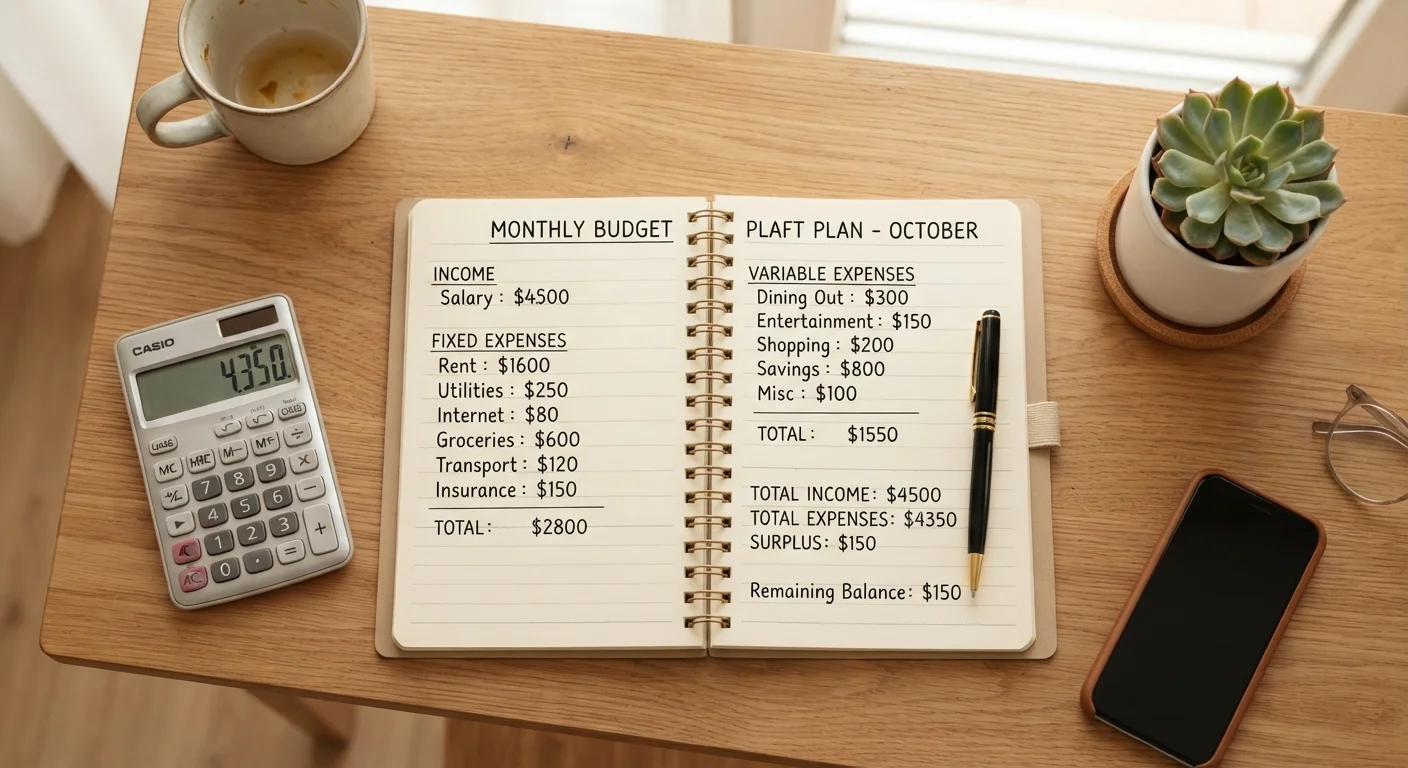
Why Budgeting Actually Works
Budgeting is not about restriction — it is about intention. When you decide in advance where each dollar goes, you replace financial anxiety with a concrete plan. Research in behavioral economics consistently finds that people who write down spending goals are more likely to follow through on them than those who rely on memory or habit alone.
The practical impact is significant. A budget creates a feedback loop: you plan, you spend, you compare, and you adjust. Over time, that loop builds financial self-awareness that no app or spreadsheet can substitute. It also protects against lifestyle inflation — the gradual, almost invisible expansion of spending that follows income increases.
This guide walks you through every stage, from auditing your baseline numbers to embedding budgeting as a monthly routine. If you are brand new to the process, our plain-language introduction to building your first budget is a helpful companion to this roadmap.
~32%
Americans with a written monthly budget
Surveys by the National Foundation for Credit Counseling have consistently found fewer than one-third of U.S. adults maintain a detailed household budget.
3–6 months
Recommended emergency fund coverage
Most personal finance guidance, including from the Consumer Financial Protection Bureau, recommends covering three to six months of essential expenses.
20%
Savings target in the 50/30/20 framework
The 50/30/20 guideline, widely referenced in personal finance education, reserves 20% of net income for savings and debt repayment.
Know Your Numbers Before You Plan
No budget can be realistic without an honest baseline. Before choosing a framework or setting targets, you need two figures: your verified net income and a genuine picture of where your money currently goes.
Net income is what lands in your bank account after taxes, benefits deductions, and retirement contributions — not your gross salary. If your income varies month to month, use a conservative average from the past three to six months.
Current spending is where most people underestimate. Pull three months of bank and credit card statements and categorize every transaction. This exercise typically surfaces subscriptions that were forgotten, dining costs that exceed what people assumed, and irregular expenses — car registration, annual insurance premiums — that rarely appear in a monthly mental tally.
For a structured way to complete this step, see our step-by-step expense audit guide. Once you have a clear baseline, you are ready to build a plan that reflects reality rather than aspiration.
Don't Skip the Baseline Audit
Building a budget from an assumed spending picture rather than actual data is one of the most common reasons budgets fail within the first month. Most households discover at least one significant spending category they had mentally underestimated. Completing even a single month of honest transaction review dramatically improves the accuracy — and the staying power — of any budget you build afterward.
Choosing a Budgeting Framework
Frameworks give structure to your numbers. The three most widely used approaches each suit a different financial personality:
- 50/30/20: Allocate roughly 50% of net income to needs, 30% to wants, and 20% to savings and debt repayment. It is intuitive and forgiving — ideal for people who want guardrails without granular tracking.
- Zero-based budgeting: Every dollar of income is assigned a job, so income minus outgoings equals zero. Nothing is unaccounted for. This method demands more time but rewards it with precision, making it effective for people aggressively paying down debt or saving toward a specific goal.
- Pay-yourself-first: Savings and investment contributions are automated immediately after each paycheck arrives, and the remainder is spent freely. It is the lowest-friction approach for people who struggle with discipline but have stable, predictable expenses.
No framework is universally superior. The one most likely to work is the one you will actually maintain. Our detailed comparison article — five budgeting frameworks compared — walks through each structure's trade-offs side by side.
Start with your three highest-spending variable categories and set limits only for those. Trying to control every line item at once is a reliable path to abandoning the budget entirely.
Behavior change research consistently shows that narrowing the focus of new habits increases follow-through rates compared to attempting comprehensive overhauls simultaneously.
Build a small 'buffer' category — even $25 to $50 per month — for genuinely unexpected minor expenses. When surprises have a designated place, they stop feeling like budget failures.
Budgets that leave no room for randomness break down at the first unexpected purchase, which conditions people to view budgeting as impractical rather than as a flexible tool.
Tracking Methods That Fit Real Life
A budget on paper is only a plan. Tracking transforms it into a practice. The method you choose matters less than how consistently you use it.
Spreadsheets offer complete customization and cost nothing. A simple template with income, fixed expenses, variable categories, and a running total is enough for most households. The downside is manual entry, which requires discipline.
Dedicated budgeting apps connect to bank accounts and categorize transactions automatically, reducing friction. They are useful if manual entry becomes the obstacle that makes you abandon the habit entirely. Evaluate any app's data-sharing practices and privacy policy before connecting financial accounts.
Envelope method (cash or digital): Money for each spending category is physically or digitally separated at the start of the month. When the envelope is empty, spending in that category stops. It is highly effective for discretionary categories like dining and entertainment where overspending is common.
Weekly Check-Ins Take Less Time Than You Think
Set a recurring five-minute calendar reminder each week to review your spending against your budget categories. Catching a $40 overspend weekly is far easier to correct than discovering a $200 overspend at month-end. Consistency at a small scale is what builds the long-term habit.
Whatever method you choose, check in at least once a week. A five-minute weekly review — comparing actual spending to your plan — catches problems while they are still small.
Turning a Budget Into a Lasting Habit
Most people build a budget once, follow it for a few weeks, and abandon it when an unexpected expense disrupts the plan. The missing piece is a monthly reset ritual.
At the start of each month, review last month's actuals against your plan. Identify one or two categories where spending drifted, and decide whether your budget needs adjusting or your behavior does — both are valid responses. Update your plan for any known irregular expenses in the coming month. This process takes fifteen to thirty minutes and prevents the slow drift that derails financial progress.
Building in small, explicit savings goals also sustains motivation. Earmarking money toward a named goal — a travel fund, a car repair buffer, an emergency fund — makes the constraint feel purposeful rather than punitive. For more on linking budgeting to broader savings and debt goals, explore our saving and debt guidance hub.
Finally, treat your budget as a living document. Life changes — income rises, expenses shift, priorities evolve. A budget that is reviewed and revised regularly is far more durable than one treated as a fixed formula. Use our monthly budget reset checklist to keep your plan current and actionable each month.
“A budget is telling your money where to go instead of wondering where it went.”
— Dave Ramsey, Personal finance author and radio host
This article is for general informational and educational purposes only and does not constitute personalized financial advice. Consult a qualified financial professional for guidance specific to your situation.
The content on this site is for informational purposes only and is not a substitute for professional advice. Always consult a qualified professional for guidance specific to your situation.