

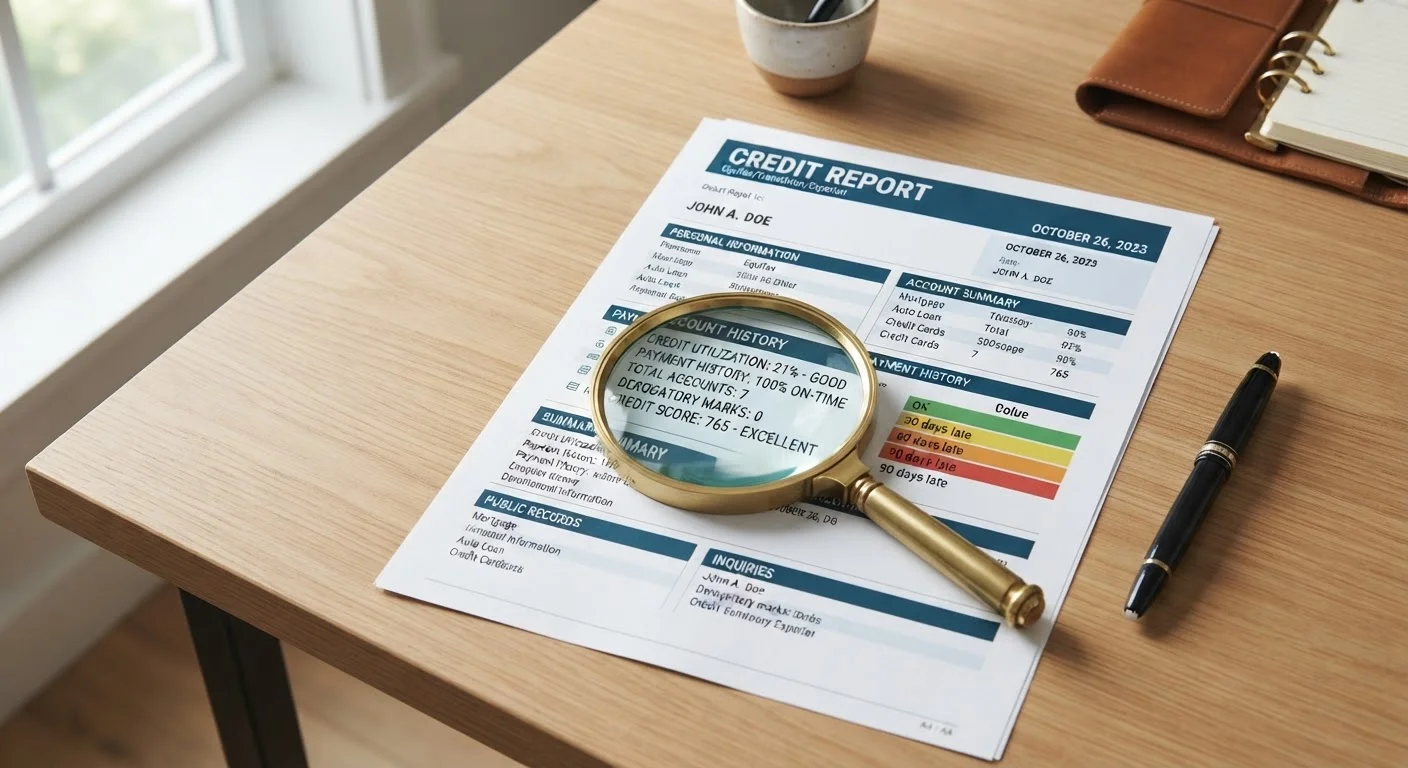
Why Credit Report Language Matters
When a lender, landlord, or employer pulls your credit report, they're reading a document filled with industry-specific terminology. If you can't read that same document fluently, you're at a disadvantage when making decisions about loans, disputes, or financial planning. This glossary decodes the terms you're most likely to encounter — no financial background required.
For a broader foundation, see our complete credit and banking overview, which covers how credit scores are calculated and how the U.S. credit system works end to end.
| Number of major U.S. credit bureaus | 3 (Equifax, Experian, TransUnion) (Consumer Financial Protection Bureau) |
| How long most negative items remain on a report | Up to 7 years (Fair Credit Reporting Act (FCRA)) |
| How long Chapter 7 bankruptcy stays on a report | Up to 10 years (Fair Credit Reporting Act (FCRA)) |
| Free annual credit reports available to consumers | 1 per bureau per year (minimum) (AnnualCreditReport.com, mandated by FCRA) |
| Typical days before a missed payment is reported | 30 days past due date (General creditor practice; varies by lender) |
Core Terms: Account Status and History
These terms describe the current standing and payment history of individual accounts listed on your report.
Charge-off
A charge-off occurs when a creditor writes off a debt as a loss after the borrower has gone a significant period — typically 180 days — without making a payment. Despite the name, the debt is not forgiven and the borrower still legally owes it.
Derogatory mark
A derogatory mark is any negative item on a credit report, such as a late payment, charge-off, collection, or bankruptcy. These entries signal elevated risk to lenders and can lower credit scores.
Account age / Length of credit history
This refers to how long your credit accounts have been open, including the age of your oldest account, your newest account, and the average age of all accounts. A longer credit history is generally viewed positively by scoring models.
Payment status
Payment status indicates the current standing of an account — for example, 'current,' '30 days past due,' '60 days past due,' or 'charged off.' It reflects whether you're meeting your repayment obligations.
Revolving account
A revolving account is a type of credit line, such as a credit card or home equity line of credit, where you can borrow up to a set limit, repay it, and borrow again. Your balance and minimum payment vary each month.
Installment account
An installment account involves borrowing a fixed sum and repaying it in equal, scheduled payments over a set term. Auto loans and mortgages are common examples.
Hard inquiry
A hard inquiry is a formal review of your credit report triggered when you apply for new credit, such as a loan or credit card. Multiple hard inquiries in a short period can modestly lower your credit score.
Soft inquiry
A soft inquiry is a credit check that does not affect your score. Examples include checking your own credit report, pre-qualification checks by lenders, and background checks by employers.
Credit limit
The credit limit is the maximum amount a lender allows you to borrow on a revolving account. Exceeding this limit can result in fees and may negatively affect your credit score.
Charge-off balance
The charge-off balance is the amount still owed on an account after the creditor has written it off as a loss. This outstanding balance may be pursued by the original creditor or sold to a collection agency.
Delinquency
Delinquency refers to the failure to make a required payment by its due date. Credit reports typically note delinquencies in time intervals: 30, 60, 90, or 120+ days past due.
Credit utilization ratio
The credit utilization ratio is the percentage of your available revolving credit that you are currently using. It is calculated by dividing your total revolving balances by your total revolving credit limits.
If you spot inaccurate account statuses on your report, understanding the dispute process is essential. Our article on disputing a credit report error walks through the federal process step by step.
Inquiries, Utilization, and Score Factors
Beyond account history, your credit report tracks how often lenders check your credit and how much of your available credit you're using. These factors directly influence your credit score.
Credit utilization ratio is the percentage of your total revolving credit limit that you're currently using. For example, a $2,000 balance on a card with a $10,000 limit represents a 20% utilization rate. Lower utilization is generally viewed more favorably by scoring models.
Credit checks are categorized as either hard or soft inquiries. Hard vs. soft inquiries affect your score differently — a hard inquiry typically occurs when you apply for new credit and may temporarily lower your score, while a soft inquiry (such as checking your own report) does not.
You're Entitled to Free Annual Credit Reports
Under the Fair Credit Reporting Act, consumers are entitled to at least one free credit report per year from each of the three major bureaus — Equifax, Experian, and TransUnion — available through AnnualCreditReport.com. Reviewing all three reports periodically helps you catch inaccuracies early. Your reports show account history and inquiries but do not include your credit score.
Public Records and Collections
Some of the most impactful entries on a credit report come from public records or accounts sent to collections. These terms signal significant credit events to lenders.
Collections refers to an account that a creditor has transferred to a collection agency after the borrower has failed to make payments for an extended period — often 120 to 180 days past due. A collections entry can remain on your report for up to seven years from the original delinquency date.
Bankruptcy is a legal process that allows individuals to seek relief from debts they cannot repay. Chapter 7 bankruptcies may remain on a credit report for up to ten years; Chapter 13 bankruptcies for up to seven years.
For broader context on managing debt-related terminology, see our debt and savings glossary, which covers related concepts like amortization and APR.
This article is for general informational and educational purposes only and does not constitute personalized financial or legal advice. Consult a licensed financial adviser or attorney for guidance specific to your situation.
The content on this site is for informational purposes only and is not a substitute for professional advice. Always consult a qualified professional for guidance specific to your situation.