

The Five Factors Behind the Number
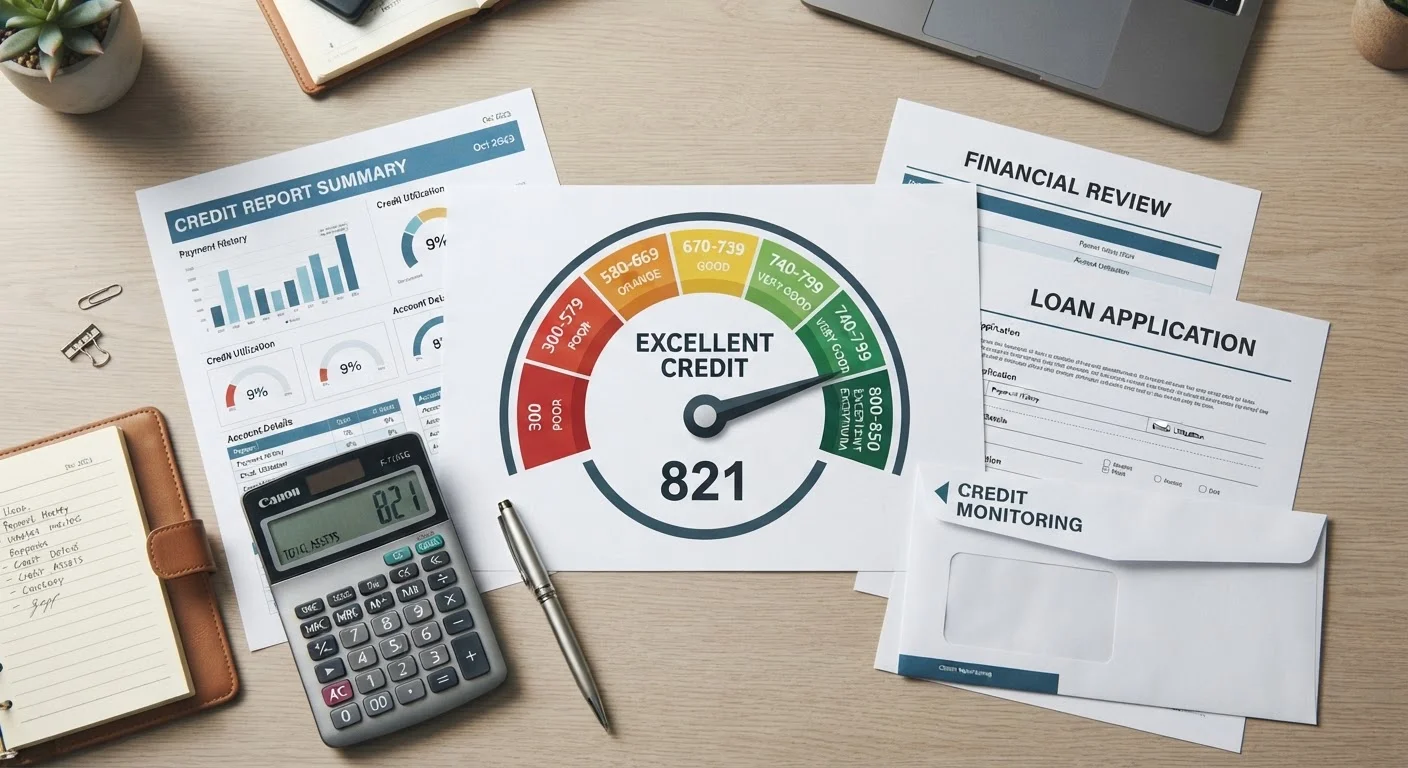
A FICO® Score is built from five specific categories of information drawn from your credit report. Understanding their relative weight explains why some actions move your score dramatically while others barely register.
- Payment history (35%): Whether you've paid past credit accounts on time. A single missed payment can cause a meaningful drop, especially on an otherwise clean file.
- Amounts owed / credit utilization (30%): How much of your available revolving credit you're currently using. Keeping utilization below 30% is widely recommended; below 10% tends to produce the strongest scores.
- Length of credit history (15%): The age of your oldest account, your newest account, and the average age across all accounts. Longer histories generally help.
- Credit mix (10%): Whether you have experience with different types of credit — credit cards, installment loans, mortgages — rather than just one category.
- New credit (10%): Recent applications for new credit, reflected as hard inquiries, and how many new accounts you've recently opened.
Notice what's absent from this list. Scores say nothing about how well you budget, whether you carry an emergency fund, or how successfully you invest — all of which matter deeply to your actual financial wellbeing.
35%
Weight of payment history in FICO® Score
According to FICO, payment history is the single largest factor in a standard FICO® Score calculation.
300–850
Standard FICO® Score range
FICO® Scores use this scale; most lenders consider scores above 670 to be in the 'good' range or better.
3
Major US credit bureaus reporting independently
Equifax, Experian, and TransUnion each maintain separate files, which is why your score may differ across bureaus.
What a Credit Score Genuinely Cannot Tell Lenders
The score is specifically engineered to predict one thing: the probability that you'll fall 90 or more days behind on a debt obligation within the next 24 months. That's a useful but narrow measure. Here's what it leaves out:
Income and Wealth
A high earner who consistently misses credit card payments can have a lower score than someone earning a modest income who pays every bill on time. Net worth — including savings accounts, retirement funds, or real estate equity — does not appear in a credit file at all.
Employment and Career Stability
Whether you are employed, self-employed, or between jobs is invisible to the scoring model. Lenders often ask for employment information separately during the application process, but it's evaluated independently of your score.
Spending Habits and Cash Management
A person who lives well within their means but uses cash or debit exclusively may build little or no credit history — producing a thin or unscorable file — despite exemplary financial discipline. The score can only see what flows through credit products.
Build Credit Without Overspending
You don't need to carry a balance to build a strong credit history. Charging a small, routine expense to a credit card each month and paying the full statement balance by the due date demonstrates responsible usage while avoiding interest charges. Consistency over time — not the size of your balances — is what drives score improvement.
This gap matters most when consumers assume a high credit score signals comprehensive financial health. It doesn't — and conflating the two can lead to overconfidence. For a deeper look at common misconceptions, see credit score myths that trip up even careful consumers.
Why the Score Still Matters — and Its Real-World Limits
Even with those limitations, your credit score has tangible financial consequences. It influences the interest rates you're offered on mortgages, auto loans, and credit cards. Some landlords use it in rental decisions, and certain employers review credit reports — though not the score itself — for roles involving financial responsibility. Insurers in many states may also use credit-based insurance scores when pricing auto or homeowners policies.
At the same time, a score is a backward-looking snapshot. It reflects what you did with credit in the past, not what your future financial behavior will be. Two people with identical scores may carry very different levels of actual financial risk because of factors the model never sees.
The parallel to other data-driven summaries is instructive. Just as gadget spec sheets can mislead by highlighting impressive-sounding numbers that don't reflect real-world performance, a credit score highlights one dimension of a much more complex picture. Treating it as the whole story — on either side — leads to poor decisions.
This article is for general informational and educational purposes only and does not constitute personalized financial, credit, or legal advice. Consult a qualified financial professional regarding your specific situation.
Frequently Asked Questions
Under the FICO® model, scores of 670–739 are generally considered 'good,' while 740–799 is 'very good' and 800 or above is 'exceptional.' Scores below 580 are typically considered poor. Lenders set their own thresholds, so these ranges are guidelines, not guarantees.
No. Income is not a factor in any standard credit score calculation. Lenders may ask for income information separately when you apply for credit, but it plays no role in the score itself.
Your credit score is recalculated each time it is requested, based on whatever information is in your credit file at that moment. Because creditors typically report account activity once a month, your score can shift from month to month as new data arrives.
No. Checking your own score is a 'soft inquiry' and has no effect on your score. Only 'hard inquiries' — generated when a lender pulls your file after a credit application — can cause a small, temporary dip.
The three major credit bureaus — Equifax, Experian, and TransUnion — collect data independently. Not every creditor reports to all three, so the information in each file may differ slightly, producing different calculated scores.
No. A credit score measures one narrow thing: how consistently you've used credit products in the past. It says nothing about your savings habits, investments, budgeting skills, or ability to manage cash.
The content on this site is for informational purposes only and is not a substitute for professional advice. Always consult a qualified professional for guidance specific to your situation.