

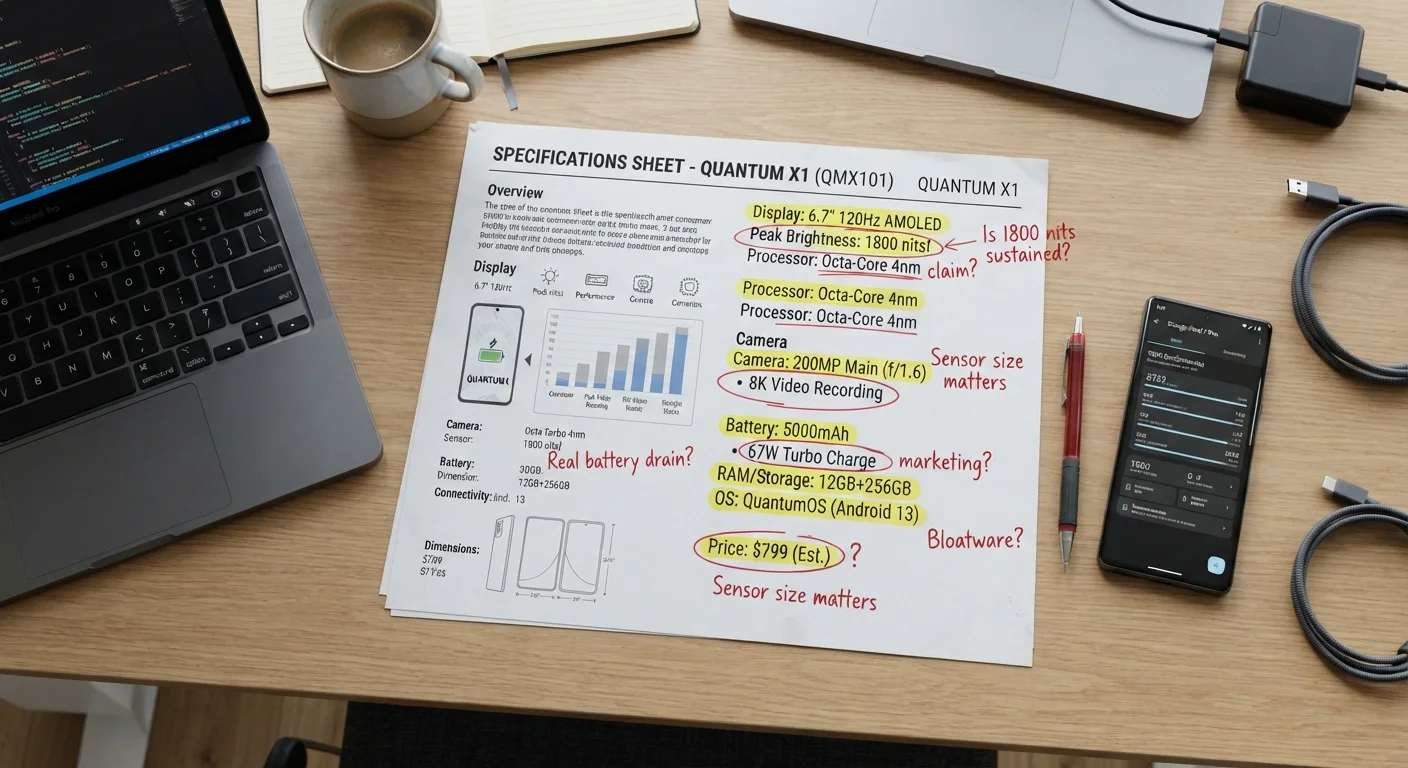
Why Spec Sheets Are Written for Marketing, Not Consumers
Every consumer gadget arrives with a spec sheet — a table of numbers and labels designed to communicate capability at a glance. The problem is that manufacturers write these documents to win the attention of browsers, not to give a complete picture of daily performance. Numbers are measured under controlled, favorable conditions that rarely mirror how you actually use a device.
This isn't necessarily dishonest, but it is selective. A phone rated for "up to 30 hours" of battery life likely achieves that figure at minimal screen brightness with cellular data disabled. A camera labeled "200MP" may produce sharp images only under specific software processing conditions. Understanding that gap — between the number on the box and the experience in your hand — is the foundation of smarter consumer decision-making. The same critical reading that helps with financial documents applies equally to gadget specs.
Specs Are Measured in Labs, Not Living Rooms
Manufacturers follow standardized testing protocols that optimize for the highest possible output — maximum brightness, lowest load, ideal temperature. These conditions rarely reflect mixed real-world use, which involves background apps, variable lighting, and continuous wireless connectivity. Treat every headline spec as a ceiling, not a typical result.
Specs That Sound Big but Rarely Predict Performance
Some figures dominate marketing because they're easy to compare, not because they matter most. Knowing which ones to discount lets you focus on what actually counts.
Discount megapixel counts as a primary quality indicator for cameras.
Sensor size, aperture, and image processing software have far more influence on photo quality than raw pixel count. A larger sensor with fewer megapixels typically outperforms a smaller sensor with more in low-light conditions, which is where most cameras struggle.
Treat peak processor clock speed as a marketing number, not a performance guarantee.
Clock speed (measured in GHz) only tells you how fast a chip can run under ideal conditions for brief periods. Thermal design, power delivery, and sustained load handling determine the performance you experience during actual tasks.
Approach advertised battery life with significant skepticism.
Battery life figures are almost always measured at low screen brightness with minimal background activity — conditions that don't reflect typical use. Screen-on time at standard brightness is the more useful metric, and it's rarely featured prominently.
Pay close attention to RAM capacity and storage type, not just storage size.
More RAM directly improves multitasking and reduces the frequency of apps reloading in the background. Storage type — whether it uses UFS (Universal Flash Storage) or slower eMMC — determines how quickly files load and apps launch, making it a meaningful predictor of daily responsiveness.
Look for independent sustained benchmark results rather than peak scores.
Manufacturers often highlight peak benchmark scores achieved in brief bursts. Sustained performance tests — run over 15 to 30 minutes — reveal whether a device maintains speed under real workloads or slows significantly due to heat management.
The Numbers That Actually Reflect Real-World Use
While flashy specs mislead, a handful of figures genuinely correlate with the experience you'll have day-to-day. These are worth examining carefully — and cross-referencing against independent tests.
Display specifications deserve special attention. Resolution matters less than panel type and color accuracy, and the relationship between refresh rate and actual smoothness depends heavily on the GPU driving the screen. The consumer's field guide to display specs breaks down these relationships in plain language. Similarly, if you're comparing devices for reading, e-reader vs. tablet comparisons go well beyond megapixels and storage figures.
~40%
Typical battery life gap vs. advertised claims
Independent device testing by consumer technology publications consistently finds real-world battery performance falls 30–50% below manufacturer-advertised figures under typical use conditions.
60–70%
Sustained performance vs. peak benchmark score
Third-party sustained load tests frequently show that high-end mobile processors deliver only 60–70% of their peak benchmark performance after 15–20 minutes of continuous intensive use due to thermal throttling.
How to Verify What a Spec Sheet Won't Tell You
The most reliable way to cut through spec inflation is to consult sources that test devices under realistic conditions. Independent reviewers measure actual battery drain during video playback, capture real-world camera samples under mixed lighting, and run sustained performance benchmarks that expose thermal throttling — a process where processors automatically slow down to manage heat, reducing the speed you actually experience.
Look specifically for sustained performance scores (not peak scores), battery tests at standard brightness settings (typically 200 nits), and camera comparisons that include low-light and motion scenarios. These details rarely appear in manufacturer materials but routinely appear in thorough third-party evaluations.
The same skepticism applies across categories. Fitness tracker specs — calorie burn, heart rate accuracy, sleep staging — are especially prone to overpromising, because the underlying measurements involve significant algorithmic estimation. And just as advertised internet speeds rarely reflect what reaches your devices, understanding how speed claims are framed helps you apply the same critical lens to connectivity purchases.
Once you've made a purchase based on realistic expectations, protecting that investment matters. Practical maintenance habits can significantly extend the useful life of any device, regardless of its original specifications.
Build a Two-Source Rule for Any Device You're Researching
Before forming a conclusion about a device's real-world performance, consult at least two independent sources that test under realistic conditions — not manufacturer press materials or retailer descriptions. Look for reviewers who publish their testing methodology, including brightness settings, workload types, and room temperature, so you can judge how those conditions compare to your own intended use.
The content on this site is for informational purposes only and is not a substitute for professional advice. Always consult a qualified professional for guidance specific to your situation.