

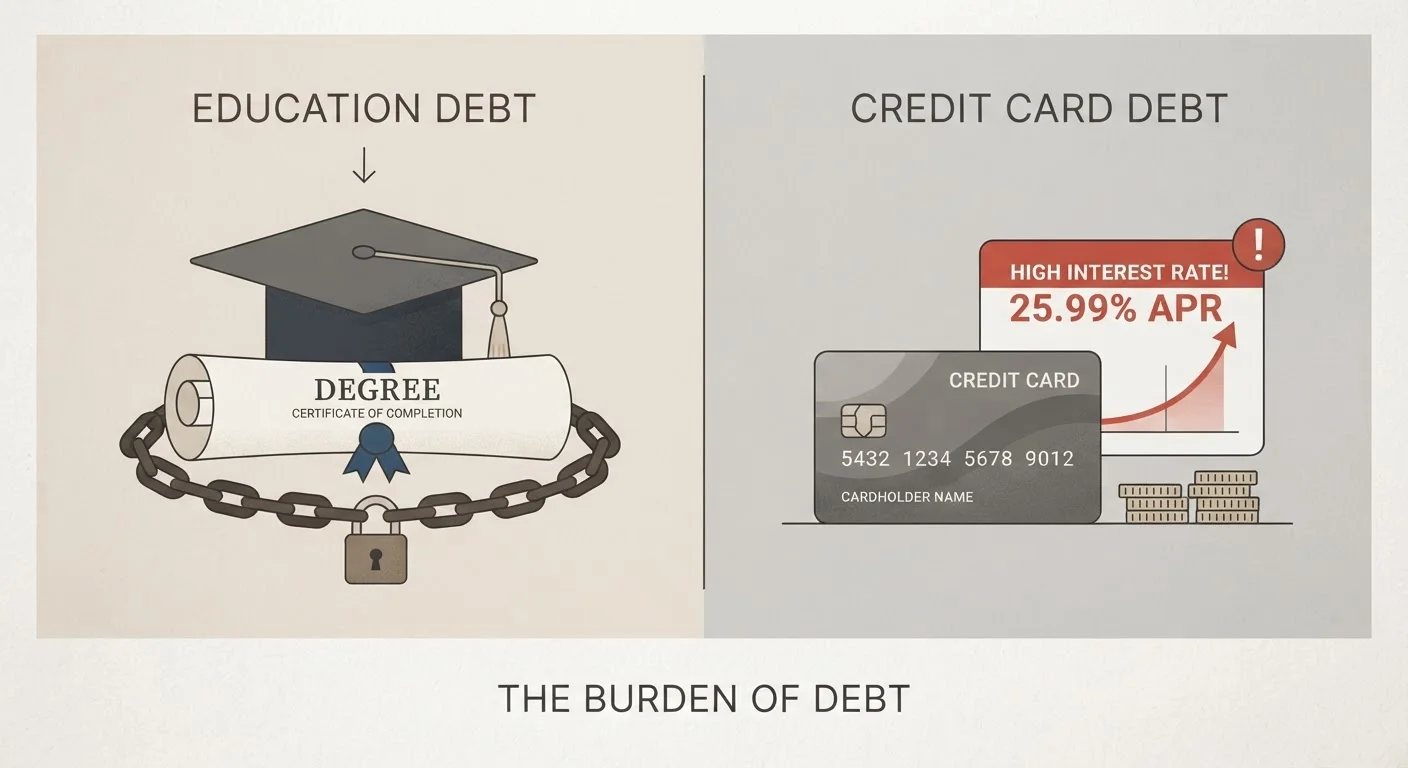
Where the 'Good Debt / Bad Debt' Idea Comes From
The distinction between good and bad debt has been a staple of personal finance advice for decades. The basic idea: debt used to acquire something that grows in value or generates income — a home, a degree, a business — is "good." Debt used to fund consumption — vacations, restaurant meals, electronics — is "bad." It's a tidy framework, and it has some real logic behind it. But it also does a lot of work with very few words, and that shorthand can steer people toward expensive mistakes.
The myth-busting pairs below examine the most common assumptions baked into this framework — where they hold, where they crack, and what a more honest accounting looks like. For a broader look at how financial myths quietly extend debt timelines, see our piece on common money myths that keep people in debt longer.
Myth
Student loans are always good debt because education increases your earning potential.
Fact
Student loan debt can be beneficial, but only when the degree and career path realistically support repayment — which is far from guaranteed.
The assumption that any degree automatically produces earnings that justify the debt ignores wide variation in program costs, field of study, and job market conditions. A six-figure loan for a credential with modest income prospects can become a long-term financial burden rather than a launching pad. The key variables are the interest rate, total loan balance, and a realistic salary trajectory — not education as a category. Borrowing for education deserves the same cost-benefit scrutiny as any other major financial decision.
Myth
A mortgage is inherently good debt because you're building equity.
Fact
Mortgages can build wealth, but only if the purchase price, interest rate, and holding period align — equity is not guaranteed.
Home values do not always rise. Buyers who purchased at market peaks, carried high-interest-rate mortgages, or needed to sell within a few years sometimes lost money despite paying down principal. Additionally, homeownership comes with property taxes, insurance, maintenance, and opportunity costs that pure equity figures don't capture. A mortgage can absolutely be a sound financial move — but classifying it as "good" simply because it's a mortgage bypasses important analysis about affordability and local market conditions.
Myth
Credit card debt is always bad debt, no matter the situation.
Fact
Credit card balances are expensive and should generally be avoided, but the label 'bad' can oversimplify situations where short-term borrowing served a real need.
High interest rates — often between 20% and 30% for many cards — make revolving credit card debt genuinely costly, and carrying balances long-term is almost always financially damaging. That said, framing all credit card use as moral failure or categorical failure can lead people to ignore the underlying pressures — income gaps, medical emergencies, job loss — that drove the debt in the first place. A more productive focus is on the interest rate and a realistic plan to eliminate the balance, rather than guilt over the category itself.
Myth
Good debt works for you automatically, so it doesn't need urgent attention.
Fact
Even low-interest debt consumes cash flow and carries risk; 'good' debt still needs active management and periodic review.
Labelling debt as "good" can create a false sense of security that delays attention. A 5% mortgage on a house you can comfortably afford is very different from a 5% mortgage that leaves you with no liquid savings. Any debt that consumes a significant share of your income reduces your ability to save, invest, or weather financial shocks. The interest rate alone doesn't determine impact — the size of the payment relative to your income and savings does. Regularly reviewing all outstanding debt, regardless of its "type," is a sound financial habit.
Rethinking Debt as a Tool, Not a Label
Once the simple labels fall away, what's left is a more useful question: does this debt, at this rate, for this amount, serve my financial life right now? That question accounts for the interest cost, the opportunity cost of those monthly payments, and whether the underlying asset or benefit is likely to deliver on its promise.
~$1.77T
Total U.S. student loan debt outstanding
According to Federal Reserve data, student loan balances represent one of the largest categories of household debt in the United States.
20%–30%
Typical credit card APR range
The Consumer Financial Protection Bureau has documented average credit card interest rates that make revolving balances among the most expensive common forms of consumer debt.
Debt repayment strategy matters just as much as which debt you carry. If you're weighing how to pay down multiple balances efficiently, understanding the mechanics of each approach helps — our guide to the debt avalanche and debt snowball methods breaks down both strategies clearly. And before committing to an aggressive payoff plan, it's worth running through a financial readiness checklist to make sure the foundations are in place.
Debt Consolidation Is Not a Reset Button
Rolling multiple debts into one loan can simplify payments and potentially lower your interest rate — but it doesn't erase the underlying balance. Without changes to spending habits or income, consolidation can result in accumulating new debt on top of the consolidated loan. Our guide on consolidating debt: potential benefits and real trade-offs covers what to consider before pursuing this path.
For many households, the real challenge isn't choosing between saving and repaying debt — it's doing both at once. That balance is achievable, though the right structure depends on your interest rates, income stability, and emergency cushion. Our guide on paying off debt and saving simultaneously walks through when doing both makes sense and how to start.
This article is for general informational and educational purposes only and does not constitute personalised financial or legal advice. Consult a qualified financial professional before making decisions about your own debt or financial situation.
The content on this site is for informational purposes only and is not a substitute for professional advice. Always consult a qualified professional for guidance specific to your situation.