

The Problem Both Technologies Are Solving
Sound is a pressure wave. When those waves are generated by sources you didn't choose — a plane engine, an open-plan office, traffic — they arrive at your ears alongside whatever audio you're actually trying to hear. The listener's challenge is straightforward: reduce the unwanted signal without degrading the desired one.
Two fundamentally different engineering approaches address this. Passive isolation treats the ear itself as a sealed chamber, keeping external sound out through physical barriers. Active noise cancellation processes sound electronically and introduces a countermeasure. Understanding the difference helps explain why a pair of headphones might perform well in one environment and fall short in another.
20–30 dB
Typical ANC reduction in low-frequency noise
Acoustic engineers generally cite 20–30 decibels of reduction as achievable with well-implemented ANC in controlled conditions for steady low-frequency sounds.
15–25 dB
Passive isolation range for well-fitted over-ear headphones
Studies of consumer over-ear headphone designs show passive attenuation typically falls in the 15–25 dB range, varying with ear cup material and seal quality.
~0.1 ms
Processing delay target for effective ANC
For ANC anti-phase signals to cancel incoming noise effectively, the system must generate a response within roughly a tenth of a millisecond — a key engineering constraint for ANC designers.
How Passive Isolation Works
Passive isolation — sometimes called passive noise reduction or PNR — requires no electronics at all. It works the same way thick walls, earplugs, or industrial ear protection work: by placing a dense, sound-absorbing physical barrier between the noise source and the ear.
In headphones, passive isolation comes from two main design elements. First, the materials used in ear cups and pads: dense foam, leather or synthetic leather, and structured plastic housings all resist sound transmission. Second, the seal created by the fit: over-ear headphones that fully encircle the outer ear (circumaural designs) and in-ear headphones with soft tips that seat inside the ear canal both create a physical barrier that attenuates incoming sound.
Passive isolation is particularly effective at mid- and high-frequency sounds — voices, cymbals, traffic noise above a certain pitch. Lower frequencies, with their longer wavelengths, are harder to block passively and tend to require thicker or denser materials to meaningfully reduce. This is a physical limitation of the approach, not a flaw in any specific product.
Fit Is the Foundation of Passive Isolation
Before assuming passive isolation is underperforming, check the fit. With in-ear headphones, switching to a different size tip can dramatically change how much sound is blocked. With over-ear models, glasses frames, hair, or ear shape can break the seal and reduce isolation substantially. Getting the fit right costs nothing and often makes a meaningful difference.
How Active Noise Cancellation Works
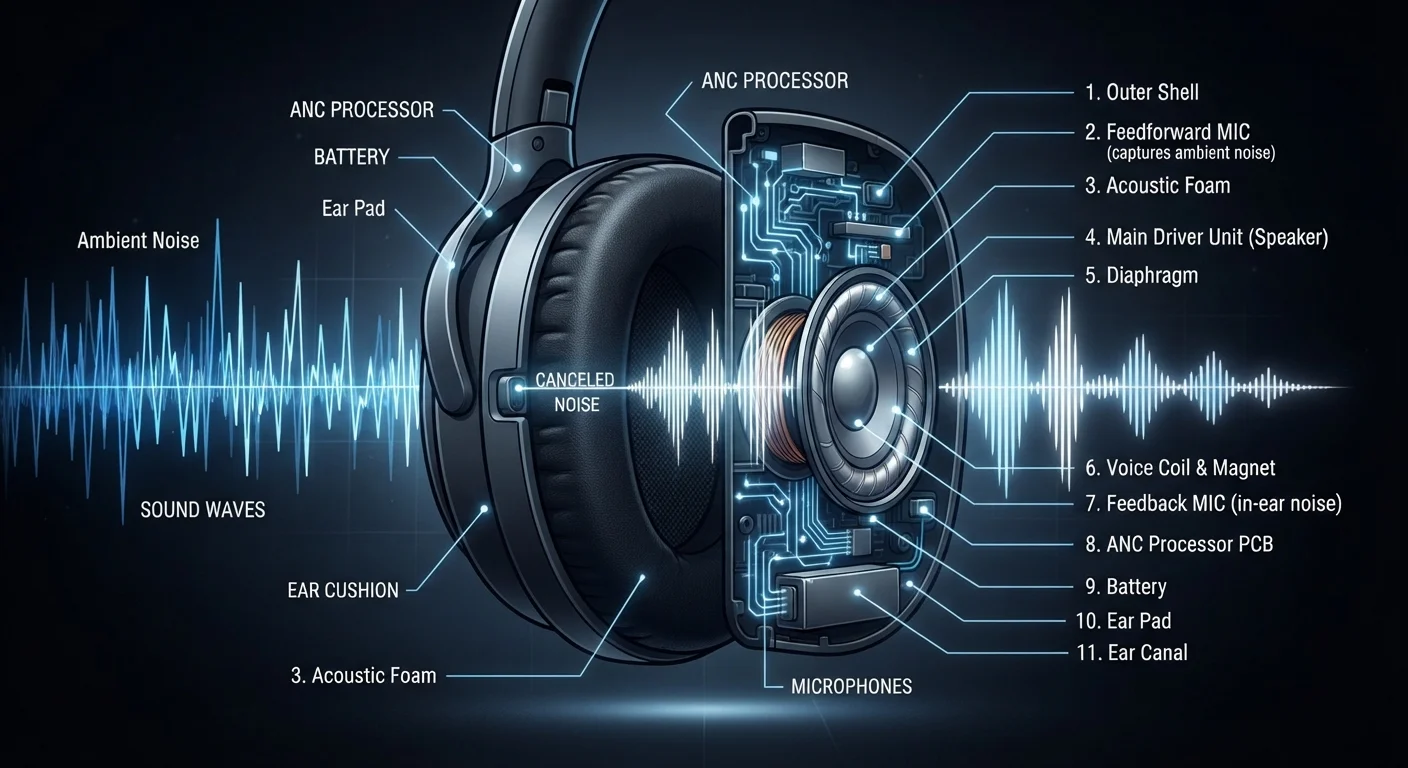
Active noise cancellation (ANC) uses a process called destructive interference. Every headphone with ANC contains at least one small microphone — often positioned on the outer surface of the ear cup — that continuously samples the ambient sound reaching the headphones.
An onboard processor analyzes that captured audio and generates a mirror-image signal: one that is identical in frequency and amplitude to the incoming noise, but inverted in phase. When two identical sounds that are perfectly out of phase combine, they cancel each other out. The processor continuously adjusts this anti-noise signal in real time as the ambient environment changes.
ANC is most effective on sounds that are predictable and consistent — low-frequency, steady-state noise like aircraft engines, train hum, or HVAC systems. These are relatively easy to model and counter electronically. Sudden, variable, or high-frequency sounds (like a conversation or a sharp sound) change too quickly for current ANC circuitry to track with full accuracy, which is why ANC is less effective against speech than against engine rumble. For more on how electronic interference affects wireless headphone performance, see our guide to Bluetooth audio dropout.
Feedforward, Feedback, and Hybrid ANC
Not all ANC implementations are the same. The position and number of microphones determine how the system captures and responds to noise.
- Feedforward ANC places the microphone on the outside of the ear cup, sampling ambient sound before it enters the ear. This approach can respond to a wider range of frequencies but must anticipate noise rather than react to it.
- Feedback ANC places the microphone inside the ear cup, closer to the ear. It measures the sound that has already entered the enclosure and corrects any residual noise. This is more precise but works across a narrower frequency range.
- Hybrid ANC uses both microphone positions simultaneously, combining the benefits of each approach. Many high-performing ANC headphones use this configuration.
The processing speed and algorithm quality behind these microphones also matter significantly — the time between sampling and signal generation must be extremely short to be effective. If you're comparing wired versus wireless headphone types and how each handles latency, our overview of wired vs. wireless earbuds covers those trade-offs in detail.
When Each Approach Has the Advantage
Neither technology is universally superior. Their performance advantages align with specific use environments.
ANC has a clear edge in environments with persistent low-frequency noise — long-haul flights, commuter trains, open offices with HVAC systems running. It actively reduces sound that passive materials struggle to block. The trade-off is battery dependency: ANC requires power, adds weight due to circuitry, and can introduce a faint background hiss audible in very quiet environments.
Passive isolation performs consistently regardless of battery status, adds no electronic artifacts, and is the more reliable barrier against mid-to-high frequency sounds. It depends entirely on how well a pair of headphones physically fits and seals. A poorly fitting ear tip or ear cup eliminates much of the benefit regardless of how well-built the headphones are otherwise.
Most over-ear headphones with ANC use both in tandem: passive isolation from the ear cup design provides a baseline reduction, and ANC handles residual low-frequency noise. This layered approach generally outperforms either method used alone.
“The physics of noise cancellation haven't changed — destructive interference is a well-understood phenomenon. What keeps improving is the speed and accuracy of the algorithms doing the prediction, especially as sounds become more complex.”
— Dr. Julius Smith, Professor of Music and Electrical Engineering, Stanford University Center for Computer Research in Music and Acoustics
Frequently Asked Questions
No. ANC requires battery power to run its microphones and processing circuitry. When the battery dies or ANC is switched off, only the passive isolation from the ear cups remains. Some headphones still allow audio playback in passive mode, though sound quality may differ.
ANC tends to excel in airplane cabins because jet engine drone is a consistent, low-frequency sound — exactly what ANC handles best. Passive isolation also helps, and many over-ear ANC headphones use both together for maximum reduction in that environment.
Mid- and high-frequency sounds like voices are harder for ANC to cancel because they vary rapidly and unpredictably. Passive isolation, which physically blocks sound, is generally more effective against speech than ANC electronics are.
Some listeners notice a subtle change in sound signature when ANC is active, including a slight pressure sensation or minor tonal shift. These effects vary by headphone design and have become less pronounced in newer generations of ANC technology.
In-ear headphones (earbuds with silicone or foam tips) can achieve strong passive isolation by forming a physical seal in the ear canal. Over-ear headphones rely on the cushion seal around the outer ear. The actual performance depends on fit quality in both cases.
A faint hiss in ANC mode is common and results from the electronic circuitry that generates the anti-phase signal. It is generally more noticeable in very quiet environments. The intensity varies by model and is separate from audio playback quality.
The content on this site is for informational purposes only and is not a substitute for professional advice. Always consult a qualified professional for guidance specific to your situation.