

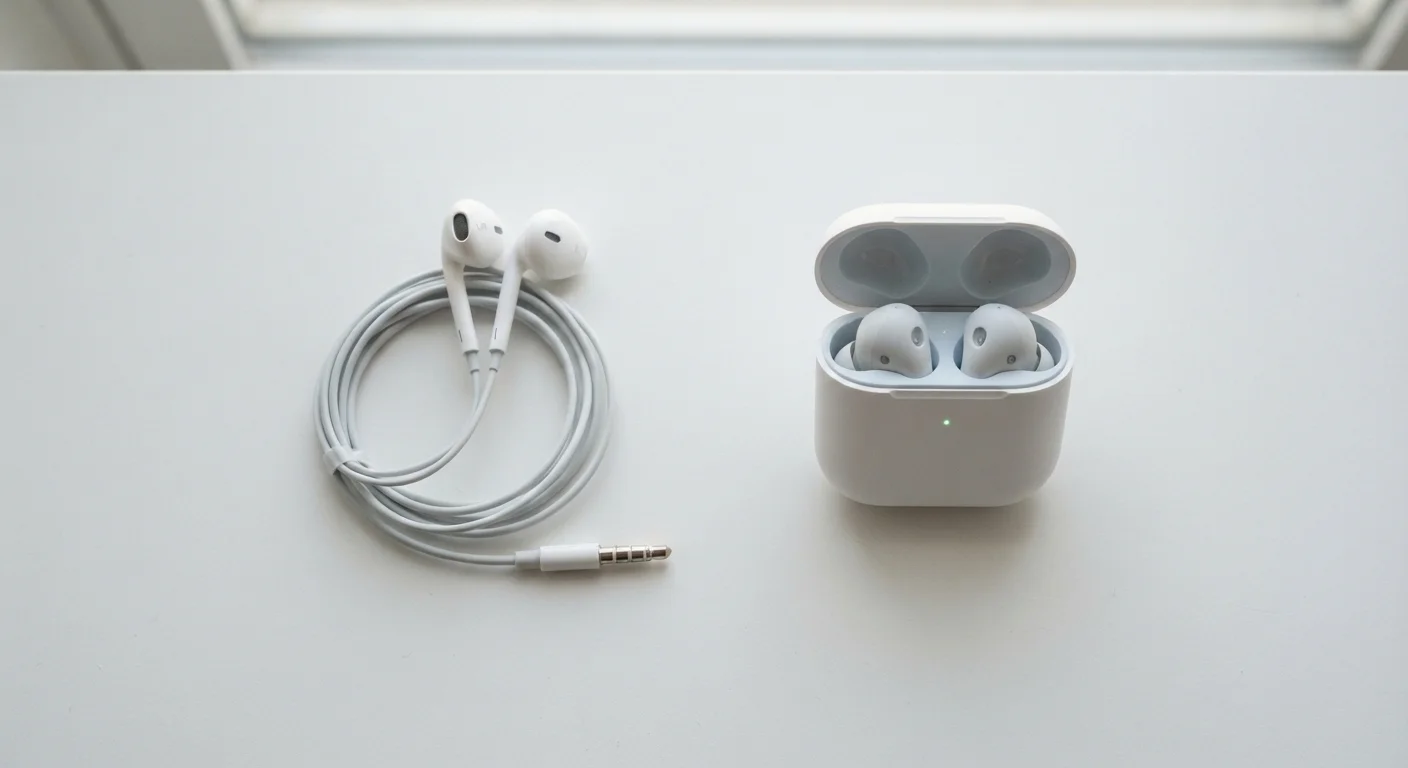
Option A
Wired Earbuds
The reliable, zero-latency audio workhorse.
Best for: Listeners who prioritize consistent audio quality, gaming, or professional use and don't mind a physical tether.
Option B
Wireless Earbuds
The cable-free, feature-rich modern choice.
Best for: Active users and commuters who value freedom of movement, call features, and on-device controls over absolute audio fidelity.
The Latency Gap: More Consequential Than Most Realize
Latency — the delay between a sound being produced and reaching your ears — is where wired and wireless earbuds differ most sharply. A wired connection transmits audio as an analog or digital signal with effectively no perceptible delay, typically under 5 milliseconds. Wireless earbuds using Bluetooth must compress, transmit, and decompress audio, a process that adds latency.
The degree of that delay depends heavily on which Bluetooth audio codec is in use. Standard SBC can introduce 150–200ms of delay, which is visibly out of sync when watching video. More advanced codecs like aptX Low Latency or LC3 (used in Bluetooth LE Audio) push that delay below 40ms — approaching, but not matching, wired performance. The problem is that both the transmitting device and the earbuds must support the same codec for it to apply.
For gaming or video editing, where audio-visual sync is critical, wired earbuds remain the more dependable option. For casual music listening, the latency difference is largely imperceptible. See also: how latency shapes your digital experience — a principle that applies well beyond internet connections.
| Criterion | Wired Earbuds | Wireless Earbuds |
|---|---|---|
| Audio Latency | Under 5ms (imperceptible) | 40–200ms (codec-dependent) |
| Battery Required | None | Yes — daily to every few days |
| Audio Quality Ceiling | Uncompressed analog signal | Codec-limited; LDAC reaches near-lossless |
| Active Noise Cancellation | Rarely available | Common in mid-to-upper tier models |
| Interference Risk | None | Possible in crowded 2.4 GHz environments |
| Device Compatibility | Universal via 3.5mm or USB-C | Broad, but requires Bluetooth pairing |
| Smart Features | Minimal or none | Touch controls, voice assistants, EQ |
| Freedom of Movement | Limited by cable length | Full range of motion |
Battery Life, Reliability, and the Charging Dependency
Wired earbuds have no battery. That single fact removes an entire category of failure. You plug them in and they work — no charging cases to keep topped up, no mid-session power warnings, no degraded battery capacity after two years of charge cycles.
Wireless earbuds, by contrast, carry rechargeable lithium-ion batteries that must be charged regularly. Most true wireless models offer between four and eight hours of playback per charge, with the case adding two to four additional charges. Battery health also degrades over time; a pair that lasts six hours when new might drop to four hours after 18–24 months of regular use, a characteristic common to all lithium-ion devices.
4–8 hrs
Typical wireless earbud playback per charge
Most true wireless earbuds on the market offer between four and eight hours of continuous playback before requiring a return to the charging case.
~20%
Estimated battery capacity loss over 2 years
Lithium-ion batteries in consumer electronics typically lose a meaningful portion of their original charge capacity after 300–500 full charge cycles, a range most daily users reach within two years.
990 kbps
Maximum LDAC Bluetooth audio bitrate
Sony's LDAC codec, now an Android open standard, can transmit audio at up to 990 kbps — significantly higher than the 328 kbps ceiling of standard SBC.
This matters most for commuters and travelers who use earbuds throughout the day without reliable access to a charging source. Wireless earbuds also carry software complexity — firmware updates, pairing memory management, and connection protocols that can introduce bugs wired connections never face. If your wireless earbuds experience audio dropouts, Bluetooth dropout has several common causes worth understanding before assuming hardware failure.
Audio Quality: The Gap Has Narrowed, But Hasn't Closed
Marketing language often overstates the audio quality of wireless earbuds and understates wired performance at equivalent price points. In practice, a wired analog connection carries audio without the lossy compression required by most Bluetooth codecs. Whether that difference is audible depends on the codec, the source material, and the listener.
High-resolution Bluetooth codecs like LDAC (developed by Sony and now part of the Android open standard) can transmit audio at up to 990 kbps — far higher than older SBC's 328 kbps ceiling. For most listeners with compressed streaming audio (typically 128–320 kbps), the codec ceiling is rarely the limiting factor. The driver quality and ear-tip seal tend to matter more to perceived sound than the wired-versus-wireless distinction alone.
Where wired earbuds maintain a clear edge is in professional or semi-professional contexts: recording monitoring, critical mixing, or high-resolution audio playback where every bit of signal fidelity matters. For everyday listening, the practical difference is modest. That said, the way isolation affects perceived audio quality is worth understanding too — a poor seal undermines any earbud, wired or wireless.
Features, Convenience, and What Each Format Trades Away
Wireless earbuds have evolved into small computers worn in the ear. Features like active noise cancellation (ANC), transparency modes, touch controls, voice assistant integration, multipoint pairing (connecting to two devices simultaneously), and real-time EQ adjustment are almost exclusively found in wireless models. Wired earbuds, by design, carry no onboard processing power, so these features are architecturally unavailable to them.
Wired earbuds, in return, offer simplicity that wireless can't replicate: universal compatibility via a 3.5mm jack or USB-C, no pairing process, no software app required, and no firmware to update. They also avoid one increasingly relevant concern — RF signal management. Wireless earbuds share the 2.4 GHz spectrum with Wi-Fi routers, microwave ovens, and other Bluetooth devices. In crowded wireless environments, interference can cause dropouts that wired earbuds never experience.
Wireless Spectrum Congestion Is a Real Factor
Bluetooth operates in the same 2.4 GHz frequency band used by most Wi-Fi routers, cordless phones, and other wireless devices. In dense environments — apartments, offices, or crowded public spaces — interference can cause audio dropouts that are unrelated to earbud quality. Some wireless earbuds support the 5 GHz band or proprietary RF protocols to reduce this effect, but Bluetooth remains the dominant standard. If you experience frequent dropouts, the environment may be the cause rather than a defective product.
The convenience trade-off also extends to device compatibility. Many modern laptops and smartphones have removed the 3.5mm headphone jack, which means wired earbuds may require a USB-C or Lightning adapter — adding a small but real friction point that wireless connections sidestep entirely. The broader parallel to wired versus wireless debates in connectivity is worth noting: cables still hold meaningful advantages in specific scenarios, even when wireless has become the default.
The content on this site is for informational purposes only and is not a substitute for professional advice. Always consult a qualified professional for guidance specific to your situation.