

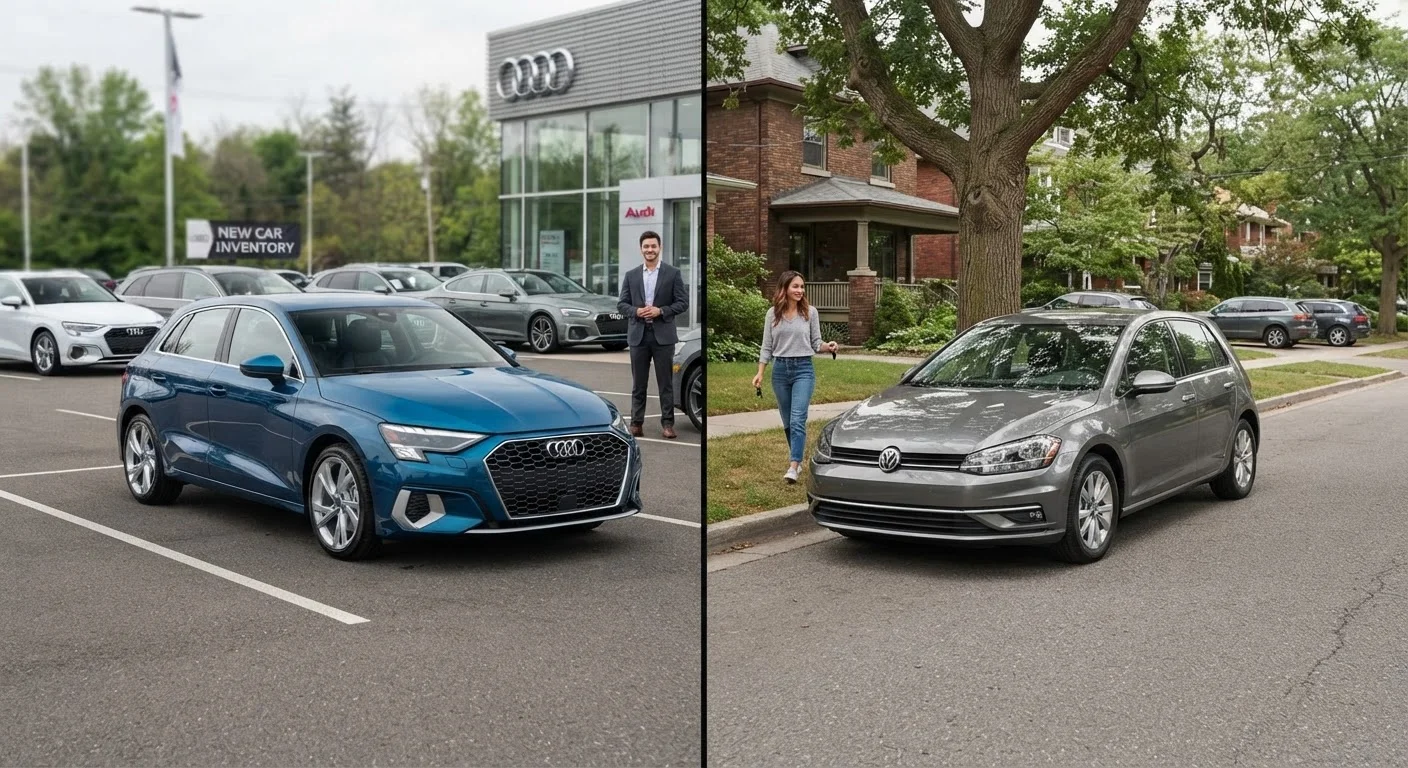
Option A
New Car
The full-warranty, zero-history, higher-cost choice.
Best for: Buyers who prioritize manufacturer warranty coverage, the latest safety technology, and predictable near-term maintenance costs.
Option B
Used Car
The depreciation-adjusted, budget-conscious alternative.
Best for: Buyers who want lower purchase prices and reduced depreciation exposure, and who are comfortable verifying a vehicle's history.
The Depreciation Reality: Where the Money Actually Goes
Depreciation is the largest single cost most car owners never see as a line item - and it's where the new-vs.-used decision has the most financial weight. A new vehicle can lose roughly 15-20% of its value in the first year alone, with the steepest drop often occurring the moment it leaves the lot. Over five years, many vehicles retain only 40-60% of their original purchase price, though this varies widely by make, segment, and market conditions.
When you buy used, you're effectively letting a prior owner absorb that initial depreciation curve. That's a genuine financial advantage. A two- or three-year-old vehicle in good condition may offer similar reliability to a new model at a meaningfully lower price point.
That said, depreciation isn't purely a loss - it's also a reflection of how long you plan to own the vehicle. If you tend to trade in every few years, buying new exposes you to the sharpest part of the depreciation slope. If you're a long-term keeper, the per-year cost of depreciation on a new car levels out considerably. For a broader look at what long-term ownership actually involves, see our in-depth ownership comparison.
| Criterion | New Car | Used Car |
|---|---|---|
| Purchase Price | Higher - full retail | Lower - post-depreciation |
| Depreciation Exposure | High in early years | Lower - prior owner absorbed it |
| Financing Rates | Often lower; promo rates available | Typically higher by 1-4 points |
| Warranty Coverage | Full manufacturer warranty | Varies; may be expired or CPO |
| Insurance Cost | Generally higher premiums | Often lower premiums |
| Safety Technology | Latest driver-assist systems | Depends on model year |
| Vehicle History | None - starts clean | Must be verified via report/inspection |
| Selection | Current model year only | Wide range of ages and trims |
Financing, Insurance, and the Hidden Cost Layers
Purchase price is only part of the monthly ownership equation. Financing terms and insurance premiums can shift the calculus significantly.
New cars generally qualify for lower interest rates - manufacturers sometimes offer promotional financing rates that used-car buyers can't access. However, the loan amount on a new vehicle is typically larger, so even a lower rate can produce a higher monthly payment. Used-car loans often carry rates one to several percentage points higher, depending on the lender, the vehicle's age, and your credit profile.
On the insurance side, a newer vehicle usually costs more to insure because its replacement value is higher. Comprehensive and collision coverage - which most lenders require on financed vehicles - are priced to reflect that value. A used vehicle in the same category will often carry lower premiums, though this depends heavily on the vehicle's safety ratings, repair costs, and theft statistics.
~20%
Typical first-year depreciation on a new vehicle
Industry estimates from automotive valuation services suggest new cars can lose roughly 15-20% of their value within the first 12 months of ownership.
1-4 pts
Average rate premium on used-car loans vs. new
Consumer Financial Protection Bureau data and lender surveys consistently show used-vehicle loans carry higher average interest rates than new-vehicle loans.
3-7 yrs
Typical manufacturer powertrain warranty on new cars
Most major automakers selling in the U.S. market offer powertrain warranty coverage ranging from 3 to 10 years, with 5-7 years being a common benchmark.
If you're working through how a vehicle purchase fits into your broader budget, the Budgeting Basics hub offers practical frameworks for evaluating large recurring expenses.
Reliability, Warranty Coverage, and Certified Pre-Owned
One of the most common concerns about used vehicles is reliability - and it's a legitimate one, though not an absolute barrier. The key variables are the vehicle's service history, mileage, and how it was used. A pre-purchase inspection by an independent mechanic is one of the most cost-effective steps a used-car buyer can take.
New vehicles come with manufacturer warranties that cover most major repairs for a defined period. If something fails within warranty, your out-of-pocket cost is minimal. That predictability has real value, particularly for buyers who aren't comfortable with repair uncertainty.
Certified Pre-Owned (CPO) programs - offered by most major manufacturers through franchised dealers - represent a middle ground. CPO vehicles must meet specific age, mileage, and condition standards, and they come with extended warranty coverage. They cost more than comparable non-certified used vehicles, but less than new. If reliability assurance matters and budget is a factor, CPO is worth evaluating seriously. For more on what high-mileage ownership involves once you're past the warranty window, see our guide on owning an older high-mileage vehicle.
Once you've decided between new and used, the next question is where to buy. The private seller vs. dealership comparison walks through how those two paths differ in terms of price, paperwork, and risk.
What a Pre-Purchase Inspection Covers
An independent pre-purchase inspection (PPI) - performed by a mechanic of your choosing, not the seller's - typically examines the engine, transmission, brakes, suspension, tires, and visible frame or unibody for signs of prior damage or wear. It usually costs between $100 and $200 and can surface issues that aren't visible during a test drive. If a seller declines to allow a PPI, that itself is useful information. A vehicle history report (from services like Carfax or AutoCheck) complements but does not replace a physical inspection.
The content on this site is for informational purposes only and is not a substitute for professional advice. Always consult a qualified professional for guidance specific to your situation.