

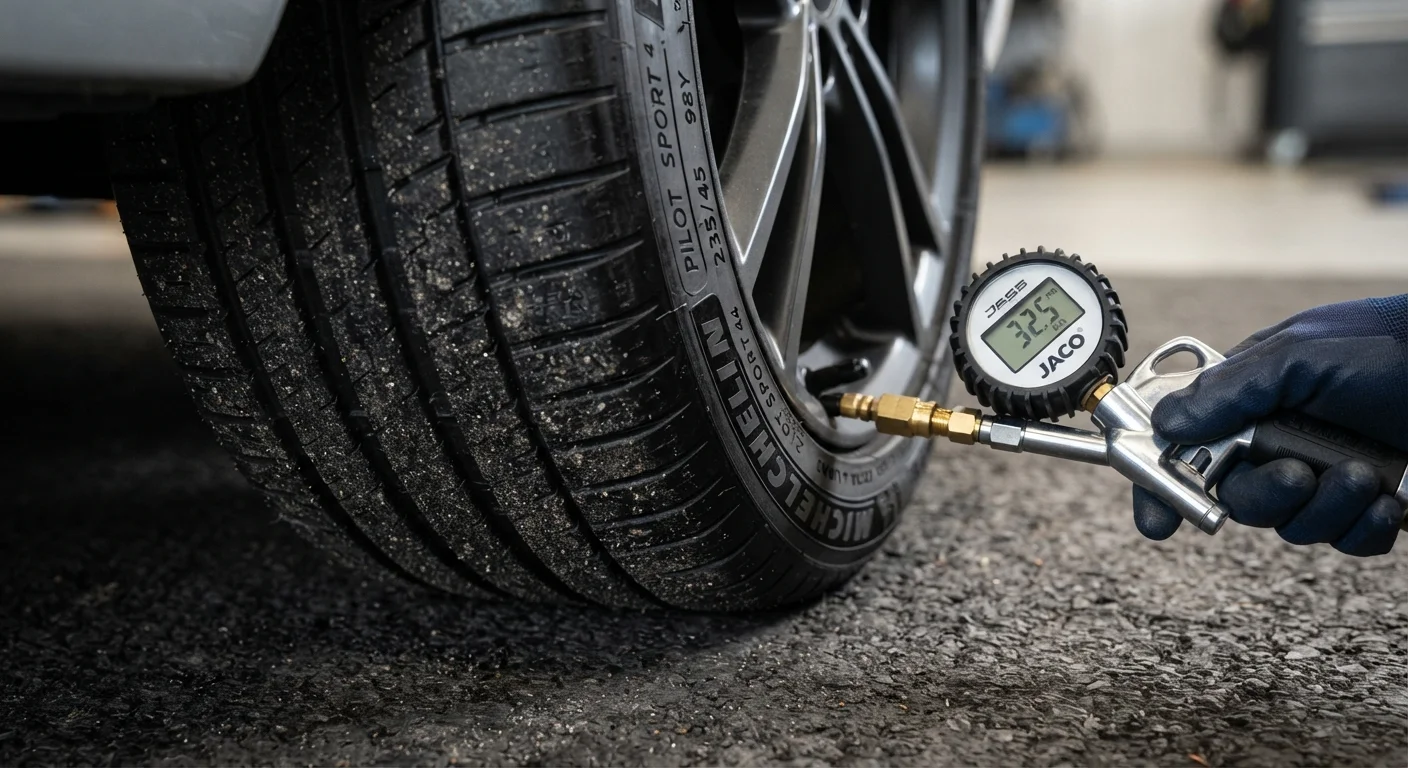
Tire Pressure: The Number That Changes Without Warning
Tire pressure is measured in PSI, and every vehicle has a manufacturer-recommended range. You'll find that number on a sticker inside the driver's door jamb or in your owner's manual - not on the tire sidewall. The sidewall number is the tire's maximum pressure rating, which is a different figure entirely.
Most passenger vehicles call for somewhere between 30 and 35 PSI, though trucks and SUVs may require more. Pressure naturally drops about 1 PSI for every 10°F decrease in temperature, which is why tires that look fine in fall can trigger a warning light by January. For more on how cold affects your vehicle overall, see what freezing temperatures do to your car.
Check pressure when tires are cold - meaning the vehicle has been parked for at least three hours or driven fewer than a mile at low speed. Heat from driving temporarily inflates the reading.
Tread Depth: How to Know When You're Running Out of Grip
Tread channels water away from the contact patch so your tires can grip the road. As tread wears down, wet-weather stopping distances increase significantly. The legal minimum in most U.S. states is 2/32 of an inch, but many safety organizations recommend replacing tires at 4/32" - especially in regions with heavy rain or snow.
The easiest field check: insert a penny into a tread groove with Lincoln's head pointing down. If you can see the top of his head, you're at or below 2/32" and the tires need replacing. A quarter works for the 4/32" threshold - if you can see the top of Washington's head, you're approaching that limit.
Uneven tread wear is worth noting too. Wear concentrated on the center of the tire suggests chronic overinflation; wear on the outer edges points to underinflation. Cupping or scalloping across the tread can indicate a suspension or balance issue - a mechanic should evaluate that.
PSI
Pounds per square inch - the unit used to measure tire air pressure. Your vehicle's correct PSI is specified by the manufacturer, not by the tire itself.
Tread depth
The distance between the top of the tire tread and the bottom of its deepest grooves. Adequate depth is essential for channeling water and maintaining grip.
Aspect ratio
A tire sidewall measurement expressed as a percentage of the tire's width. A ratio of 65 means the sidewall height is 65% of the tire's width.
Load index
A numerical code on the tire sidewall indicating the maximum weight each tire can safely support when properly inflated.
Speed rating
A letter code indicating the maximum sustained speed a tire is designed to handle under load. Common ratings include H (130 mph) and V (149 mph).
DOT code
A Department of Transportation identifier molded into the tire sidewall. The last four digits encode the week and year the tire was manufactured.
Rotation: Why Moving Tires Around Extends Their Life
Tires wear unevenly by design. Front tires handle steering forces and typically wear faster on front-wheel-drive vehicles. Rear tires on rear-wheel-drive vehicles absorb acceleration stress. Rotating tires - moving them to different axle positions on a regular schedule - distributes this wear more evenly across all four, extending the useful life of the full set.
The standard recommendation is rotation every 5,000 to 7,500 miles, though your owner's manual is the authoritative source for your specific vehicle. Many drivers align rotation with oil changes as a convenient reminder. Your vehicle's maintenance schedule will clarify what intervals apply to your car.
Common rotation patterns include front-to-back (same side), cross-rotation, and, for directional tires, a straight front-to-rear swap on the same side only. A qualified tire technician will select the correct pattern based on your tire type and drivetrain. Keeping tires properly maintained also fits into the broader goal of avoiding expensive repairs through consistent habits.
1 in 4
Vehicles on U.S. roads with at least one underinflated tire
According to the National Highway Traffic Safety Administration (NHTSA), underinflation is among the most common - and easily prevented - tire safety issues.
~0.5%
Fuel economy lost per 1 PSI drop in all four tires
The U.S. Department of Energy notes that keeping tires properly inflated can modestly improve fuel efficiency.
Up to 25%
Potential increase in tire lifespan from regular rotation
Industry estimates suggest consistent rotation intervals meaningfully extend tread life by evening out wear across all four tires.
Reading the Sidewall: What Those Codes Actually Mean
The string of letters and numbers on a tire sidewall looks cryptic but follows a standard format. Take P215/65R17 98H as an example:
- P - Passenger vehicle tire (LT indicates light truck)
- 215 - Tire width in millimeters
- 65 - Aspect ratio: sidewall height is 65% of the width
- R - Radial construction (nearly universal today)
- 17 - Wheel diameter in inches
- 98 - Load index (how much weight each tire can support)
- H - Speed rating (H = up to 130 mph under load)
There's also a DOT code on the sidewall. The last four digits indicate the week and year of manufacture - for example, 2319 means the 23rd week of 2019. Tires older than six years may degrade internally even if tread looks fine, and most manufacturers recommend replacing tires by ten years regardless of condition. See the seasonal car care checklist for timely reminders to inspect your tires year-round.
This article provides general vehicle maintenance information for educational purposes. For specific guidance on your vehicle, consult a qualified mechanic or tire professional.
The content on this site is for informational purposes only and is not a substitute for professional advice. Always consult a qualified professional for guidance specific to your situation.