

What the Nutrition Facts Panel Actually Is
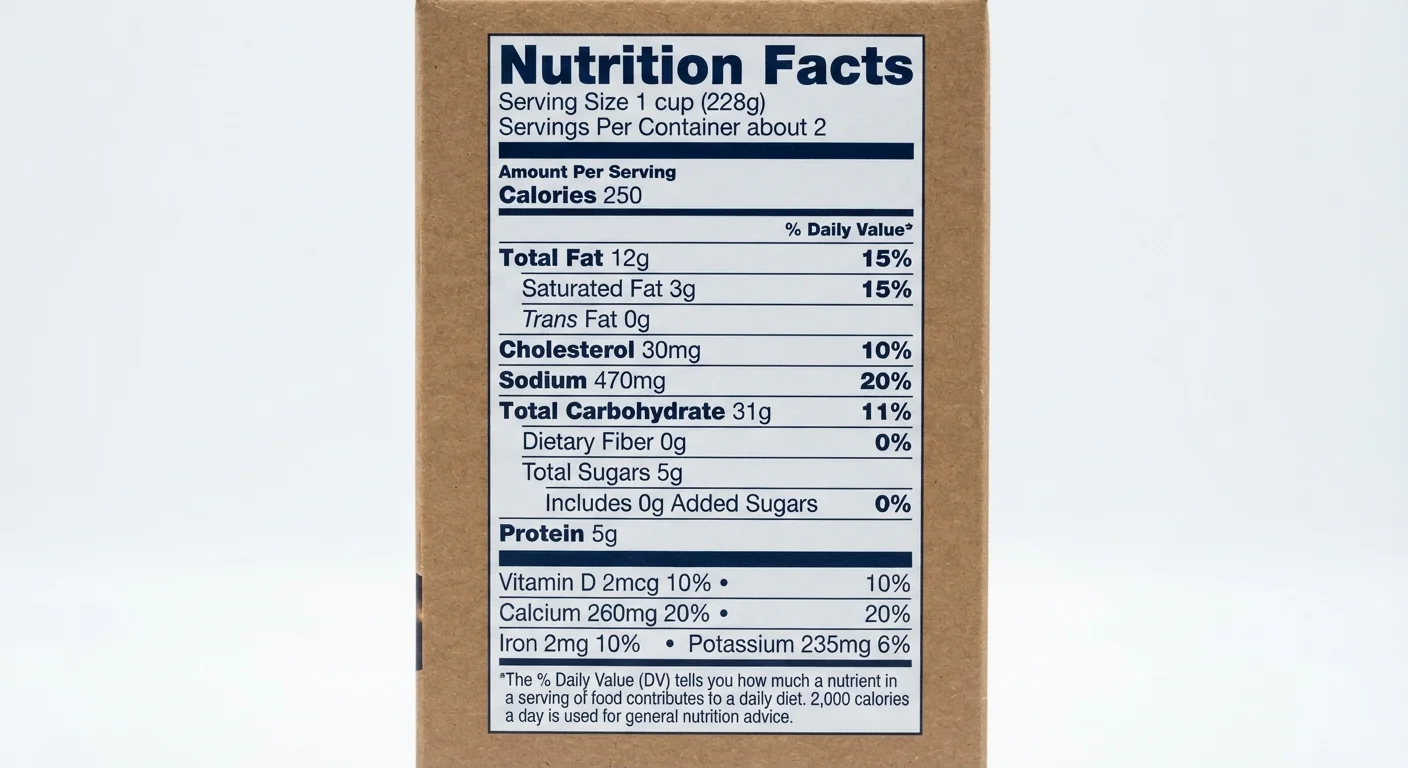
The Nutrition Facts panel is a federally standardized label required by the U.S. Food and Drug Administration (FDA) on most packaged foods and beverages sold in the United States. Its layout and content are regulated — not optional — meaning every number follows the same rules regardless of brand or product.
The panel was significantly updated in 2016 (with full industry compliance by 2020) to reflect advances in nutrition science and better mirror how Americans actually eat. Key changes included a larger calorie display, the addition of added sugars as a separate line, and updated daily reference values for several nutrients.
This article is general nutrition information and education, not personalized dietary advice. For guidance tailored to your health situation, consult a registered dietitian or qualified healthcare provider.
| Regulatory body | U.S. Food and Drug Administration (FDA) |
| Label last major update | 2016 rule; full compliance by 2020 (FDA) |
| Daily Value calorie reference | 2,000 calories per day (FDA Nutrition Facts label regulations) |
| Required micronutrients listed | Vitamin D, calcium, iron, potassium (FDA, current rules) |
| "Low" %DV threshold | 5% DV or less per serving (FDA guidance) |
| "High" %DV threshold | 20% DV or more per serving (FDA guidance) |
Serving Size and Servings Per Container
The serving size sits at the very top of the panel and is the foundation for every number below it. All gram, calorie, and nutrient figures refer to one serving — not the entire package.
Under the updated FDA rules, serving sizes must reflect amounts people typically consume, based on government dietary survey data — not what a manufacturer might prefer. A 20-oz bottle of soda, for example, is now listed as a single serving because that's how most people consume it.
Servings per container tells you how many of those servings are in the package. Multiplying the calories (or any nutrient) by this number gives you the full-package total — a useful reality check for foods often eaten in one sitting.
For a practical walkthrough of applying this and the rest of the label at the store, see Reading a Food Label Before You Buy.
Calories, Macronutrients, and Daily Values
Calories represent the total energy provided by one serving. The FDA requires this number to be displayed prominently. Calories come from three macronutrients — fat, carbohydrates, and protein — each contributing a different amount of energy per gram.
Serving Size
The standardized amount of food the label's nutrient data refers to, set by the FDA based on typical consumption patterns. It is not a dietary recommendation.
% Daily Value (%DV)
The percentage of a nutrient's daily reference intake provided by one serving, based on a 2,000-calorie diet. It helps compare foods but is not a personalized target.
Added Sugars
Sugars and syrups added to foods during processing or preparation, listed separately from naturally occurring sugars. The FDA's daily reference value is 50 grams.
Saturated Fat
A type of dietary fat found mainly in animal products and some tropical oils. It is listed separately on the label because of its association with blood cholesterol levels.
Trans Fat
Industrially produced partially hydrogenated oils that raise LDL cholesterol. The FDA has largely eliminated artificial trans fats from the U.S. food supply, but the line remains required.
Daily Reference Value (DRV)
Government-established intake benchmarks for macronutrients and certain other nutrients, used as the basis for calculating %DV on the Nutrition Facts panel.
Below calories, the label lists each macronutrient in grams. Fat is further broken down into saturated fat and trans fat, both listed separately because of their distinct effects on cardiovascular health. Total carbohydrates are subdivided into dietary fiber and total sugars, with added sugars shown as an indented sub-line beneath total sugars. To understand why fiber deserves attention, see Understanding Dietary Fiber.
The % Daily Value (%DV) column — printed on the right side — shows how much a nutrient in one serving contributes toward a general daily reference intake, based on a 2,000-calorie diet. As a rough guide: 5% DV or less is considered low; 20% DV or more is considered high. These are reference points, not personal targets. For a deeper look at what carbs, fat, and protein do in your body, see What Macronutrients Actually Do Inside Your Body.
2,300 mg
FDA daily reference value for sodium
Current FDA Nutrition Facts label regulations set 2,300 mg as the daily reference value for sodium for adults.
50 g
Daily reference value for added sugars
The FDA sets the daily reference value for added sugars at 50 grams, corresponding to 10% of a 2,000-calorie diet.
28 g
Daily reference value for dietary fiber
The FDA's current daily reference value for dietary fiber is 28 grams, reflecting updated nutrition science in the 2016 label rules.
Vitamins, Minerals, and What's Required on the Label
Since the 2016 update, the FDA requires four specific micronutrients to appear on every Nutrition Facts panel: Vitamin D, calcium, iron, and potassium. These replaced Vitamin A and Vitamin C, which are now optional, because dietary surveys showed deficiencies in the four currently listed nutrients are of greater public health concern in the U.S.
Manufacturers may voluntarily list additional vitamins and minerals. All micronutrient amounts are expressed as %DV. For a lookup-friendly reference on what each of these nutrients does and which foods supply them, see Vitamins and Minerals: A Plain-Language Reference Guide.
One nutrient worth particular attention: sodium. It appears in the macronutrient section but functions like a mineral on the label. The FDA's daily reference value for sodium is 2,300 mg. Many Americans consume well above this, largely from packaged and restaurant foods. For more context, see Sodium in the American Diet.
The 2,000-Calorie Reference Is Not Universal
All %DV figures on the Nutrition Facts panel are calculated against a 2,000-calorie daily reference diet. This figure is a population-level benchmark used to standardize label comparisons — it is not a recommendation for every individual. Calorie needs vary widely based on age, sex, body size, activity level, and health status. A registered dietitian can help you determine what nutrient targets make sense for your specific situation.
This article provides general nutrition information and education only. It is not a substitute for advice from a registered dietitian, physician, or other qualified healthcare professional.
The content on this site is for informational purposes only and is not a substitute for professional advice. Always consult a qualified professional for guidance specific to your situation.