

Option A
Whole-House Cleaning Schedule
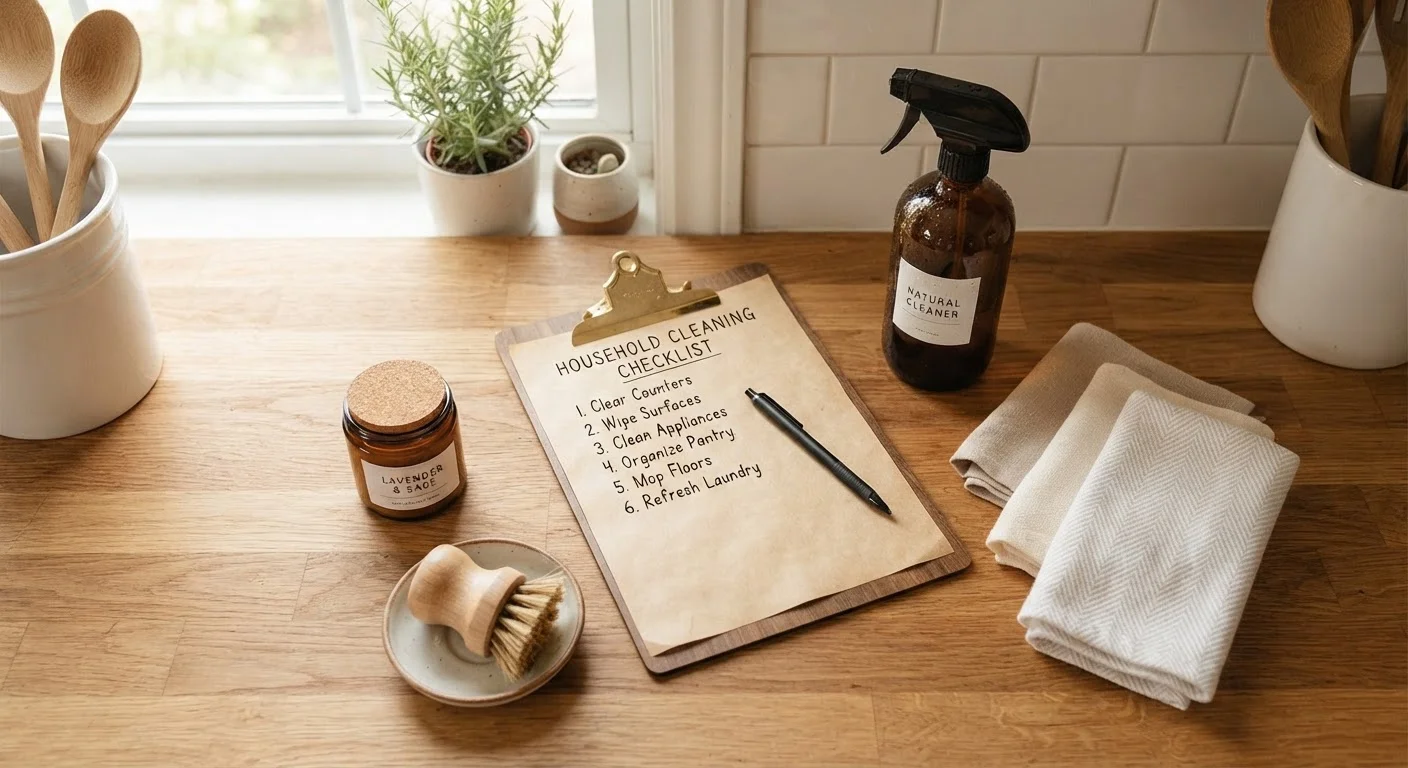
The structured, planned approach to keeping every room in order.
Best for: Households that need clear expectations, shared responsibilities, or have multiple rooms to maintain consistently.
Option B
Cleaning as You Go
The flexible, habit-driven approach woven into daily routines.
Best for: Individuals or smaller households who prefer low-effort maintenance over dedicated cleaning sessions.
How Each Approach Works
A whole-house cleaning schedule assigns specific tasks to specific days or time blocks — vacuuming on Tuesdays, bathrooms on Saturdays, and so on. It treats cleaning as a planned activity with a defined beginning and end, typically cycling through the entire home on a weekly or biweekly basis.
Cleaning as you go is less a schedule and more a set of embedded habits: wiping the stovetop after cooking, hanging towels immediately after showering, or sweeping a floor before leaving a room. The goal is to prevent mess from accumulating rather than addressing it in bulk later.
Both approaches can produce a clean home. The difference lies in when the effort happens, how it's distributed across time, and how much structure is required to sustain it.
| Criterion | Whole-House Schedule | Cleaning as You Go |
|---|---|---|
| Structure required | High — planned days and task lists | Low — habit-based, no formal plan |
| Best household size | Medium to large, multi-occupant | Small, one to two people |
| Depth of clean | Deeper — dedicated blocks allow thoroughness | Surface-level — maintenance-focused |
| Flexibility | Lower — missed days create backlog | Higher — adapts to daily flow |
| Chore delegation | Easier — tasks are explicit and assignable | Harder — relies on individual initiative |
| Motivation needed | Lower — schedule provides external structure | Higher — self-driven consistency required |
| Risk of overlooked tasks | Low — schedule catches irregular tasks | Higher — easy to skip non-obvious tasks |
Where a Whole-House Schedule Has the Edge
A written cleaning schedule excels at ensuring nothing gets overlooked. Tasks like cleaning behind appliances, washing baseboards, or descaling fixtures are easy to forget — but a schedule assigns them a slot before they become a problem. For households with children, pets, or multiple occupants, a schedule also creates a shared framework. Everyone knows what needs doing and when, which makes delegation more straightforward.
Scheduled cleaning also tends to produce a deeper clean. When you set aside two hours on a Saturday morning specifically for cleaning, you're more likely to move furniture, scrub grout, or address overlooked corners than you would during a quick daily pass. For households with higher foot traffic or pets, that periodic deep effort matters. See our room-by-room home maintenance calendar for a practical framework to layer onto any weekly schedule.
Where Cleaning as You Go Has the Edge
The primary advantage of cleaning as you go is that it prevents problems from compounding. A spill wiped up immediately takes ten seconds. The same spill left for three days may require a dedicated scrubbing session. By making small cleaning actions part of transitions — before leaving a room, after finishing a meal, before starting a new task — the overall workload stays low.
This approach also requires no planning or scheduling overhead. There's no list to maintain, no blocked-off time slots to protect, and no guilt if a scheduled day gets missed. For people with highly variable schedules or low mental bandwidth for household management, the absence of structure is a feature, not a bug.
The limitation is consistency. Cleaning as you go only works if those small habits are actually followed through. Without the anchor of a schedule, it's easy to let individual steps slide — and the mess still accumulates.
Neither Approach Requires Perfection
A cleaning system only works if it's sustainable for your actual life — not an idealized version of it. If a full whole-house schedule feels overwhelming, start with three scheduled tasks per week and build from there. If cleaning as you go keeps slipping, anchor one or two habits to an existing daily routine (such as wiping the kitchen counter after dinner) before adding more. Small, consistent actions generally outperform ambitious plans that are rarely followed through.
Combining Both: What Most Households Actually Do
In practice, most well-run households use a blend of both approaches. Daily habits — dishes done before bed, bathroom surfaces wiped down after use — handle the ongoing maintenance load. A lighter weekly reset covers tasks that can't realistically be done in passing: vacuuming, mopping, laundering towels, and cleaning mirrors.
The ratio depends on household size and lifestyle. A single person in a studio apartment may need almost no scheduled cleaning if daily habits are consistent. A family of five will likely need both strong daily habits and a structured weekly or biweekly cycle to prevent any room from falling behind.
If keeping your home organized is also a challenge, maintaining a clean space becomes easier when clutter is already managed. Our guide to sustainable everyday decluttering pairs well with either cleaning approach. Similarly, the principles behind organizing on a tight budget can reduce the number of surfaces and items that need cleaning in the first place.
6 hrs
Average weekly time Americans spend on housework
Data from the U.S. Bureau of Labor Statistics American Time Use Survey indicates Americans spend roughly six hours per week on household cleaning and maintenance activities on average.
~30 sec
Time saved wiping a surface immediately vs. later
Home cleaning research consistently notes that addressing spills and messes immediately reduces required effort significantly compared to letting residue dry or harden over time.
The content on this site is for informational purposes only and is not a substitute for professional advice. Always consult a qualified professional for guidance specific to your situation.