

Our Verdict
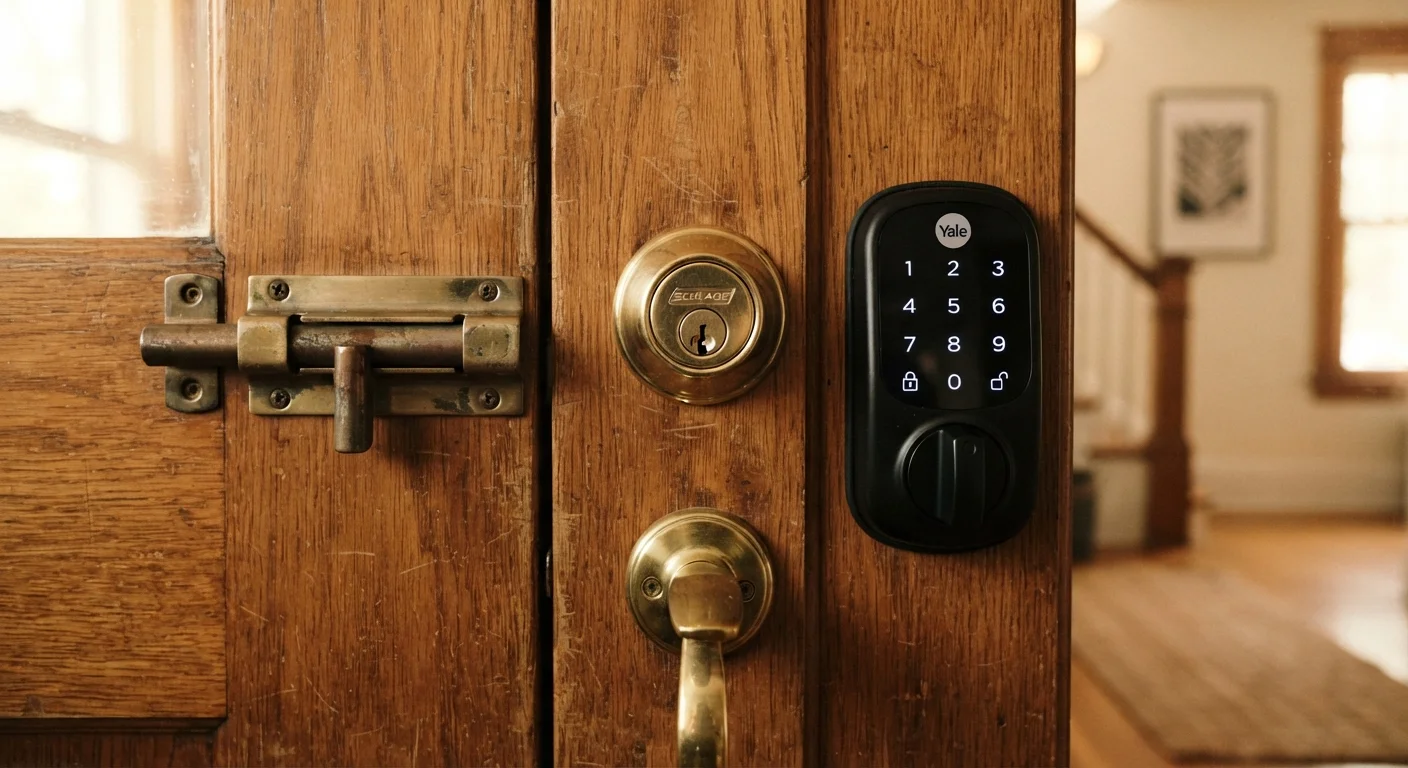
Deadbolts remain the most reliable choice for primary exterior door security, combining proven physical resistance with simplicity. Smart locks are a compelling upgrade for households that prioritize access management and remote control, provided they're paired with strong digital security habits. Sliding bolts serve best as supplemental or interior locks rather than standalone security solutions.
| Best for | Recommended |
|---|---|
| Households prioritizing physical security and reliability | Deadbolt |
| Families managing multiple users, renters, or remote access needs | Smart Lock |
| Interior rooms, bathrooms, or secondary reinforcement | Sliding Bolt |
| Maximum security at main entry points | Deadbolt + Smart Lock combination |
How These Three Lock Types Actually Work
Before comparing security levels, it helps to understand the basic mechanics behind each lock type. Each operates differently, and those differences directly affect how well they resist common break-in techniques.
Sliding Bolts
A sliding bolt (also called a barrel bolt or surface bolt) is mounted on the surface of a door and manually slides a metal rod into a receiver mounted on the door frame. Because they are surface-mounted and hand-operated from one side only, they provide no key-based access control. They are quick to operate but offer limited resistance to lateral force.
Deadbolts
A deadbolt extends a solid metal bolt directly into the door frame's strike plate when locked. Unlike a spring latch — which can be slipped with a card — a deadbolt cannot be retracted without deliberate key or thumb-turn action. This makes it far more resistant to both shimming and kick-in attacks, especially when installed with a reinforced strike plate and long anchor screws.
Smart Locks
Smart locks replace or overlay traditional lock cylinders with electronic mechanisms. They typically allow access via keypad code, smartphone app, key fob, or biometrics. Many connect via Wi-Fi, Bluetooth, or Z-Wave to allow remote locking, access logs, and temporary digital keys. The underlying bolt mechanism is usually a deadbolt — the "smart" component refers to how it's controlled, not a separate bolt design.
Comparing Security Strengths and Weaknesses
| Sliding Bolt | Deadbolt | Smart Lock | |
|---|---|---|---|
| Primary mechanism | Surface-mounted manual rod | Keyed solid bolt into frame | Electronic deadbolt with digital control |
| Resistance to forced entry | Low — surface mount is weak point | High — especially Grade 1 with reinforced strike | Moderate to high — depends on underlying bolt quality |
| Key-based access control | None — one-sided only | Yes — keyed cylinder | Optional — most exclude or supplement keys |
| Remote or app access | No | No | Yes — via smartphone or app |
| Digital attack vulnerability | None | None | Yes — firmware, PIN, and network risks |
| Best use case | Interior or secondary supplement | Primary exterior door lock | Main entry with access management needs |
| Installation complexity | Very low — surface screws only | Moderate — requires door boring | Moderate to high — requires wiring or batteries |
| Average lifespan | Many years with simple maintenance | 10–20+ years for quality units | Varies — tied to app/firmware support lifecycle |
A few critical factors shape real-world security performance for each option:
- Strike plate quality: Even a high-grade deadbolt is only as strong as its strike plate installation. Short screws in a weak frame are a common failure point.
- Lock grade: The American National Standards Institute (ANSI) and Builders Hardware Manufacturers Association (BHMA) rate residential locks from Grade 1 (highest) to Grade 3 (basic). Grade 1 deadbolts offer the best resistance to cycles, impacts, and torque.
- Digital attack surface: Smart locks that rely on weak PINs or unpatched firmware can be vulnerable to brute-force or wireless attacks — a risk that deadbolts and sliding bolts simply don't have.
Don't Rely Solely on Smart Lock PINs
Some smart lock models have been found to be vulnerable to brute-force attacks if they lack lockout features after repeated failed attempts. Before installing any smart lock, verify that it supports automatic lockout after failed entries and that its firmware receives active security updates from the manufacturer. A smart lock with a weak PIN policy may offer less real-world security than a well-installed traditional deadbolt.
Where Each Lock Type Belongs in Your Home
Choosing the right lock is partly about understanding the right context for each type.
Primary exterior doors
A Grade 1 deadbolt is the standard recommendation for front, back, and side entry doors. It should be paired with a reinforced strike plate using 3-inch screws that reach the door's structural framing, not just the trim.
Smart locks as a complement
Many homeowners install a smart lock alongside or instead of a traditional keyed deadbolt on the main entry door. This works well for households with multiple occupants, frequent guests, or short-term renters. If you use a smart lock, apply strong, unique access codes — the same principle applies to your online accounts. See our guide to two-factor authentication for a useful parallel on layering security credentials.
Sliding bolts for supplemental use
Sliding bolts are well-suited for interior privacy (bedroom, bathroom), securing a gate from the inside, or adding a secondary layer to an outward-opening door. They should not be a home's only exterior locking mechanism.
Reinforce the Strike Plate, Not Just the Lock
Even a high-grade deadbolt can fail if its strike plate is secured with short screws that only reach the door trim. Replace standard screws with 3-inch screws that anchor into the structural framing of the door jamb. This single upgrade dramatically improves kick-in resistance and costs almost nothing.
Smart Locks and Digital Security Considerations
Because smart locks operate as connected devices, their security extends beyond the physical. Weak PINs, reused codes, outdated firmware, and unsecured home Wi-Fi networks can all create vulnerabilities at the digital layer — even when the physical lock is solid.
Practical habits that matter for smart lock owners:
- Use codes that are at least six digits and avoid obvious sequences like birth years or repeating numbers.
- Regularly audit who has access codes and revoke them promptly when no longer needed.
- Keep the lock's firmware updated through its companion app.
- Make sure your home Wi-Fi network uses strong encryption (WPA3 or WPA2) and a unique password.
This digital layer of home security parallels the habits covered in our article on strong digital security habits. For a broader look at how smart locks compare to monitored alarm systems, see our overview of smart home security devices vs. traditional alarm systems.
Building a Layered Door Security Strategy
Security professionals generally recommend thinking in layers rather than relying on any single product. For most American households, an effective door security strategy typically includes:
- A Grade 1 deadbolt on all exterior doors, properly installed with reinforced hardware.
- A door viewer (peephole) or video doorbell to screen visitors before opening.
- A sliding bolt or door chain on the interior for additional control when home.
- Optionally, a smart lock for access management — especially in households with children, caregivers, or regular service providers.
Door security is one component of overall home safety, not a complete solution on its own. Window locks, exterior lighting, and alarm systems all contribute to a more comprehensive approach. No lock guarantees that a determined intruder cannot eventually gain entry — the goal is to increase time, effort, and noise required, which significantly reduces the probability of a successful break-in.
~34%
Burglaries via front door entry
According to FBI Uniform Crime Report data, a significant share of residential break-ins occur through the front door, underscoring the importance of primary entry security.
Grade 1
Highest ANSI/BHMA lock rating
ANSI/BHMA Grade 1 deadbolts are tested to withstand at least 250,000 open/close cycles and significant impact force, making them the standard for exterior residential security.
The content on this site is for informational purposes only and is not a substitute for professional advice. Always consult a qualified professional for guidance specific to your situation.