

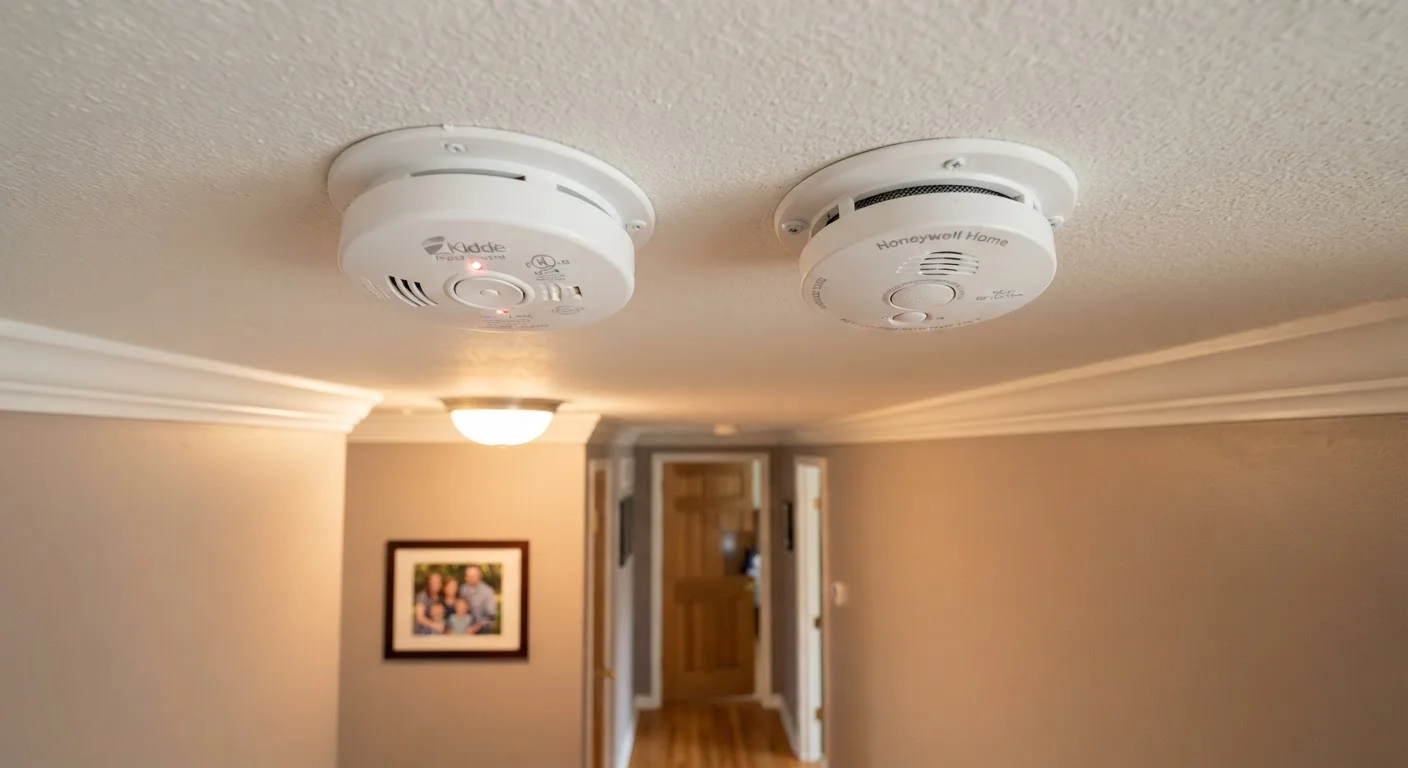
Option A
Smoke Alarm
The fast-response detector for most living spaces.
Best for: Bedrooms, hallways, and living areas where detecting smoldering or flaming fires early is the priority.
Option B
Heat Detector
The durable, false-alarm-resistant option for harsh environments.
Best for: Kitchens, garages, and utility rooms where smoke, steam, or dust would trigger unnecessary alarms.
How Each Device Detects Fire
Smoke alarms and heat detectors use fundamentally different mechanisms — and that difference determines where each belongs in your home.
Smoke alarms sense the byproducts of combustion. The two most common types are ionization alarms, which react quickly to fast-flaming fires, and photoelectric alarms, which are more responsive to slow, smoldering fires that produce heavier smoke. Many fire safety organizations suggest that dual-sensor or interconnected combinations of both types provide the broadest coverage.
Heat detectors ignore smoke entirely. They are triggered either when the ambient temperature crosses a fixed threshold (commonly 135°F or 194°F depending on the model) or when temperature rises unusually fast — a mode called rate-of-rise detection. Because they don't react to particles, they are essentially immune to the cooking steam, dust, or exhaust fumes that cause nuisance alarms.
The trade-off is response speed. Heat detectors generally activate later in a fire's development than smoke alarms, because a fire must grow enough to raise air temperature significantly before the device trips. For areas where occupants need maximum escape time — especially bedrooms — that delay matters.
| Criterion | Smoke Alarm | Heat Detector |
|---|---|---|
| Detection method | Combustion particles (smoke) | Temperature rise or fixed threshold |
| Response speed | Fast — early fire stages | Slower — fire must grow substantially |
| False alarm risk | Higher in kitchens, garages | Very low in most environments |
| Best rooms | Bedrooms, hallways, living areas | Kitchen, garage, attic, laundry |
| Typical replacement interval | Every 10 years | Varies — check manufacturer label |
| Code requirement (NFPA 72) | Required in sleeping areas | Acceptable alternative in select locations |
Room-by-Room Placement Guide
Choosing between these two devices is largely a placement decision. The U.S. Fire Administration and the National Fire Protection Association (NFPA) provide guidance that most local codes build on.
Smoke Alarms: Where They Belong
- Every bedroom — inside each room, not just outside the door.
- Hallways and corridors — particularly those leading to sleeping areas.
- Living rooms and family rooms — where occupants spend significant time and fires can start from furniture, electronics, or candles.
- At the top of every stairway — smoke rises, and stairways act as chimneys.
Heat Detectors: Where They Belong
- Kitchen — steam, grease, and cooking smoke trigger smoke alarms constantly here; a heat detector provides fire detection without the nuisance trips.
- Attached garage — vehicle exhaust, paint fumes, and dust make smoke alarms impractical.
- Attic and crawl spaces — temperature extremes and dust accumulation make heat detectors a more reliable fit.
- Laundry rooms — lint and steam can falsely trigger smoke alarms.
For a broader look at room-level hazards throughout your home, see our room-by-room home safety audit.
Combination Devices Are Available
Some manufacturers produce units that combine both smoke and heat detection in a single housing. These can simplify installation in borderline locations — such as a finished basement or a large open-plan kitchen-dining area — but they are not a universal replacement for dedicated devices placed room by room. Check that any combination unit carries a recognized testing laboratory listing (such as UL) before purchase.
Maintenance, Testing, and Integration
Even the right device in the right location fails if it isn't maintained. Both smoke alarms and heat detectors require regular attention.
- Test monthly — press the test button on each unit and confirm the alarm sounds.
- Replace batteries annually (or use 10-year sealed-battery models where available).
- Replace the entire unit every 10 years for smoke alarms; heat detectors vary by manufacturer — check the label.
- Keep devices clean — dust and spider webs can interfere with sensors. Use a vacuum attachment, never spray cleaners directly on the unit.
If your devices are interconnected — wired or wirelessly — when one alarm sounds, all of them sound. This feature is strongly recommended by NFPA 72, the standard most local codes reference, because it gives occupants in distant parts of the home the same warning simultaneously.
Fire detection is only one part of home safety preparedness. Once your devices are in place, a rehearsed escape plan is equally important. Our guide on home fire escape planning walks through how to map routes and practice with your family. You may also want to review our broader complete family home safety reference for coverage beyond fire detection.
This article provides general home safety information and education. It is not a substitute for consultation with a licensed fire safety professional or your local fire marshal, and local building codes may impose specific requirements that differ from the general guidance here.
The content on this site is for informational purposes only and is not a substitute for professional advice. Always consult a qualified professional for guidance specific to your situation.