

Why Staircases Deserve Your Attention
Staircase falls are among the most common causes of serious home injury in the United States, affecting people of every age group — from toddlers learning to climb to older adults navigating steps at night. The majority of these incidents are preventable with straightforward, low-cost modifications.
Unlike many household hazards that target a specific demographic, stairs create risk for everyone. A young child misjudges a step. A teenager rushes downstairs in socks. An adult carries a laundry basket that blocks their sightline. An older family member descends in dim light. Each scenario shares the same solution set.
This guide walks through the most effective, research-informed practices for reducing stair-related fall risk throughout your home. For a broader view of hazards room by room, see our room-by-room home safety audit.
Over 1 million
Stair-related injuries treated annually in U.S. emergency rooms
According to data compiled by the U.S. Consumer Product Safety Commission, stairways are consistently among the most hazardous features in American homes.
55%
Of stair falls attributed to environmental factors
Research published in injury prevention literature identifies physical hazards — poor lighting, absent handrails, slippery surfaces — as the leading contributors to stair-related falls.
Core Safety Practices for Every Staircase
The following practices address the structural, environmental, and behavioral factors most commonly linked to stair falls. Implementing even a few of them meaningfully reduces risk across your household.
Lighting: The Overlooked Priority
Poor visibility is a leading contributor to stair missteps, yet lighting upgrades are frequently deprioritized because falls in low light are hard to anticipate until one occurs. A staircase that looks adequate in daytime may be genuinely hazardous at 2 a.m.
Test Your Staircase Lighting at Night
Walk your staircase after dark without turning on additional lights to experience exactly what a household member sees during a nighttime trip. Note any steps that disappear into shadow or where glare from a single overhead bulb makes depth perception difficult. This quick test reveals lighting gaps that are completely invisible during daytime assessment.
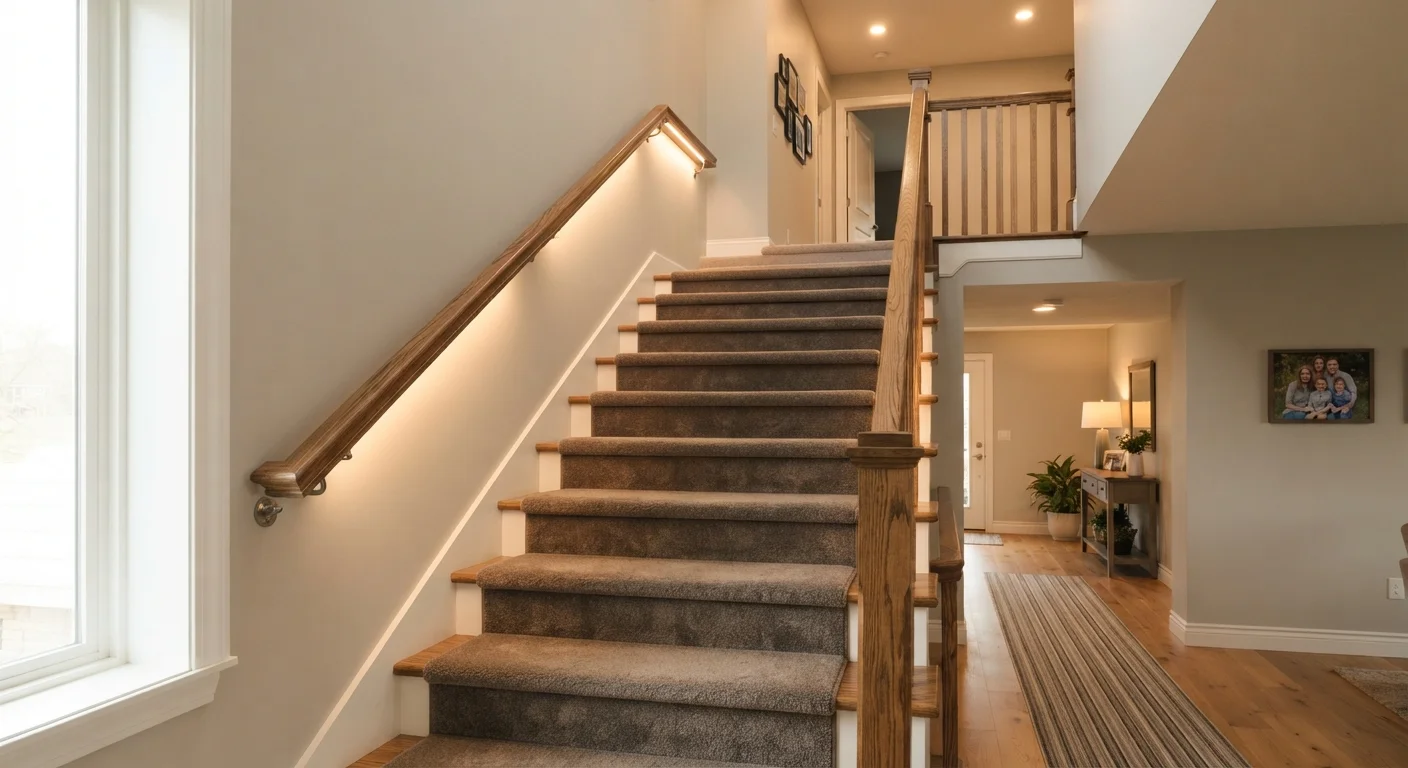
Motion-activated lights are especially practical for nighttime trips — they activate without fumbling for a switch and conserve energy when the stairs aren't in use. Step lights mounted low on the wall, rather than overhead fixtures alone, reduce glare and cast light directly onto each tread surface where it matters most.
Households with older adults may want to think carefully about lighting as part of a broader set of modifications. Our article on home safety modifications for aging adults covers this in more depth.
Children, Pets, and Special Considerations
Households with young children or pets face specific staircase challenges that standard adult-focused advice doesn't always address. Pressure-mounted or hardware-mounted safety gates at the top and bottom of stairs are widely recommended for children under five — hardware-mounted gates are generally considered more secure at the top of stairs where a fall would be most severe.
Pets, particularly older dogs with limited mobility or small animals, can also be tripped over on stairs. Keeping pets off high-traffic stairways during busy household hours reduces the chance of a collision. For age-specific safety thinking, see why child-proofing isn't just for babies.
Gate Placement Matters for Child Safety
Safety experts generally distinguish between pressure-mounted and hardware-mounted gates based on location. Hardware-mounted gates — which screw directly into wall studs or a solid frame — are strongly preferred at the top of stairs, where a gate failure could result in a serious fall. Pressure-mounted gates are typically considered appropriate only at the bottom of a staircase. Check the gate manufacturer's guidance and, when in doubt, consult a certified childproofing professional.
Building a Safer Staircase Culture at Home
Physical modifications matter, but household habits reinforce them. Establishing simple, consistent expectations — no running on stairs, no carrying objects that block your view, shoes off on carpeted steps — reduces the behavioral component of stair risk without making safety feel punishing.
Walk your staircase periodically with fresh eyes: test each handrail for wobble, check whether any treads have shifted, and look for clutter that has quietly accumulated. This habit takes less than two minutes and catches problems before they cause harm.
A staircase safety check fits naturally into a broader home safety review. The complete family home safety reference covers fall prevention alongside fire safety, toxic hazards, and emergency planning in one place.
This article provides general home safety information for educational purposes only. It is not a substitute for professional assessment of your specific home. If you have concerns about fall risk for a household member with a medical condition or mobility limitation, consult a qualified healthcare or occupational therapy professional.
The content on this site is for informational purposes only and is not a substitute for professional advice. Always consult a qualified professional for guidance specific to your situation.