

Option A
HMO (Health Maintenance Organization)
The structured, lower-cost network plan.
Best for: People who want predictable costs and don't mind coordinating care through a primary care physician.
Option B
PPO (Preferred Provider Organization)
The flexible, broader-access network plan.
Best for: People who want to see specialists or out-of-network providers without needing a referral first.
The Core Difference: Network Rules and Referrals
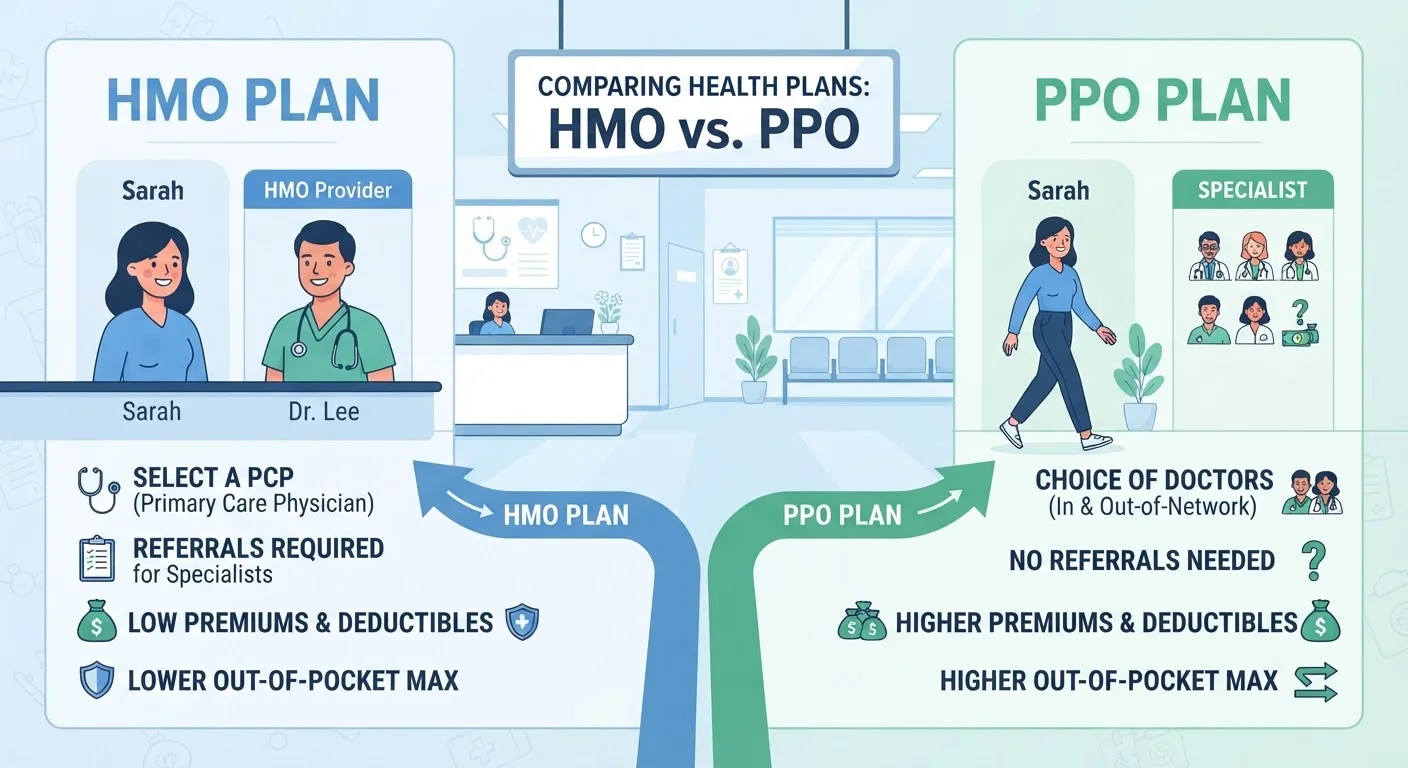
Both HMOs and PPOs are types of managed care plans — meaning they contract with networks of doctors, hospitals, and other providers to deliver care at negotiated rates. The key difference is how tightly each plan controls which providers you can use and how you access specialists.
With an HMO, you choose a primary care physician (PCP) who acts as your main point of contact for all health care. If you need to see a cardiologist, dermatologist, or any other specialist, your PCP must issue a referral first. You're also required to stay within the HMO's provider network — with very limited exceptions, going outside that network means you pay the full cost out of pocket.
A PPO works differently. You can see any doctor or specialist, in-network or out-of-network, without a referral. You'll pay less when you use in-network providers, but the plan still covers a portion of out-of-network care. That flexibility is the PPO's defining feature — and it's reflected in typically higher premiums.
Understanding these structural differences is foundational before you compare costs. For a plain-language guide to what premiums, deductibles, and copays actually mean, see our breakdown of key insurance cost terms.
| Criterion | HMO | PPO |
|---|---|---|
| Monthly premium | Generally lower | Generally higher |
| Primary care physician required | Yes | No |
| Referrals needed for specialists | Yes | No |
| Out-of-network coverage | Rarely or never | Yes, at higher cost |
| Network size | Narrower | Broader |
| Deductible (typical) | Lower or none in-network | Higher, applies more broadly |
| Best for | Cost-conscious, routine care users | Flexible access, specialist-heavy needs |
How Costs Actually Compare
Plan structure directly shapes what you pay — both monthly and when you use care. HMOs generally have lower monthly premiums and often feature flat copays for office visits with little or no deductible for in-network services. That predictability appeals to people who use care regularly and want to know exactly what each visit will cost.
PPOs carry higher premiums in exchange for broader access. You're also more likely to encounter a deductible you must meet before the plan starts sharing costs. Out-of-network visits under a PPO are covered — but at a lower reimbursement rate, leaving you responsible for a larger share of the bill.
~48%
Employer plan enrollees in PPOs
According to KFF's 2023 Employer Health Benefits Survey, PPOs remain the most common plan type among workers with employer-sponsored coverage.
~13%
Employer plan enrollees in HMOs
KFF's 2023 survey found HMO enrollment at roughly 13% of covered workers, reflecting a long-term shift toward more flexible plan types.
It's worth looking beyond the premium when comparing plans. How a plan's deductible interacts with its out-of-pocket maximum can significantly affect your total annual cost. Our article on deductibles vs. out-of-pocket maximums walks through how those two limits work together.
If either plan type is offered as a high-deductible health plan (HDHP), that adds another layer of trade-offs. The guide to high- vs. low-deductible plans can help you think through that decision separately.
EPOs and POS Plans Also Exist
HMO and PPO are the most common plan structures, but you may also encounter EPOs (Exclusive Provider Organizations) and POS (Point of Service) plans. An EPO resembles a PPO in that no referral is needed, but it offers no out-of-network coverage like an HMO. A POS plan blends elements of both — it requires a PCP and referrals but allows some out-of-network use. If you're comparing plans during open enrollment, check which structure each plan uses before focusing on premiums. Our overview of how premiums, deductibles, and out-of-pocket maximums work together can help you read cost structures across any plan type.
This article provides general educational information about health insurance plan structures and is not personalized medical, financial, or insurance advice. Coverage details, costs, and network rules vary by plan and state. Always review the Summary of Benefits and Coverage (SBC) for any plan you're considering, and consult a licensed insurance agent or broker for guidance specific to your situation.
The content on this site is for informational purposes only and is not a substitute for professional advice. Always consult a qualified professional for guidance specific to your situation.