

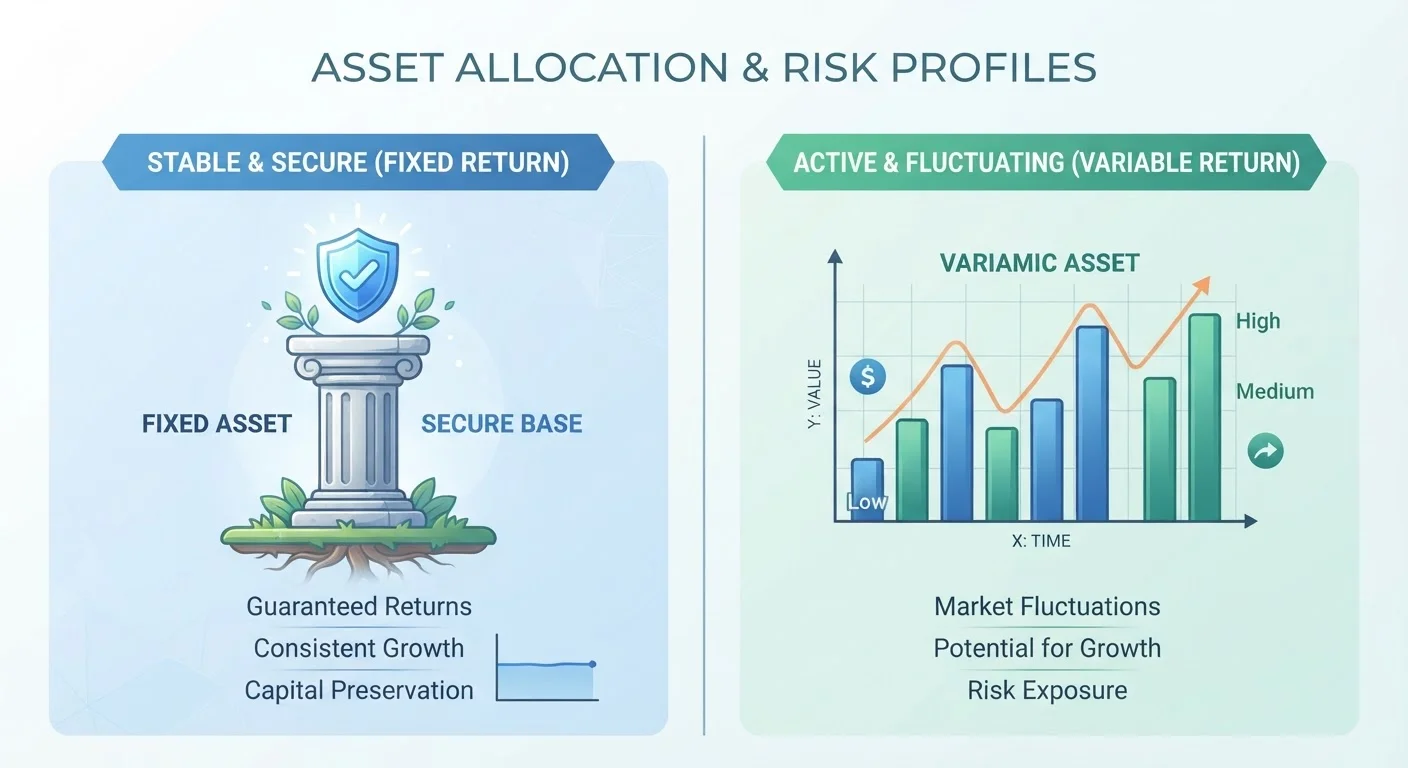
Option A
Fixed Expenses
The predictable, consistent foundation of your budget.
Best for: Expenses that stay the same amount each billing cycle and are easy to plan around in advance.
Option B
Variable Expenses
The flexible, fluctuating portion of your spending.
Best for: Expenses that change month to month and require ongoing monitoring and adjustment.
What Makes an Expense Fixed or Variable?
Before you can build a realistic budget, you need to understand how your expenses behave. Not all spending is alike — some costs are locked in, while others shift with your habits, choices, or the season. This single distinction is foundational. If you're unfamiliar with core budgeting terminology, our budgeting terminology reference defines these and other key concepts in plain language.
Fixed expenses are costs that remain the same amount from one billing cycle to the next. You agreed to them in advance — usually through a contract or subscription — and they don't change based on how much you use or consume. Common examples include rent or mortgage payments, auto loan installments, student loan payments, and most insurance premiums.
Variable expenses, by contrast, fluctuate. They depend on usage, behavior, or market conditions. Groceries, gasoline, dining out, utilities (in many cases), and entertainment all fall here. The amount you owe or spend changes month to month.
| Criterion | Fixed Expenses | Variable Expenses |
|---|---|---|
| Amount each month | Stays the same | Changes each period |
| Examples | Rent, loan payments, insurance | Groceries, gas, dining out |
| Predictability | High — easy to plan around | Low — requires active tracking |
| Control lever | Negotiate or eliminate at renewal | Reduce usage or frequency anytime |
| Budget role | Sets minimum income floor | Reveals flexibility and savings room |
| Risk if income drops | High — obligations don't shrink | Lower — spending can be cut quickly |
Why the Distinction Matters for Your Budget
Treating fixed and variable expenses the same in a budget leads to poor planning. Here's why the distinction is so consequential:
- Fixed expenses establish your baseline. Once you total your fixed costs, you know the minimum income required to keep the lights on. Everything above that threshold is available for variable spending, saving, or debt repayment.
- Variable expenses are where most budget flexibility lives. Since they shift each month, they're also the category where conscious decisions — cooking at home more, reducing streaming subscriptions — produce measurable results quickly.
- They respond to different budgeting tactics. Fixed expenses are best managed by negotiating them down at renewal or eliminating them altogether. Variable expenses require ongoing tracking and spending limits.
Don't Confuse 'Fixed' With 'Essential'
A fixed expense is defined by its payment consistency, not its necessity. A luxury car lease is a fixed expense; so is a basic internet plan. Similarly, some variable expenses — like groceries — are essential even though the amount changes. Categorizing by payment behavior and by necessity are two separate exercises, and both matter when you're pressure-testing a budget.
This framework also supports broader financial goals. When you know exactly how much of your income is already committed, you can make smarter decisions about building savings and managing debt without guessing.
The Gray Zone: Semi-Variable Expenses
Not every expense fits neatly into one category. Semi-variable expenses — sometimes called mixed costs — have both a fixed component and a variable one. A cell phone plan with a set monthly fee plus data overage charges is a clear example. Electricity bills often work similarly: there may be a base service charge that's fixed, while the rest depends on consumption.
For budgeting purposes, two approaches work well for these hybrid costs:
- Use a rolling average. Look at the past six to twelve months of statements and average the amount. Budget that average as if it were fixed.
- Set a spending ceiling. Decide on a maximum you're willing to spend on that category and treat anything below it as variable to manage actively.
If your income isn't consistent month to month, managing semi-variable expenses becomes especially important. Our guide on budgeting with irregular income explores frameworks designed for exactly this situation.
Putting It Into Practice
Once you've categorized your expenses, the practical benefits become clear. Start by listing every regular outflow and labeling it fixed, variable, or semi-variable. Then total your fixed costs. That number is your financial floor.
From there, you can allocate your remaining income to variable categories using envelopes, spending limits, or whichever system fits your habits. Our article comparing envelope budgeting and digital spending accounts walks through two popular approaches for controlling variable spending.
~33%
Of take-home pay spent on housing alone
The U.S. Bureau of Labor Statistics' Consumer Expenditure Survey consistently finds that housing — largely a fixed cost — represents roughly a third of average household spending.
12–15%
Of household spending on food
Food — a core variable expense — accounts for approximately 12 to 15 percent of average U.S. household budgets, according to Bureau of Labor Statistics data.
For large but infrequent variable costs — annual car registration, holiday gifts, home repairs — consider a sinking fund. Rather than absorbing a surprise lump sum, you set aside a small amount each month in advance. See our sinking funds explainer for how to structure one. Once you're comfortable with this categorization approach, comparing full budgeting frameworks is a natural next step.
This article is for general informational and educational purposes only and does not constitute personalized financial advice. Consult a qualified financial professional for guidance specific to your situation.
The content on this site is for informational purposes only and is not a substitute for professional advice. Always consult a qualified professional for guidance specific to your situation.