

Why Accessorizing Feels Tricky
Accessories are the most flexible part of any wardrobe — they can transform the same outfit into something casual, professional, or festive. But that flexibility is also what makes them confusing. With no obvious limit on how many to wear or which to combine, it's easy to either under-accessorize (a look that feels unfinished) or overdo it (a look that feels chaotic).
Understanding a few core principles — visual weight, focal hierarchy, and occasion calibration — takes the guesswork out of the process. Think of it less like following fashion rules and more like understanding how proportion and attention work. Our deeper exploration of accessories as the architecture of an outfit explains exactly how each accessory category shapes a look's overall structure.
More Accessories ≠ More Style
It's tempting to pile on pieces when you love what you own, but visual overload tends to flatten an outfit rather than elevate it. The eye needs a resting place — that's what makes a focal piece feel special. When everything competes for attention, nothing stands out. Restraint is a styling skill, not a limitation.
The steps below are designed to work for any outfit, budget, or style direction — whether you own a dozen pieces or hundreds.
Full-length mirror
Lets you assess the full visual weight of your look from head to toe before committing.
Neutral base outfit
A simple, low-pattern outfit provides the clearest canvas for testing accessory combinations.
Small tray or flat surface
Laying accessories out together before putting them on helps you spot clashes and imbalances early.
How to Accessorize with Intention
Follow these steps each time you're putting together a look. With practice, the process becomes second nature — something you do intuitively rather than deliberately.
What you will need
Identify your outfit's existing focal point
Before adding a single accessory, look at your outfit and ask: what's already doing the most work? A bold printed blouse, a structural blazer with statement lapels, or a richly textured skirt already carries visual weight. Accessories should support that focal point — not compete with it.
If your outfit is relatively quiet (think solid neutrals, simple silhouettes), it can handle more accessory presence. If it's already expressive, your accessories should stay minimal.
Choose one statement piece, then build from there
Pick a single accessory to be the focal point of your overall look. This could be a chunky necklace, an eye-catching belt, a structured bag, or a printed scarf. Once that piece is selected, every other accessory you add should be lower in visual weight.
For example: if you're wearing bold hoop earrings, skip the layered necklaces. If the bag is the standout, keep your jewelry simple and understated. This hierarchy is what separates a polished look from one that feels scattered.
Match accessory formality to the occasion
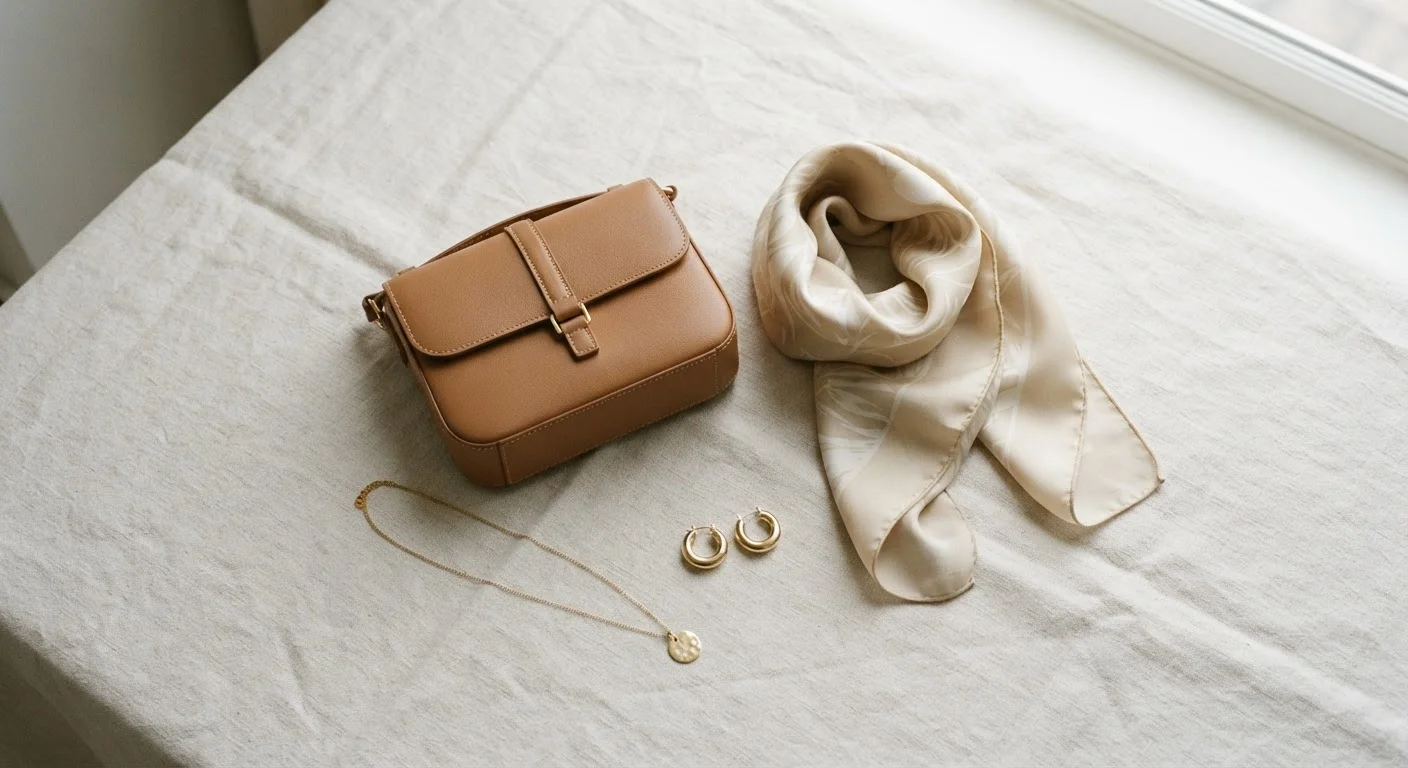
An accessory that's right for a Saturday farmers market might feel jarring at a job interview — and vice versa. Consider the setting before finalizing your choices. Delicate gold jewelry, a structured leather bag, and simple flats read as polished and versatile. Oversized resin jewelry, embellished bags, and layered chains feel more expressive — better suited to social or creative settings.
For occasion-specific guidance, our occasion dressing guide breaks down how to read the room across different settings.
Check for color and texture harmony
Your accessories don't need to match your outfit exactly — but they should relate to it. A warm-toned rust bag can echo amber jewelry. A navy scarf can anchor a cool-toned outfit. The key word is relate, not match.
Mixing metals (gold and silver together) works when kept at the same scale and level of simplicity. Mixing textures — leather with linen, silk with denim — is similarly effective when one texture is clearly dominant.
If color combinations are something you navigate with uncertainty, our color coordination guide offers a beginner-friendly foundation.
Edit before you leave
This is the step most people skip — and it makes the biggest difference. Once you've assembled your look, stand in front of a mirror and take an honest inventory. Ask yourself: is anything fighting for attention? Does one element feel redundant? Would the look be stronger with one less piece?
A widely referenced styling principle suggests removing one accessory before heading out the door. It's become a cliché because it genuinely works — the edit almost always sharpens the look.
Seasonal Adjustments Matter Too
Your accessory choices can shift meaningfully by season — heavier fabrics, layering, and weather-appropriate materials all change what works. For a fuller picture of how seasonal thinking affects your whole outfit, see our seasonal styling guide. Lighter, simpler accessories tend to work best in warmer months; richer textures and layered pieces can shine in cooler ones.
There Are No Universal Rules
Accessorizing guidelines are useful starting points, not mandates. Body proportions, personal style, cultural context, and individual preference all shape what works. A principle like 'less is more' may resonate with some readers and feel restrictive to others — both responses are valid. Use these steps as a framework, not a formula, and adjust based on what feels right for you.
For readers still developing their personal aesthetic, finding your personal style is a useful companion to the practical steps above — it helps you understand why certain choices feel right for you, which makes the editing process much easier over time.
The content on this site is for informational purposes only and is not a substitute for professional advice. Always consult a qualified professional for guidance specific to your situation.