

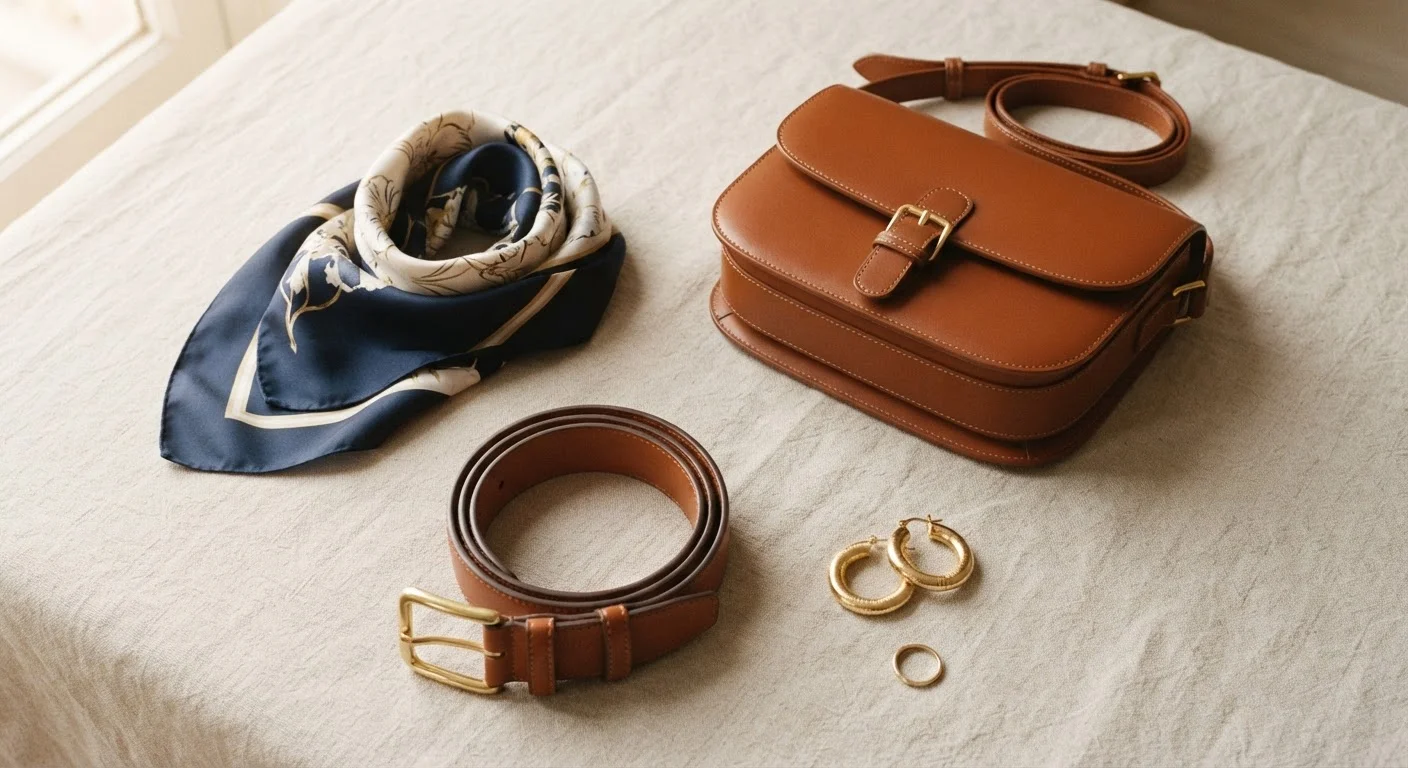
Why Accessories Are Structure, Not Decoration
Most people reach for accessories last — a necklace tossed on, a bag grabbed by the door. But professional stylists treat them as primary design elements, chosen before or alongside the clothing itself. That shift in mindset is what separates outfits that feel effortlessly complete from ones that feel somehow unresolved.
Think of a plain white shirt and tailored trousers. Without anything else, the look is clean but neutral — it doesn't say much. Add a wide leather belt and structured earrings, and suddenly there's a focal point, a waist, a formality. Swap those for a silk scarf tied loosely at the neck and a canvas bag, and the same outfit becomes relaxed and creative. The clothes didn't change. The architecture did.
Understanding this principle connects directly to how proportion and silhouette work in dressing. Proportion and silhouette are the underlying logic; accessories are one of the most accessible tools for applying that logic to your actual wardrobe.
72%
Shoppers who say accessories complete a look
A consumer survey cited in trade reporting from the NPD Group found that a large majority of shoppers view accessories as essential rather than optional in finalizing an outfit.
3–5x
Outfit variations one versatile bag enables
Style educators commonly cite that a single well-chosen, neutral-toned bag can visually anchor three to five distinct outfit combinations in an everyday wardrobe.
The Four Main Players — and What Each One Does
Different categories of accessories serve different structural functions. Knowing what each one contributes makes it easier to choose deliberately.
Belts
Belts are waist-definers and proportion-shifters. A wide belt on a midi dress creates an hourglass emphasis. A thin belt on high-waisted trousers adds a polished finish without interrupting the line. Worn at a non-natural waist — over a blazer or at the hip — a belt can completely reframe where the eye reads the body's center.
Scarves
Scarves add color, texture, and softness in a way few other accessories can. Tied at the neck, knotted on a bag handle, or draped over the shoulders, they introduce movement and pattern without requiring a bold clothing choice. They're also one of the most season-adaptable accessories — lightweight silks work in summer; heavier wovens anchor a winter coat.
Bags
A bag's size and structure strongly influences how an outfit reads. A tiny clutch signals occasion and intention. An oversized tote reads practical and casual. A structured mid-size bag sits at the sweet spot for many everyday looks, grounding the outfit without overwhelming it. The bag is often the heaviest visual anchor in a look, so its proportion relative to your body matters.
Jewelry
Jewelry controls where the eye goes. Statement earrings draw attention upward — toward the face. Layered necklaces create a visual column at the center of the body. Stacked rings or bracelets add texture at the hands. The general styling principle: concentrate your jewelry at one primary focal point to avoid visual competition. Balancing accessories effectively is its own skill worth developing.
How to Accessorize Intentionally
Intentional accessorizing starts with reading the outfit you've already built. Ask: where does this look need weight? Where does it need lightness? What's the primary focal point, and does it need reinforcement or contrast?
A monochromatic outfit — all one color or tone — often benefits from a single textural accessory to create dimension. A heavily patterned outfit typically works better with quieter accessories so nothing competes. A look that skews casual might only need one slightly elevated piece — a sculptural earring, a refined bag — to read as intentional rather than thrown-together.
Start With One Intentional Swap
If your current approach is to grab accessories habitually, try replacing just one default piece with something deliberately chosen. Swap your everyday tote for a structured bag, or trade a pendant necklace for simple studs. Assess whether the overall look feels different — it often does, quickly demonstrating how much accessories steer a whole outfit's message.
Accessories are also one of the most powerful tools for occasion-dressing. The same jeans-and-blazer combination can read as a casual Friday or a creative-industry meeting depending entirely on bag, shoe, and jewelry choices. For a deeper look at reading the room, occasion dressing principles are worth understanding alongside accessory strategy.
If you're working with a capsule wardrobe, accessories become even more essential — they're what allow a small set of versatile base pieces to feel varied and expressive across different days and situations.
Frequently Asked Questions
Accessories carry strong cultural signals about occasion. A structured leather bag and simple stud earrings read as polished; a canvas tote and layered beaded necklaces read as relaxed. Swapping one element — like adding a belt or switching shoes — can shift the same base outfit across formality levels without changing the clothing itself.
There's no universal rule, but a common stylist guideline is to aim for balance rather than a specific number. If every element of an outfit is competing for attention, visual noise builds up. A useful approach: add pieces one at a time and step back to assess whether the overall look feels cohesive or cluttered.
Sometimes, yes. A belt can define a silhouette on a boxy dress; a scarf can add warmth in color to an otherwise dull palette. But accessories work best when the base outfit is solid — they enhance rather than rescue. See also: fit and proportion as foundational factors.
Stylists often point to a few high-utility items: a neutral-toned structured bag, a classic belt in a versatile width, simple metal earrings, and one or two scarves in colors that complement your wardrobe's palette. These tend to layer across many different outfits and occasions without clashing.
Matching metals or tones creates cohesion, but it's not required. Intentional contrast — like warm-toned jewelry with a cool-toned bag — can add visual interest when done deliberately. The key is that the combination looks purposeful rather than accidental.
The content on this site is for informational purposes only and is not a substitute for professional advice. Always consult a qualified professional for guidance specific to your situation.