

Our Verdict
Both strategies have genuine merit, and the right balance depends on your budget, lifestyle, and how you actually dress day-to-day. Investing in quality makes the most sense for items you wear constantly and in contexts where durability pays off. Volume buying earns its place for trend-driven pieces, fast-changing seasons, or when cash flow limits upfront spending.
Readers who want to make intentional wardrobe decisions that align with their real spending habits and daily routine — not a style ideal.
The Core Trade-Off Explained
Every wardrobe decision ultimately comes down to a simple tension: spend more now for longer-lasting pieces, or spread a similar budget across more items at lower price points. Neither path is inherently right. What matters is understanding what each approach actually costs you — not just at checkout, but over months of wear.
A useful way to evaluate clothing value is cost-per-wear: the purchase price divided by the number of times you wear an item. A $120 jacket worn 60 times costs $2 per wear. A $30 jacket worn 5 times before it pills or falls apart costs $6 per wear. That math doesn't always favor expensive clothing, but it does reveal that frequency of use is the critical variable most shoppers underestimate.
For a deeper look at how bargain basics can quietly drain a budget, see why cheap basics often cost more in the long run.
Pros and Cons of Spending More on Fewer Pieces
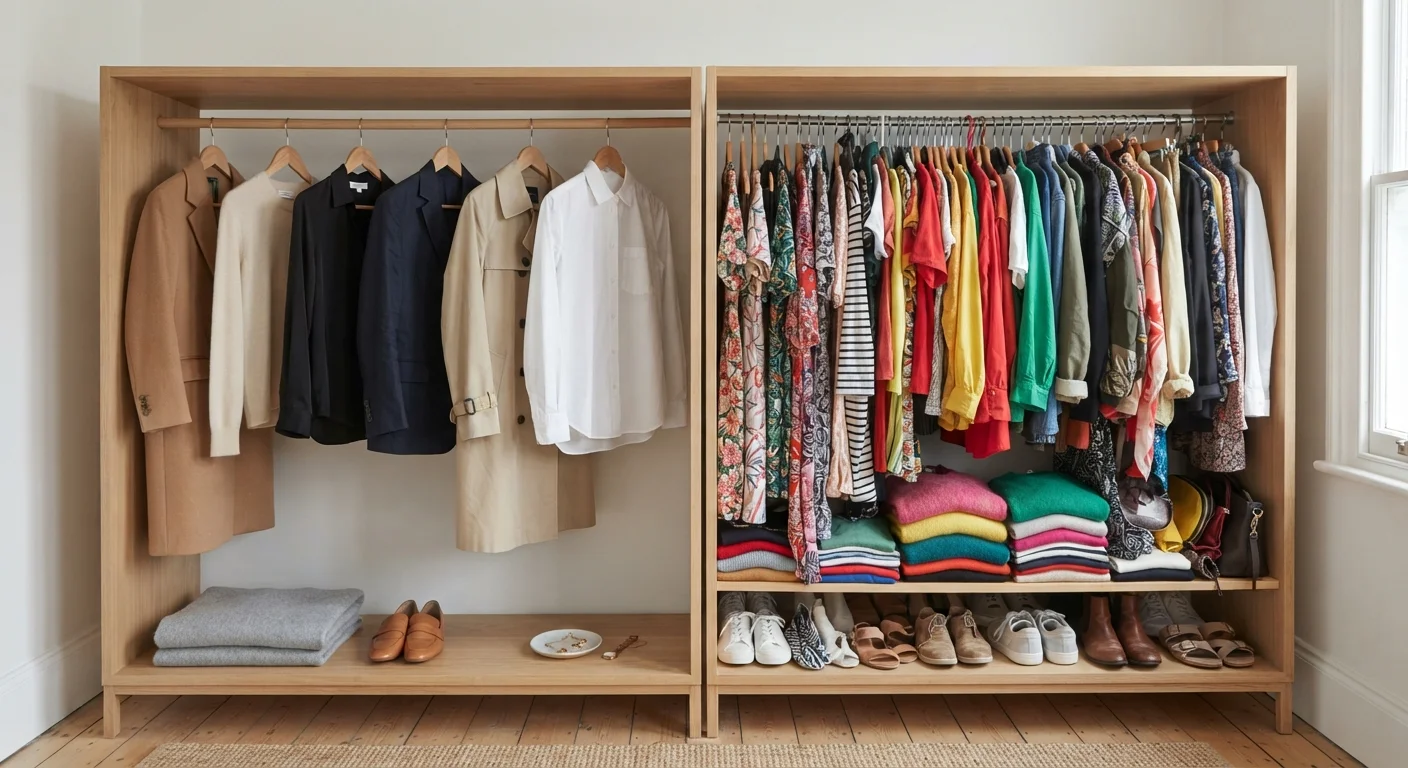
Investing in a smaller, carefully chosen wardrobe — sometimes called a capsule approach — has real advantages, particularly around durability, versatility, and mental clarity when getting dressed.
Higher durability means fewer replacements over time
Well-constructed garments with quality fabric and stitching typically hold their shape and color longer, reducing how often you need to repurchase the same item.
Lower cost-per-wear on items used frequently
A pricier everyday staple worn hundreds of times can ultimately cost less per use than a budget version that degrades after a season.
Easier to build a cohesive, mix-and-match wardrobe
A smaller set of versatile, well-chosen pieces tends to work together naturally, reducing decision fatigue and the 'nothing to wear' feeling despite a fuller closet.
Better fit and construction often improve confidence
Quality garments are more likely to be well-finished and properly structured, which can translate to a more polished appearance with less effort.
That said, this strategy has meaningful limitations. A high upfront cost can strain a tight budget regardless of long-term math. And investing heavily in pieces that turn out not to suit your lifestyle or evolving taste can feel like a costly mistake.
High upfront cost limits accessibility
Quality pieces often require significant spending at purchase, which isn't realistic for everyone regardless of long-term math.
Risk of over-investing in wrong pieces
If a pricey item doesn't suit your lifestyle, fit, or evolving taste, the financial loss is harder to absorb than a budget equivalent would be.
Less variety and fewer options for experimentation
A smaller wardrobe limits flexibility, particularly for trend-driven dressing or occasions that call for a range of looks.
Quality alone doesn't guarantee better style outcomes
An expensive item that doesn't fit well or suit your coloring won't look better than an affordable one that does — construction has limits.
If you're considering a more curated approach, capsule wardrobe building blocks outlines the foundational pieces worth prioritizing.
The Case for Buying in Volume
Buying more clothes at lower price points isn't inherently wasteful or unwise — it's a practical reality for many budgets and lifestyles. Volume buying allows for variety, experimentation with trends, and the flexibility to dress for multiple contexts without a large per-item investment.
~$1,700
Average annual U.S. household clothing spend
According to the U.S. Bureau of Labor Statistics Consumer Expenditure Survey, American households spend roughly this amount on apparel and related services each year.
30–40%
Wardrobe items rarely or never worn
Multiple closet audit studies and sustainability researchers estimate that a significant portion of most wardrobes goes unworn, regardless of how much was spent per item.
It also lowers the emotional stakes. When a budget piece gets stained, worn out, or goes out of style, replacing it doesn't feel catastrophic. For people with active lifestyles, children, or jobs that are hard on clothing, disposability can be a feature rather than a flaw.
The real risk is invisible accumulation: buying frequently in small amounts can add up to more total spending than a few deliberate purchases. Tracking clothing expenditures as a category — a habit covered in budgeting basics — often surprises people.
Volume Buying and Sustainability
Frequent low-cost purchasing is associated with higher textile waste, since budget items often have shorter lifespans and lower rates of donation or resale. This doesn't make volume buying wrong, but it's worth factoring into your decision — especially if environmental impact matters to you. Extending the life of any garment, regardless of price point, is generally the most impactful individual action.
Finding Your Practical Balance
For most people, a hybrid approach makes the most sense. Identify the items you wear most — probably a handful of tops, one or two pairs of pants, and your go-to outerwear — and consider those worth a higher investment. Trend-driven items, occasion-specific pieces, or anything you're not sure about can remain in the lower-cost column.
Your lifestyle shapes this math significantly. A freelancer who works from home has different durability needs than someone commuting daily in business attire. Dressing well on a tight budget offers principles that work regardless of which side of this debate you lean toward.
It's also worth considering secondhand shopping as a middle path — quality construction at lower prices. Understanding how secondhand, vintage, and thrift differ can help you shop those channels more strategically.
This article provides general style and budgeting information for educational purposes. Individual financial circumstances vary — consider consulting a financial professional for personalized guidance on spending decisions.
The content on this site is for informational purposes only and is not a substitute for professional advice. Always consult a qualified professional for guidance specific to your situation.