

Where the Idea Comes From
The capsule wardrobe concept has been around since the 1970s, when London boutique owner Susie Faux used the term to describe a core set of quality, timeless pieces that a woman could build on with seasonal additions. The idea got major mainstream traction in the U.S. when designer Donna Karan released her influential "Seven Easy Pieces" collection in 1985 — a wardrobe system built around interchangeable, professional essentials.
Since then, the concept has been reinterpreted endlessly in fashion media, often in ways that drift from the original intent. Today it's equally at home in sustainable fashion conversations, personal styling advice, and budget-conscious dressing guides. Its staying power comes from a simple, durable insight: owning fewer, more useful things tends to make getting dressed easier.
For a deeper look at putting this thinking into practice, see our capsule wardrobe building blocks guide.
What a Capsule Wardrobe Actually Is
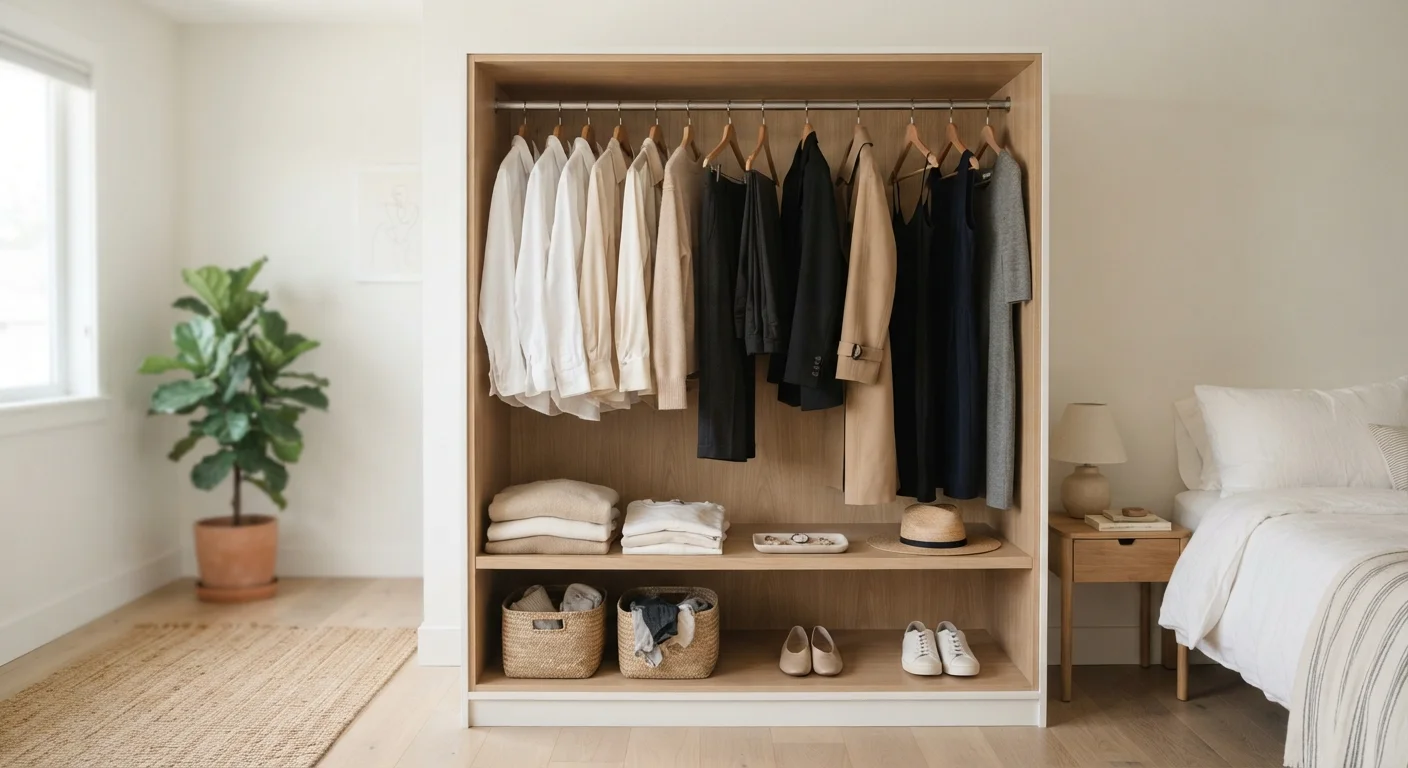
At its core, a capsule wardrobe is a curated collection where most pieces work with most other pieces. That interchangeability is the key — not the item count, not the color palette, not the price tags. The practical payoff is a closet where you can get dressed quickly, feel confident in what you're wearing, and rarely find yourself with "nothing to wear" despite a full closet.
Versatility is the defining quality. A blazer that works over a dress, with trousers, or thrown over jeans qualifies. A sequined jacket that only works for one annual event probably doesn't — unless that event matters enough to justify the space it takes up.
~30%
Clothing items people typically wear regularly
Research by fashion industry analysts has consistently found that most people wear only a fraction of what hangs in their closet on a regular basis.
1970s
Decade the capsule wardrobe concept was coined
London boutique owner Susie Faux introduced the term to describe a core set of timeless, interchangeable wardrobe pieces.
Importantly, a capsule wardrobe is personal. It should reflect your actual life, not someone else's aesthetic on social media. A teacher's capsule looks different from a freelancer's, and both look different from someone working in a creative studio environment. The structure adapts to you, not the other way around.
What a Capsule Wardrobe Is Not
This is where a lot of confusion creeps in. A capsule wardrobe is not a minimalist lifestyle mandate. You don't have to pare your possessions down to 33 items or commit to a gray-on-gray color story. Those are specific interpretations — not definitions.
It's also not exclusively for people with simple, pared-back aesthetics. Someone who loves bold prints and statement accessories can absolutely build a capsule wardrobe — it just means choosing prints and accessories that coordinate, rather than accumulating pieces that never get combined.
Start With Your Real Life, Not Pinterest
Before curating any capsule wardrobe, spend a week tracking what you actually reach for. The pieces you wear on autopilot are your true capsule foundation — everything else is a candidate for reassessment. Use the wardrobe audit questions framework to structure that evaluation.
And it's not a one-time project. Seasons change, life circumstances shift, and your wardrobe should evolve accordingly. A capsule wardrobe is a living framework, not a locked-in list. Running a regular wardrobe audit is one of the most effective ways to keep yours relevant without starting over from scratch.
Finally, it's not a budget-specific concept. While building one can absolutely save money over time by reducing impulse purchases, you don't need to invest in expensive "investment pieces" to make it work. Intentional choices at any price point count.
Is a Capsule Wardrobe Right for You?
The honest answer is: it depends on how you relate to clothes. If you find getting dressed stressful, spend money on items you rarely wear, or feel overwhelmed when you open your closet, capsule thinking can genuinely help. It provides a decision-making lens — "does this work with what I already own?" — that cuts through a lot of the noise.
If you love fashion as a form of self-expression and enjoy rotating trend-driven pieces, a strict capsule approach might feel limiting. But even then, applying some capsule logic to your core, everyday wardrobe — while allowing more freedom around statement or seasonal pieces — can reduce the "I have nothing to wear" problem without cramping your style.
For those wondering where to begin, our guide to building a wardrobe from zero covers the essentials. And if you're weighing the approach more carefully, our honest pros and cons breakdown is a balanced place to start.
Whether you adopt it fully or borrow just the core idea, the capsule wardrobe framework is ultimately a tool — and like any tool, its value depends on how well it fits the job you need it to do.
Frequently Asked Questions
There's no official number. Common approaches range from 30 to 50 pieces, but that's a guideline, not a rule. What matters is that most of your items get regular wear and can be combined in multiple outfits.
Absolutely not. Neutrals are popular because they mix easily, but a capsule wardrobe built around colors or patterns you genuinely love works just as well — as long as the pieces coordinate with each other.
No. The concept is about intentionality, not minimalism as a lifestyle philosophy. Someone with a larger wardrobe can still apply capsule thinking to ensure everything they own gets worn.
Yes. Starting with what you already own and gradually replacing worn-out pieces with more versatile ones is a completely valid approach. The goal is purposeful choices, not expensive ones.
Not necessarily. A wardrobe audit — evaluating what you own and what actually gets worn — is a useful starting point. You don't have to purge everything at once; you can build gradually.
Yes, though it may take more planning. Many people build multiple mini-capsules — one for workwear, one for casual wear, one for athletic use — that each function as their own coordinated set.
The content on this site is for informational purposes only and is not a substitute for professional advice. Always consult a qualified professional for guidance specific to your situation.