

Why Fashion Rules Exist — and Why So Many Outlive Their Usefulness
Fashion rules have always served a purpose: they simplify decisions and offer a starting point when you're unsure. But many of the most-repeated style commandments were invented to enforce social conformity, not to help you look or feel good. Others were practical workarounds for specific eras that no longer apply. The trick is knowing which rules have genuine logic behind them — and which ones you can confidently toss.
For a deeper dive into the principles that do hold up, see principles that have stayed useful across decades. Here, we're focused on the myths that deserve a second look.
Myth
You should never mix black and navy together — it looks like a mistake.
Fact
Black and navy is a deliberate tonal combination embraced by designers and stylists alike.
This rule likely emerged from the era before artificial lighting, when near-matching dark tones could appear accidentally mismatched in dim rooms. Today, black-and-navy pairings are considered a sophisticated tonal look — particularly in tailoring and eveningwear. The key is intentionality: make the contrast clear enough that it reads as a choice. A navy trouser with a black blazer in similar weights and finishes signals confidence, not a laundry mishap.
Myth
You should dress your age — certain styles are simply 'too young' or 'too old' for you.
Fact
Age is not a style constraint; comfort, context, and confidence are far better guides.
'Dress your age' is one of the most culturally loaded rules in fashion, and it carries very little practical logic. Style conventions tied to age have shifted considerably over time and vary across cultures. What actually matters is whether a piece fits well, suits the occasion, and reflects how you want to present yourself. See how personal style differs from trend-chasing for more on developing a look grounded in who you are rather than arbitrary benchmarks.
Myth
You should never mix prints — patterns should never appear in the same outfit.
Fact
Mixed prints can work well when they share a common color palette or vary clearly in scale.
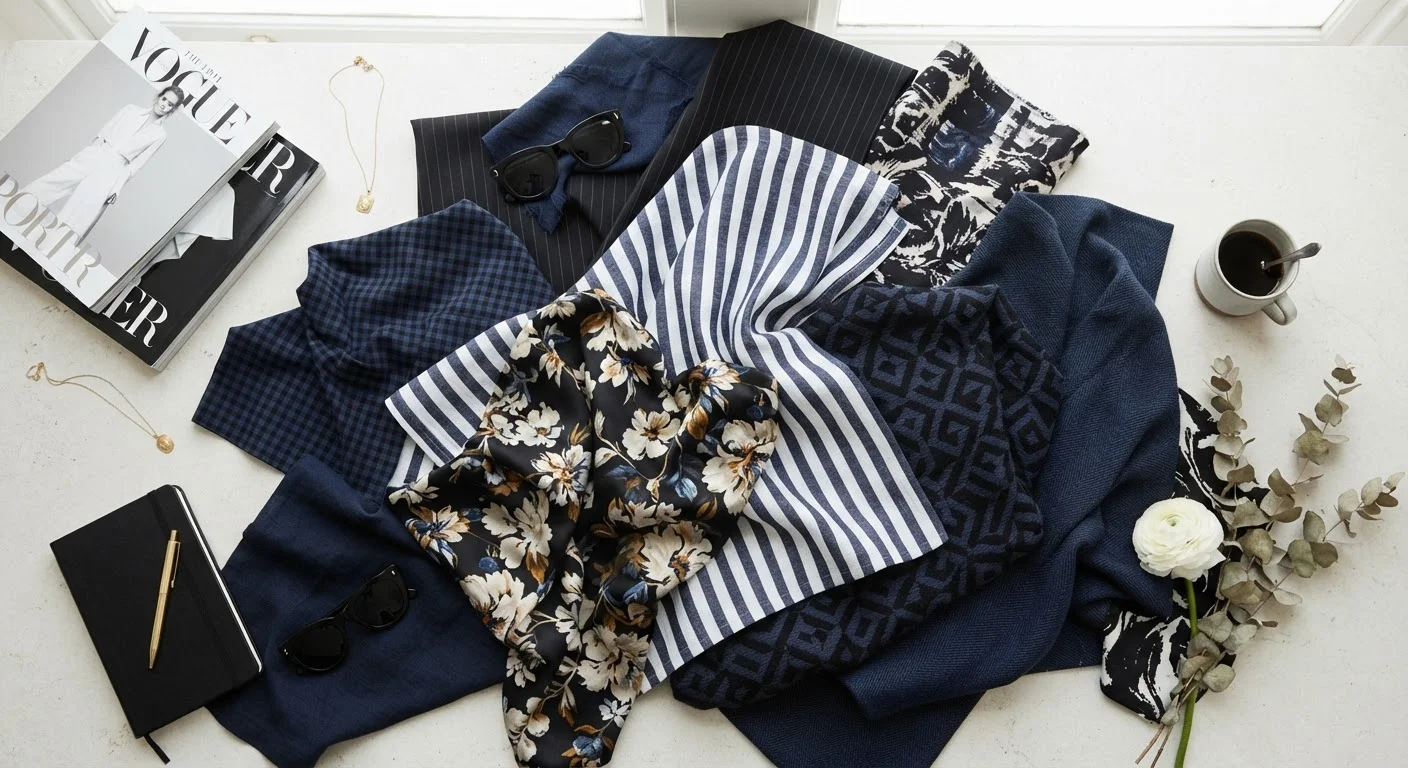
The no-mixing rule oversimplifies a skill that's about proportion and color coordination, not avoidance. Stripes and florals, for example, can coexist when one is small-scale and the other is larger, or when both pull from the same color family. The rule exists because clashing prints in similar scales and no shared colors genuinely do read as chaotic — but that's a matter of technique, not a prohibition on mixing at all.
Myth
Horizontal stripes make you look wider and should be avoided by certain body types.
Fact
Research on the optical effect of stripes is more nuanced than the blanket rule suggests.
The idea that horizontal stripes universally add visual width is based on the Helmholtz illusion, but studies examining that effect in real clothing contexts have produced inconsistent results. Garment cut, stripe width, fabric weight, and overall silhouette all interact in complex ways. Avoiding an entire pattern category based on a simplified optical rule means missing out on a lot of great clothing for no well-substantiated reason. What body-shape advice actually means unpacks this kind of guidance more carefully.
Myth
You should never wear white after Labor Day.
Fact
This is a historically specific American social convention with no basis in style logic.
The 'no white after Labor Day' rule originated in early 20th-century American upper-class social codes as a way of signaling seasonal transitions and, implicitly, class belonging. It was never a style principle — it was etiquette. Today, winter whites and cream tones are widely worn year-round, and white coats, sweaters, and trousers in heavier fabrics are standard fall and winter wardrobe choices in contemporary dressing.
What's Actually Worth Following
Not every guideline belongs in the trash. A handful of style conventions earn their keep because they reflect genuine practical logic rather than taste policing.
The One Rule That Genuinely Holds Up
Among all the style guidance out there, fit is the most consistently validated principle. A well-fitting garment — one that sits correctly at the shoulders, moves comfortably through the body, and hits at the right length — will almost always look more polished than an expensive piece in the wrong size. Tailoring a $40 thrift find will generally outperform wearing a $200 item off the rack in the wrong proportions. This isn't opinion; it's the single factor most frequently cited by professional stylists as the foundation of a put-together look.
Dress for the occasion. Context genuinely matters — what works at a weekend barbecue differs from what's appropriate at a job interview or a formal event. This isn't about conformity; it's about reading a room. Our guide to casual vs. smart-casual dressing can help you navigate those lines without overthinking it.
Fit matters more than almost anything else. This is one rule that consistently holds up. Clothes that fit well — proportional to your frame and comfortable to wear — will always look more intentional than expensive pieces that don't. That holds true whether you're spending a lot or a little. If you're working within a tight wardrobe budget, principles for dressing well without overspending are worth bookmarking.
61%
Americans who feel limited by fashion rules
A survey by fashion research platform Edited found that a majority of respondents felt conventional style guidelines made them less confident rather than more.
3x
Cost-per-wear advantage of well-fitted basics
Style educators frequently cite fit as the variable that most affects how often a garment is actually worn, directly impacting its long-term value.
The bottom line: question every rule before you follow it, but don't throw out guidance just because it feels restrictive. The goal is a wardrobe that works for your actual life — not someone else's checklist. For a broader look at how body-shape advice really works (and when to ignore it entirely), the myths around dressing for your body shape is a useful companion read.
The content on this site is for informational purposes only and is not a substitute for professional advice. Always consult a qualified professional for guidance specific to your situation.