

Start here
Why Fluids Matter More Than Most Drivers Realize
Core knowledge
The Six Fluids You Should Know
Hands-on
How to Check Fluid Levels Safely
Diagnose
Color and Condition: Reading the Warning Signs
Decision time
When to Top Off vs. When to See a Mechanic
Why Fluids Matter More Than Most Drivers Realize
Your car's engine, brakes, steering, and cooling system all depend on fluids to do their jobs. When levels drop or fluid quality degrades, components work harder, wear faster, and eventually fail - often at the worst possible time. The good news is that most fluid problems give you warning signs well before a breakdown, if you know what to look for.
Checking your fluids regularly is one of the lowest-effort, highest-payoff maintenance habits you can build. It costs nothing but a few minutes and can help you catch a slow leak or contaminated fluid before it becomes an expensive repair. For a broader look at keeping costs manageable, see our guide to avoiding expensive repairs.
The Six Fluids You Should Know
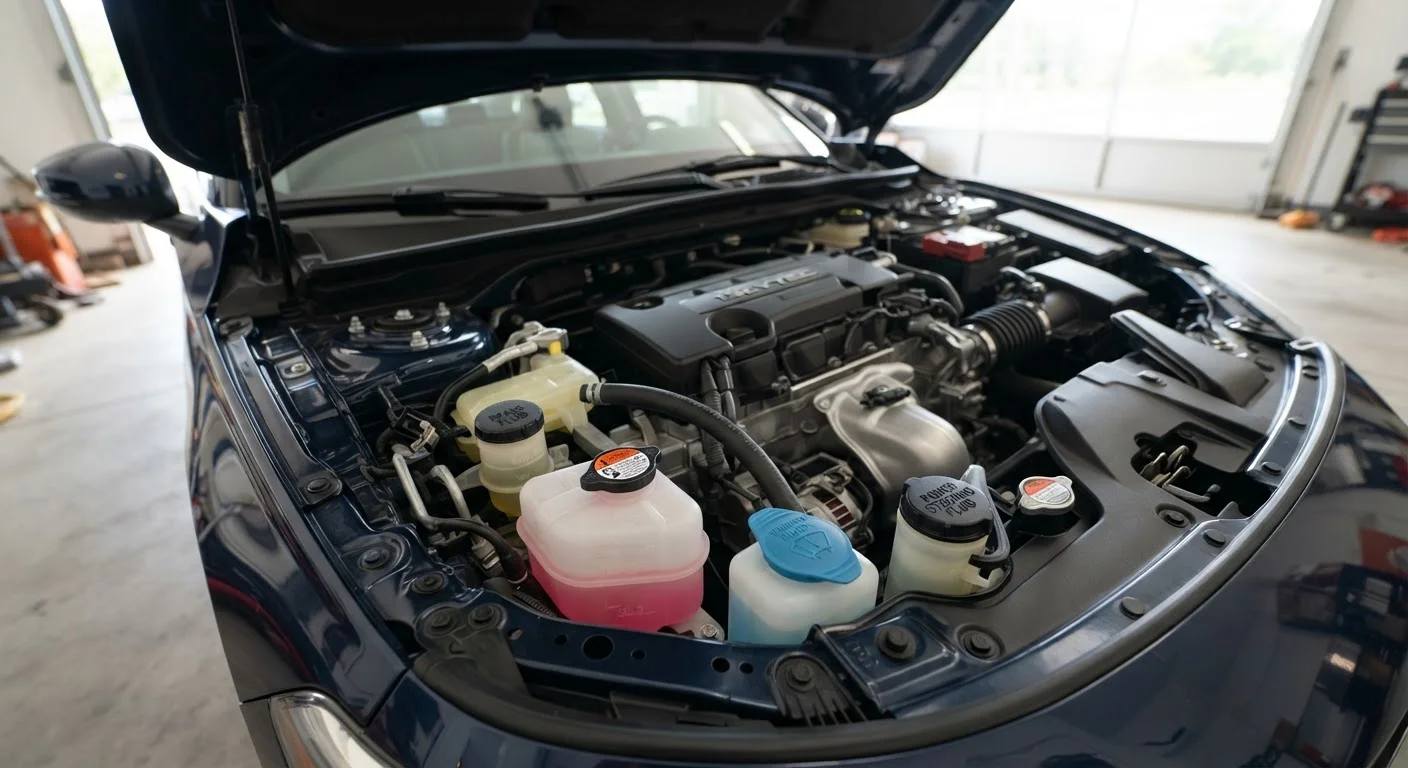
Open the hood on most passenger vehicles and you'll find reservoirs for these six fluids:
Dipstick
A long, thin metal rod inserted into the oil reservoir (or transmission) that you pull out to read the fluid level against MIN and MAX markers.
Coolant (antifreeze)
A liquid that circulates through the engine to absorb heat and prevent the water in the cooling system from freezing in winter or boiling in summer.
Brake fluid
A hydraulic fluid that transmits the force you apply to the brake pedal through the brake lines to the calipers that slow the wheels.
Transmission fluid
Oil designed specifically to lubricate and cool the gears and clutch components inside an automatic (or manual) transmission.
Reservoir
A plastic or metal container under the hood that holds a specific vehicle fluid and typically has MIN and MAX lines for checking the level.
Head gasket
A seal between the engine block and cylinder head that keeps coolant and oil from mixing; a failed head gasket is a serious and often expensive repair.
- Engine oil - Lubricates moving engine parts and reduces heat from friction. Checked via a dipstick, typically marked with MIN and MAX lines.
- Coolant (antifreeze) - Regulates engine temperature and prevents freezing in winter. Stored in a translucent reservoir with MIN/MAX markings. Cold weather puts extra strain on coolant, so check levels before temperatures drop.
- Brake fluid - Transfers force from your pedal to the brake calipers. Housed in a small reservoir near the firewall, with MIN and MAX lines on the side.
- Power steering fluid - Assists the steering system (on vehicles without electric power steering). Check the reservoir cap or dipstick attached to it. Many newer vehicles use electric power steering and have no fluid here.
- Transmission fluid - Lubricates gears and clutch packs in automatic transmissions. Some vehicles have a dipstick; others are sealed and require a professional to check.
- Windshield washer fluid - The only reservoir safe to open and top off at any time, using any temperature-appropriate washer solution.
How to Check Fluid Levels Safely
Always check fluids when the engine is cool and the car is on a level surface. Checking coolant or oil on a hot engine can give inaccurate readings and, in the case of the coolant reservoir cap, poses a burn risk from pressurized steam.
- Pop the hood and secure it with the prop rod or built-in latch.
- Locate each reservoir using your owner's manual if needed - reservoir placement varies by make and model.
- For oil: pull the dipstick, wipe it clean, reinsert fully, then pull it again. The oil film should fall between the MIN and MAX markers.
- For coolant, brake fluid, and washer fluid: read the level directly through the translucent reservoir wall. Do not open the coolant cap on a warm engine.
- For transmission fluid (if your vehicle has a dipstick): follow the same wipe-and-recheck method as engine oil, but consult your manual for whether to check it warm or cold.
Photograph Your Reservoirs Once
Take a quick photo of each reservoir when levels are correct and fluid looks healthy. That baseline makes it much easier to spot changes - in level or color - the next time you check. Store the photo in your phone's album alongside your vehicle's make and model for easy reference.
If you're unsure where a reservoir is or how to read it, your owner's manual is the definitive reference. It also specifies the exact fluid type your vehicle requires - using the wrong specification can cause damage.
Color and Condition: Reading the Warning Signs
Level is only half the story. Fluid color and texture can signal trouble that a level check alone won't reveal.
| Fluid | Healthy appearance | Warning signs |
|---|---|---|
| Engine oil | Amber to light brown, clear on dipstick | Black and gritty (overdue change); milky/frothy (coolant contamination - see a mechanic immediately) |
| Coolant | Bright green, orange, pink, or blue depending on type - clear, not cloudy | Brown or rusty color; oily film on surface (possible head gasket issue) |
| Brake fluid | Clear to light yellow | Dark brown or black (moisture absorption, may need replacement) |
| Power steering fluid | Clear, pink, or light amber | Dark brown or foamy (contamination or aeration) |
| Transmission fluid | Red or pink, slightly sweet smell | Dark brown, burnt smell (heat damage); metal flakes visible |
If you spot an unusual symptom alongside a fluid issue, the driver's symptom reference can help you piece together what the car may be telling you.
Never Open the Coolant Cap on a Hot Engine
The cooling system operates under pressure. Removing the radiator or reservoir cap while the engine is warm can release a burst of scalding steam and fluid. Always wait until the engine has been off and cooled for at least 30 minutes before opening the coolant system.
When to Top Off vs. When to See a Mechanic
Topping off a fluid that's slightly low is fine as a short-term measure - but it's not a fix. Fluids that are consistently low are leaking or being consumed somewhere, and that underlying cause needs diagnosis.
Safe to top off yourself: washer fluid always; engine oil and coolant occasionally if a small amount low and fluid looks healthy. Use only the specification listed in your owner's manual.
Get a mechanic involved when:
- Any fluid is below the MIN line repeatedly after topping off
- You see fluid pooling under the vehicle (color and location help identify the source)
- Oil or coolant shows contamination (milky, foamy, or mixed-looking)
- Brake fluid is noticeably low - brakes are a safety system and a persistent drop warrants inspection
- The transmission dipstick shows dark, burnt-smelling fluid or metal particles
Pairing fluid awareness with your vehicle's scheduled service intervals is the smartest approach. Our maintenance schedule explainer breaks down what each service milestone actually covers and when fluid changes typically fall due.
Dashboard warning lights sometimes accompany fluid issues - if a light appears, check out our dashboard warning lights guide to understand the urgency level before deciding your next step.
This article is for general informational purposes only. For maintenance tasks that involve safety-critical systems such as brakes, or for any repair you are unsure about, consult a qualified mechanic.
Frequently Asked Questions
A monthly visual check is a reasonable habit for most drivers. Oil and coolant are the most critical to monitor regularly. Your owner's manual will also list intervals tied to specific service milestones.
For most fluids, mixing brands of the same specification is generally acceptable in a pinch. However, mixing different types - such as two incompatible coolant formulations - can cause problems. Always check the specification listed in your owner's manual before adding anything.
Milky or frothy oil typically indicates coolant has entered the oil system, often through a failed head gasket. This is a serious issue that warrants immediate professional inspection - continued driving can cause significant engine damage.
Brake fluid darkens over time as it absorbs moisture and contaminants. Very dark or murky fluid may indicate it is due for replacement. A qualified mechanic can test moisture content to confirm whether a change is needed.
Running without adequate coolant causes the engine to overheat rapidly, which can warp cylinder heads or cause catastrophic engine damage. If your temperature gauge spikes or a warning light appears, pull over safely and allow the engine to cool before investigating.
EVs still use coolant (to manage battery and motor temperature), brake fluid, and washer fluid. However, they do not have engine oil or a traditional transmission, so their fluid checklist is shorter than a conventional vehicle's.
The content on this site is for informational purposes only and is not a substitute for professional advice. Always consult a qualified professional for guidance specific to your situation.